
What Makes a Parchment Paper Supplier Reliable for Repeat Orders? 5 Signals Beyond Price (2026)

Runjia New Material parchment paper supplier production floor, Shandong, China — consistency verified at every reel.
A reliable parchment paper supplier shows five signals that go far beyond price: (1) consistent grammage and silicone-coat weight across every batch — verifiable by third-party QC reports, not just spec sheets; (2) lead times that are promised in writing and honored within ±3 days; (3) a formal sample policy that ships production-equivalent — not showcase — material; (4) current, auditable certifications (ISO 9001, FSC, BRC or equivalent food-contact certificates); and (5) a single, responsive contact who replies within 24 hours and escalates production issues proactively. These five signals separate a parchment paper supplier you can build a sourcing program on from one that looks competitive in a first quote and disappoints on the second order. Buyers who import parchment paper for retail private label, food-service distribution, or bakery chains need all five, because a single batch inconsistency at scale — wrong silicone gram-per-square-metre, wrong release force — can trigger a product recall or retailer delistment. Price is table stakes; repeatability is the real purchase decision.
Why “Repeat Order Reliability” Is the #1 Sourcing Criterion in 2026
Global supply chains are under pressure from PFAS regulations in the EU and US, rising silicone raw-material costs, and ongoing tariff volatility. In this environment, importers are consolidating vendors rather than spreading risk. Your parchment paper supplier must be someone you can trust for 12 months — not just 1 container. This guide shows you exactly what to look for and what to ask before signing a long-term supply agreement.
Signal 1: Batch-to-Batch Consistency Backed by QC Data
Every credible parchment paper supplier should provide a Certificate of Analysis (CoA) for each production batch — not a generic product specification. A CoA covers grammage (g/m²), silicone coat weight (g/m²), tensile strength (MD/CD), elongation at break, and release force (cN/cm). If a supplier cannot produce batch-level CoAs dating back 6–12 months, that is a hard disqualifier.
- Ask for CoAs from 3 consecutive production runs — compare variance on grammage and silicone coat weight
- Acceptable variation: ±2 g/m² on grammage; ±0.3 g/m² on silicone coat weight
- Request SGS or Intertek third-party test results (not just internal factory data)
- Confirm the QC lab is in-house or contracted — in-house labs cut turnaround time but need independent auditing
- Food-contact migration testing (REACH, FDA 21 CFR 176.170) should be current — retest every 12 months
An unreliable parchment paper supplier often passes the first shipment because samples are hand-selected. Batch CoAs reveal the real production distribution. Third-party labs such as SGS Paper & Board Testing provide independent verification that no supplier can manipulate.

In-house QC at Runjia — silicone coat-weight verified every 2 hours during baking paper production runs.
Signal 2: Lead Times That Are Written, Guaranteed, and Tracked
Verbal lead-time promises are worthless. A trustworthy parchment paper supplier will commit to production lead time in writing — typically in the sales confirmation or pro forma invoice — and should have a track record to support it. Standard lead times for a reliable silicone-coated baking paper manufacturer in China run 15–25 days for standard SKUs and 25–35 days for custom sizes or printed packaging.
- Request the supplier’s on-time delivery rate for the past 12 months (credible suppliers track this KPI)
- Confirm whether the lead time clock starts from deposit receipt or from purchase order date
- Ask what happens when raw-material (silicone, base paper) costs spike — does lead time extend?
- For repeat orders, ask if the supplier maintains safety stock of your SKU
- Get the production schedule in writing for each order and request weekly status updates
In 2026, silicone resin supply tightness — partly caused by Chinese raw-material price increases — has made lead-time management more important than ever. A supplier who absorbs these disruptions through pre-purchased inventory or dual sourcing of raw materials is a far safer long-term partner than one who passes every delay downstream.
Signal 3: A Sample Policy That Sends Production-Equivalent Material
One of the most common sourcing mistakes importers make with a parchment paper supplier is approving samples from “showcase stock” — material produced under ideal conditions, often months before the inquiry. A reliable supplier ships samples cut directly from the current production reel, labeled with the production date and batch number so buyers can cross-reference the CoA.
- Insist that samples carry a batch number that you can match to the CoA
- Request samples in the exact substrate weight and width you intend to order — no substitutions
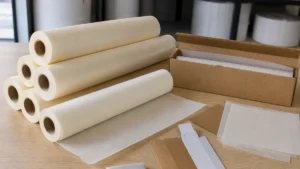
- For jumbo parchment paper rolls, request a full-width sample slit from the reel edge and center (variation can differ)
- Run your own release-force test on the samples before approval — oven-test at your actual baking temperature
- Ask how long the supplier keeps archive samples from each production run — minimum 6 months is the industry standard
A parchment paper supplier who ships generic brochure samples or refuses to label batches is signaling that production control is weak. The sample process is your best window into how the factory actually operates, so treat it as due diligence rather than a formality.
Signal 4: Current, Auditable Certifications — Not Expired PDFs
Certifications for a parchment paper supplier serve two purposes: they prove the factory meets an independent standard, and they protect you legally when your retail customer or food-service client demands documentation. The minimum certification set for a credible food-contact parchment paper supplier in 2026 is ISO 9001 + at least one food-safety or sustainability certification.
- ISO 9001:2015 — Quality management system; check that the scope includes silicone coating. Verify certificate validity at iso.org.
- BRC/IOP Packaging — Global standard for food-contact packaging. Buyer-required by most UK, EU, and Australian retailers. Verify audited factories at brcgs.com.
- FSC Chain of Custody — Increasingly demanded by US, EU, and Scandinavian buyers. Verify at info.fsc.org.
- FDA 21 CFR 176.170 compliance letter (for US-bound shipments)
- EU Framework Regulation (EC) No 1935/2004 declaration of compliance (for EU shipments)
Always check the expiry date and the certificate scope. An ISO 9001 certificate that covers “paper manufacturing” but excludes “silicone coating” is not valid for your product. Expired certificates are a red flag — a reliable parchment paper supplier maintains continuous surveillance audits and renews proactively.

Certification stack at Runjia New Material — ISO 9001, FSC, and food-contact compliance documentation kept current for buyer audit requests.
Signal 5: A Single Responsive Contact Who Solves Problems, Not Just Takes Orders
The fifth — and most underrated — signal of a reliable parchment paper supplier is the quality of your account management. In B2B paper sourcing, problems always arise: a reel width is 1 mm off tolerance, a customs hold delays the shipment, a raw-material shortage threatens the schedule. What separates a great parchment paper supplier from an average one is not whether problems occur — it is whether your contact tells you before you find out yourself.
- Test response time before placing a first order: send a technical question at 5 PM China time and see if you get an answer within 24 hours
- Ask whether you will have a dedicated account manager or rotate through a sales team pool
- Confirm that your contact can access production data and escalate to the factory QC manager directly
- Ask for one reference from a buyer who has placed at least 5 repeat orders with the supplier
- Evaluate language quality: technical English fluency matters for accurate spec communication
A supplier who goes silent when problems arise — or who sends templated “we are checking” replies — will cost you more in rework, chargebacks, and scrambled contingency sourcing than any price premium you saved upfront. The best parchment paper supplier relationships feel like a manufacturing partner, not a vendor transaction.
🏭 From Our Factory Floor
Real case: In late 2024, a UK bakery-supply importer — let’s call them BakePro — had been sourcing silicone parchment paper from a lower-cost factory in Guangdong for two years. The price was roughly 8% below market. By the third year, BakePro started seeing inconsistent release performance complaints from their foodservice customers: sheets were sticking at high-convection oven temperatures, causing product losses and one near-miss retailer delistment. When BakePro requested batch CoAs from their supplier, the supplier could only produce one CoA per quarter — not per production run. Independent SGS testing of retained samples revealed silicone coat weight variance of up to ±0.9 g/m², nearly three times the acceptable tolerance. BakePro switched their parchment paper supplier to Runjia New Material after requesting 6 months of batch-level CoAs, running a production-equivalent sample trial across three oven configurations, and verifying our ISO 9001 certificate scope covered silicone coating. Their first full-container order arrived within the quoted 22-day lead time. As of Q1 2026, they are on their eighth consecutive repeat order with zero QC claims.
What we learned: The 8% price saving BakePro thought they had was absorbed entirely by the product losses and emergency air-freight of replacement stock during the complaint period. Reliability is not a premium — it is the baseline cost of doing B2B paper sourcing correctly. Every parchment paper supplier looks cheap until the second or third problem arrives.
Reliable vs. Unreliable Parchment Paper Supplier: Side-by-Side Comparison
Use this table when evaluating a new parchment paper supplier or auditing your current one. A reliable partner should score “green” in all five columns.
| Criterion | Reliable Parchment Paper Supplier | Unreliable Parchment Paper Supplier |
|---|---|---|
| Lead Time | Written commitment in pro forma; on-time rate ≥95%; safety stock for key SKUs | Verbal only; delays blamed on “raw material” each time; no tracking shared |
| QC Reports | Batch-level CoA with every shipment; third-party SGS/Intertek annual test | Generic spec sheet only; “we passed factory inspection” with no data |
| Sample Policy | Production-equivalent, batch-labeled, matches current CoA | Showcase stock; no batch number; different substrate than production order |
| Certifications | ISO 9001 (scope: silicone coating), FSC, BRC/food-contact — current + verifiable | Expired certificates; scope excludes coating process; cannot provide audit reports |
| Communication | Dedicated account manager; replies within 24h; proactively flags production issues | Rotates contacts; 48–72h response; problems only disclosed after buyer discovers them |
| Repeat Order Record | Can provide 3+ buyer references with 5+ consecutive repeat orders | References unavailable or only first-order buyers cited |
Pre-Order Due Diligence Checklist for a New Parchment Paper Supplier
- Request batch CoAs from the last 3 production runs — check grammage and silicone variance
- Verify ISO 9001 certificate on the issuing body’s website — confirm scope includes silicone coating
- Check FSC certificate at info.fsc.org if sustainable sourcing is required by your buyer
- Ask for the factory’s on-time delivery rate for the past 12 months
- Request a production-equivalent sample labeled with batch number + production date
- Run oven-test on samples at your actual operating temperature and humidity conditions
- Confirm food-contact compliance documents: FDA 21 CFR 176.170 or EU Regulation 1935/2004
- Test account manager response time with a technical query before committing to an order
- Ask for two buyer references from customers with 5+ consecutive repeat orders
- Review the supplier’s MOQ and lead-time terms for reorder vs. first order (many suppliers inflate MOQ after first purchase)
3 Common Mistakes Buyers Make When Evaluating a Parchment Paper Supplier
Mistake 1: Approving price before verifying QC capability. A competitive price means nothing if the parchment paper supplier cannot maintain specification tolerance across 100 production runs. Always request CoAs before requesting a price list.
Mistake 2: Not specifying the exact substrate in the RFQ. “Parchment paper 40gsm” is ambiguous. A proper RFQ for a reliable parchment paper supplier specifies: base paper weight, silicone coat weight (one or two sides), release force range (cN/cm), width and reel/sheet dimensions, and any printing or packaging requirements. Vague RFQs attract opportunistic quotes, not accurate supplier responses.
Mistake 3: Skipping a factory audit because the price is right. An on-site or virtual audit of the production line, QC lab, and warehouse takes half a day and costs almost nothing for a virtual session. Yet most importers who experience repeat-order failures with a parchment paper supplier admit they never audited the factory. Even reviewing a supplier’s most recent BRC or ISO audit report (which reputable factories share on request) is a meaningful substitute.
Frequently Asked Questions — Parchment Paper Supplier Sourcing
How do I verify that a parchment paper supplier’s certifications are real and current?
Go directly to the certification body’s public database. For ISO 9001, search the issuing body’s registry or use the IAF CertSearch tool. For FSC, search at info.fsc.org. For BRC/IOP Packaging, use the BRCGS Certification Directory. Any parchment paper supplier who cannot provide a certificate number for you to verify independently should be treated as uncertified until proven otherwise.
What is a reasonable MOQ when sourcing parchment paper from a Chinese supplier?
For standard silicone-coated parchment paper supplier orders, typical MOQ is 3,000–5,000 kg for sheet formats and 1–3 jumbo rolls for custom reel widths. Below that threshold, most factories will quote at a premium or decline. If you need smaller initial quantities, ask specifically about trial-order pricing — reliable suppliers often offer a one-time lower-MOQ trial to establish the relationship.
How can I tell if a parchment paper supplier is actually manufacturing or just trading?
Ask for a factory tour (virtual or physical) showing the base-paper unwinding, silicone coating line, and slitting/converting area. Request the factory’s business license (营业执照) and check whether the registered business scope includes “manufacturing” (制造). A genuine parchment paper supplier manufacturer will also have an in-house QC lab and can show you their production scheduling system. Trading companies can supply good product but typically cannot offer the same degree of specification customization or consistency as direct manufacturers.
What lead time should I expect for a repeat parchment paper order in 2026?
For an established parchment paper supplier relationship with standard SKUs, expect 15–22 production days from deposit receipt. Custom widths, custom printing, or non-standard silicone weights typically add 7–10 days. Plan your inventory cycle around 4–5 weeks total from order placement to port, plus shipping time (21–35 days sea freight to the US/EU). Building 6–8 weeks of safety stock is advisable given current freight schedule volatility.
Is PFAS-free parchment paper commercially available from Chinese suppliers in 2026?
Yes. Reputable silicone-coated parchment paper supplier factories do not use PFAS (per- and polyfluoroalkyl substances) in their silicone coating process — silicone and PFAS are entirely different chemistries. If your buyer requires a written PFAS-free declaration, ask your supplier for a material declaration or third-party test report confirming no PFAS compounds (PFOA, PFOS, GenX, etc.) are present in the finished product. This is increasingly required by EU and California-market buyers following recent food-contact PFAS restrictions.
How should I structure payment terms with a new parchment paper supplier?
For a first order with a new parchment paper supplier, 30% deposit + 70% against copy of Bill of Lading is standard and fair to both parties. As the relationship matures over 3–5 repeat orders with zero QC claims, you can negotiate 20% deposit + 80% on BL or even 30/60/90-day open account terms for established importers. Never pay 100% in advance to a supplier you have not audited and transacted with before.
What documentation should a parchment paper supplier provide with each shipment?
A complete documentation package from a reliable parchment paper supplier should include: Commercial Invoice, Packing List, Bill of Lading, Certificate of Origin (Form E for ASEAN, or CO for general), Certificate of Analysis (batch-level), food-contact compliance declaration (FDA or EU), and FSC Transaction Certificate if applicable. For US shipments, the supplier should also provide ISF (10+2) data well in advance of vessel departure.
Can a parchment paper supplier in China produce custom sizes and printed packaging?
Yes, most established parchment paper supplier manufacturers offer converting (cut-to-sheet, reel-to-sheet, die cutting) and custom retail packaging with your brand label. Minimum order for custom print typically starts at 10,000–20,000 units depending on format. Ask for a plate fee (usually $150–$400 one-time) and a press proof before full production. Our contact team can provide a full OEM specification form to streamline this process.
Conclusion: Choose Your Parchment Paper Supplier on Reliability, Not Just Rate
In a B2B sourcing program where parchment paper touches food, retail packaging, and ultimately your customer’s brand promise, the cheapest parchment paper supplier quote is almost never the best procurement decision. The five signals covered in this guide — batch-consistent QC data, written lead-time guarantees, production-equivalent samples, auditable certifications, and responsive account management — are the real selection criteria that differentiate a supply partner from a vendor you cycle through every two years.
Buyers who invest in due diligence before the first order — requesting CoAs, verifying certifications, running oven tests on properly labeled samples — consistently achieve lower total cost of ownership than buyers who optimize purely on unit price. A reliable parchment paper supplier relationship compounds over time: better lead times, preferential capacity allocation during peak seasons, and the ability to co-develop new SKUs with a factory that knows your quality expectations intimately.
Runjia New Material has been supplying baking paper and parchment paper to importers across 30+ countries since 2009. Our batch-level QC reporting, ISO 9001 certification, and FSC chain-of-custody documentation are available for review by any serious buyer. We welcome factory audits — virtual or on-site.

Runjia New Material finished-goods warehouse — export cartons labeled, inspected, and ready for container loading on schedule.
Ready to Verify a Reliable Parchment Paper Supplier?
Request batch CoAs, a production-equivalent sample pack, and our full certification file — all free of charge, no commitment required. Our team typically responds within 12 business hours.
Sources & References:
- ISO 9001:2015 Quality Management Systems — Requirements
- BRCGS Packaging Materials Standard, Issue 6
- FSC Certificate Search — Forest Stewardship Council
- SGS Paper & Board Testing Services
Last reviewed: April 2026. Data and standards are subject to change — verify current requirements with your certification body or regulatory authority.

 ZH
ZH  EN
EN  RU
RU  ES
ES  FR
FR  NL
NL  PT
PT  AR
AR  JA
JA  KO
KO 