
In institutional food service—from schools and hospitals to catering facilities and corporate cafeterias—the demand for baking paper goes far beyond performance. Here, decisions are driven by efficiency, food safety, and sustainability at scale. Choosing the right bulk baking paper format can reduce waste, improve handling convenience, and enhance compliance. For procurement managers and B2B buyers, understanding these bulk options is critical to balancing operational performance and cost control.
Last updated: March 2026
🚨 The Challenges of Institutional Kitchens
Unlike retail bakeries or restaurants, institutional kitchens operate under high-volume, fast-turnover conditions. Thousands of meals are prepared daily, which introduces unique challenges:
- Consistency & speed – Sheets must be ready-to-use without slowing down food lines.
- Hygiene & compliance – Materials need certifications such as BRC, ISO 9001, and FSC to ensure zero contamination risk.
- Waste reduction – Institutions face pressure to cut both food waste and packaging waste.
- Cost efficiency – Every choice is measured against budgets, making bulk packaging formats highly attractive.
📦 Manufacturers like Runjia address these challenges with tailored bulk solutions designed for large-scale operations.

📏 Bulk Roll Formats: Continuous Supply, Minimal Waste
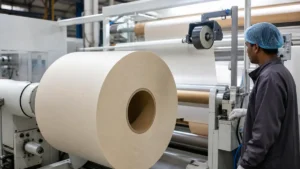
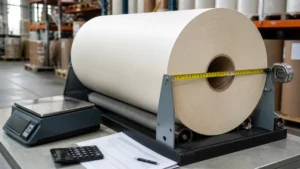
Jumbo rolls are among the most efficient solutions for institutional food service. Available in 1.5″, 3″, and 6″ core sizes and widths matching industrial trays, jumbo rolls reduce downtime and waste.
Key benefits:
- Fewer roll changes → less kitchen disruption.
- Custom lengths → no unnecessary trimming or paper waste.
- Dispenser compatibility → faster and safer handling.
👉 With Runjia’s automated cutting lines, buyers can specify roll widths to fit standard oven trays, ensuring consistency across high-volume operations.
🧾 Pre-Cut Sheets: Speed and Hygiene
When speed and hygiene take priority, pre-cut baking sheets are the preferred option. Sized to fit trays exactly, they eliminate cutting, trimming, and handling bulk rolls.
Advantages:
- Guaranteed consistency → every tray looks the same.
- Hygienic use → staff don’t need scissors or knives near prep areas.
- Faster service → less prep time in school cafeterias and hospital kitchens.
Runjia offers flat-packed or interfold pre-cut sheets, designed for easy dispensing without waste.

🧾 Pre-Cut Sheets: Speed and Hygiene
When speed and hygiene take priority, pre-cut baking sheets are the preferred option. Sized to fit trays exactly, they eliminate cutting, trimming, and handling bulk rolls.
Advantages:
- Guaranteed consistency → every tray looks the same.
- Hygienic use → staff don’t need scissors or knives near prep areas.
- Faster service → less prep time in school cafeterias and hospital kitchens.
Runjia offers flat-packed or interfold pre-cut sheets, designed for easy dispensing without waste.
🍲 Specialty Formats: Air Fryer & Steamer Papers
Modern institutional kitchens are adopting air fryers and steamers for healthier menus. Demand for perforated air fryer liners and round steamer papers has grown in catering and healthcare facilities.
Benefits:
- Improved air/steam circulation → better cooking results.
- Reduced equipment cleaning → less grease build-up.
- Safer, faster prep → lower labor costs.
Runjia operates 20 dedicated production lines for these specialty formats, ensuring consistent quality in bulk supply.

🛡️ Safety and Certification Standards
Food safety in institutional catering is non-negotiable. Buyers should always verify that baking paper meets:
- BRC & ISO 9001 → food safety and quality assurance.
- Kosher certification → essential in schools and hospitals.
- FSC certification → sustainable sourcing verification.
Runjia maintains all major certifications, giving procurement teams confidence in compliance across global markets.
✅ Conclusion: A Strategic Choice for Efficiency and Safety
For institutional food service, the choice of baking paper format is not just about convenience—it’s about efficiency, hygiene, and sustainability.
- 📏 Jumbo rolls → reduce downtime and waste.
- 🧾 Pre-cut sheets → ensure speed and hygiene.
- 🍲 Specialty papers → meet modern equipment needs.
By partnering with suppliers like Runjia, buyers gain access to customizable bulk formats backed by global certifications, ensuring food safety, sustainability, and operational reliability.
In large-scale food operations, the right baking paper format becomes a strategic advantage—supporting both cost savings and brand trust.
✅ Conclusion: A Strategic Choice for Efficiency and Safety
For institutional food service, the choice of baking paper format is not just about convenience—it’s about efficiency, hygiene, and sustainability.
- 📏 Jumbo rolls → reduce downtime and waste.
- 🧾 Pre-cut sheets → ensure speed and hygiene.
- 🍲 Specialty papers → meet modern equipment needs.
By partnering with suppliers like Runjia, buyers gain access to customizable bulk formats backed by global certifications, ensuring food safety, sustainability, and operational reliability.
In large-scale food operations, the right baking paper format becomes a strategic advantage—supporting both cost savings and brand trust.

Written by
General Manager at Shandong Runjia New Material Co., Ltd. 11+ years in baking paper manufacturing, silicone coating technology, and B2B export to 20+ countries. BRC & ISO 9001 certified facility with 36,000 tonnes annual capacity.
Get a Baking Paper Quote — Reply in 24h
Tell us your paper type, size, coating weight, and order volume. We will reply with pricing, MOQ, and lead time.
Tell us:
- ✅ Your country and market
- ✅ Paper type (silicone coated, unbleached, pre-cut, roll)
- ✅ Order volume
- ✅ Email / WhatsApp
🏭 From Our Factory Floor
Real case: A European bakery chain ordered 50 tons of silicone-coated baking paper (41 GSM, double-sided coating, 400mm×600mm sheets). After the first shipment, they reported 3% of sheets sticking to croissants at 220°C. Our lab found the silicone coating weight on the bottom side was 0.8 g/m² — below our 1.0 g/m² spec. We increased coating uniformity by adjusting the Meyer bar gap and the sticking rate dropped to 0.1%.
What we learned: For double-sided baking paper, always specify minimum coating weight PER SIDE, not total. A 0.2 g/m² difference is invisible on paper but causes sticking at high temperatures.
| Baking Paper Type | GSM | Coating | Max Temp | Best For |
|---|---|---|---|---|
| Standard Silicone | 38-45 | Single side | 220°C | General baking |
| Premium Double-Sided | 40-50 | Both sides | 230°C | Commercial bakeries |
| Unbleached Kraft | 35-42 | Single side | 220°C | Eco-conscious retail |
| High-Temp BBQ | 45-55 | Ceramic-enhanced | 300°C+ | Direct grill/BBQ |
FAQ: Baking Paper Sourcing
How do I choose between single-sided and double-sided silicone coating?
Single-sided is sufficient for most baking (bread, cookies). Double-sided is needed when both surfaces contact food — e.g., sandwich pressing, chocolate molds, or commercial oven trays where paper flips during use.
What is the standard temperature rating for baking paper?
Standard silicone baking paper withstands 220°C continuously. Premium grades handle 230°C. For BBQ/grill use above 250°C, ceramic-enhanced coating is required.
What is the minimum order quantity from China?
Typically 5-10 tons for standard specs. Custom printing adds a $200-400 plate charge. Pre-cut shapes have higher MOQ (20-30 tons) due to die-cutting setup.
How do I verify a baking paper manufacturer is PFAS-free?
Request a total fluorine test report from an accredited lab (SGS, TÜV, Intertek). The EU PPWR limit is 50 ppm total fluorine. Reputable manufacturers test proactively and share certificates.

 ZH
ZH  EN
EN  RU
RU  ES
ES  FR
FR  NL
NL  PT
PT  AR
AR  JA
JA  KO
KO 