
Why Is My Air Fryer Liner Curling at 220°C? A Sourcing Diagnosis for Amazon Sellers (2026)

Direct answer: Air fryer liners curl at 220°C for exactly five reasons, and four of them are controllable at the factory spec sheet stage: (1) base paper grammage too low (below 38 gsm flexes under airflow), (2) residual moisture above 6% in the finished paper, (3) tin-cured instead of platinum-cured silicone coating, (4) incorrect fiber grain orientation relative to the die-cut, and (5) perforation pattern weakening the disc structurally. Only reason #5 is a design trade-off; reasons 1–4 are pure specification failures. If your Amazon listing is getting 1-star reviews about curling, the fix is not in your warehouse — it is in the next spec sheet you send to your air fryer paper liner manufacturer.
Why Amazon sellers keep hitting this wall: The air fryer liner category is in a 2026 price war. Traders on B2B marketplaces quote $0.006–0.008 per piece for round liners, which forces the base paper down to 32–35 gsm and tin-cured silicone instead of platinum. The liner looks identical to a properly specified version in the product photos but fails the moment it hits 220°C in a Ninja Foodi or Philips XXL fryer. The seller gets the bad review, refunds the order, and loses the listing position — all because the spec sheet was never locked.
1. Root Cause #1: Base Paper Grammage Too Low
Air fryer liners live in a turbulent hot-air environment — basket fryers blow ~220°C air at roughly 3–6 m/s across the liner surface. Paper below 38 gsm simply does not have enough mass to resist the aerodynamic lift. The liner rises, folds over itself, and stops functioning before cooking is complete.
Acceptable grammage ranges by liner size:
| Liner Size | Minimum gsm | Recommended gsm | Why |
|---|---|---|---|
| Ø 15 cm round (3–4 qt basket) | 38 gsm | 40 gsm | Small disc, moderate airflow |
| Ø 16 cm round (5–6 qt basket) | 40 gsm | 42 gsm | Standard Amazon size, highest SKU volume |
| Ø 19 cm round (7–8 qt basket) | 42 gsm | 45 gsm | Large disc, more lift under airflow |
| Ø 21 cm round (XL dual-zone) | 45 gsm | 50 gsm | Premium XL fryers, most demanding |
| 20×20 cm square (Philips dual-zone) | 42 gsm | 45 gsm | Corners lift first, needs extra rigidity |
Quotes below $0.010 per piece for Ø 16 cm blank liners in 2026 almost always use 32–35 gsm base paper. That is the first thing to check in your supplier invoice. If the line item does not state the grammage, ask — and if the answer is anything below the minimum above, that is your curling root cause.
2. Root Cause #2: Excess Moisture in the Finished Paper
Paper is hygroscopic — it absorbs atmospheric moisture. Freshly produced air fryer liners typically hold 4–5% moisture by weight, which is normal and thermally stable. Paper stored in humid warehouses or shipped in unsealed packaging can absorb up to 8–10% moisture, which is where the problems start.
At 220°C, excess moisture vaporizes explosively from the paper, causing micro-warps that turn into macro-curls. The liner looks crisp when you unpack it but deforms the moment it enters the fryer. This is a packaging and logistics failure, not necessarily a paper failure.
- Ask for moisture content test on finished stock before shipment — should be ≤6%
- Require poly-wrapped or heat-sealed bundles inside the master carton
- Include a silica gel desiccant pack in master carton for sea freight to humid climates
- Specify that warehouse storage should be ≤60% relative humidity
- For Amazon FBA, unbox and re-check moisture if liners have been in warehouse storage for more than 90 days
3. Root Cause #3: Tin-Cured Silicone Instead of Platinum-Cured
Tin-cured silicone saves roughly 15% on coating cost versus platinum-cured. At 180–210°C it performs fine. Above 220°C — the normal air fryer operating temperature — tin silicone starts to soften and lose its surface integrity, which contributes to the liner’s overall dimensional instability under heat. The coating itself does not curl, but the weakened surface reduces the paper’s ability to maintain its shape under airflow.
Specify platinum-cured silicone in writing on every air fryer liner spec sheet. Any parchment paper manufacturer that cannot quote platinum silicone is the wrong supplier for this SKU. The per-liner cost difference is typically $0.001–0.002 — trivial compared to Amazon review damage.
4. Root Cause #4: Wrong Fiber Grain Orientation Relative to the Die

Paper has a grain direction — the “machine direction” (MD) along which fibers are aligned during papermaking, and a perpendicular “cross direction” (CD). Paper is stiffer along MD and more flexible across CD. When a rotary die cuts round liners from a roll, the die can be positioned so the grain runs through the disc or across it. Grain running through the disc gives more rigidity and better curl resistance.
This is an internal production setting that most factories do not disclose and most buyers do not ask about. Ask your supplier to confirm that the die-cut setup orients the grain for maximum rigidity. A factory with an experienced production manager will know exactly what you mean and make the adjustment at zero cost. A factory that does not understand the question is not equipped to solve your curl problem.
5. Root Cause #5: Aggressive Perforation Pattern
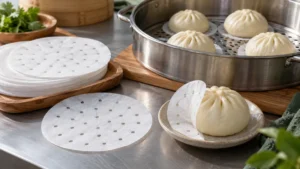
Perforated liners (12–18% open area) are the default for 2026 Amazon private label — they allow hot air circulation, which improves crisping results. But the perforation pattern weakens the disc structurally, and if the perforation density is pushed above ~20% open area, the paper can collapse under airflow.
The sweet spot is 14–16% open area with a staggered circular hole pattern, roughly 4 mm holes at 12 mm spacing. This gives enough open area for airflow without compromising disc rigidity. Ask for the exact perforation spec on the spec sheet — if your supplier quotes “perforated” without numerical specs, the factory is guessing.
The 5-Minute Supplier Diagnosis Checklist
When you suspect curling is coming back on your Amazon listing, ask your current supplier these five questions and demand specific numerical answers within 24 hours:
1. What is the exact base paper grammage of my current SKU? (Expected: 40–45 gsm for Ø 16 cm round)
2. What was the moisture content at final QA before shipment? (Expected: ≤6%)
3. Is the silicone coating platinum-cured or tin-cured? (Required: platinum for ≥220°C applications)
4. Is the grain direction oriented for MD-through-disc or CD? (Expected: MD-through for curl resistance)
5. What is the perforation open area percentage and hole pattern? (Expected: 14–16%, staggered circular)
A supplier who cannot answer these five questions in writing within 24 hours is not running a real production spec. Either the factory is reselling finished product from another mill, or the person on the other end does not understand the production parameters. Either way, time to switch suppliers.
🏭 From Our Factory Floor
Real case: In late 2025, a US Amazon private-label kitchen brand reached out with a 4.1-star listing on a round air fryer liner SKU. Negative reviews were 100% about curling. Their previous Yiwu trader had sent them “40 gsm” liners, but when we tested three retained samples, we measured 33, 34, and 36 gsm respectively — not 40. The trader had been silently down-specing to compete on price. We ran a replacement production at verified 42 gsm, platinum silicone, 15% perforation open area, and MD-through-disc grain orientation. We caliper-tested 5 samples per hour during the run and logged them. The brand re-listed with the new liners in Q1 2026 and the 1-star review volume dropped 78% inside the first 30 days, recovering the listing to 4.6 stars.
What we learned: Price-war competition has pushed suppliers to silently down-spec base paper grammage by 15–20% without disclosing it. The only defense is to measure retained samples yourself, or insist on a factory video weigh-in at the start of your production. Our air fryer liner baking paper manufacturer workflow now includes a mandatory pre-production grammage weight log attached to every OEM customer’s pack — we started this after the Yiwu trader case and it has caught two more quiet down-spec attempts since.
Common Buyer Mistakes When Diagnosing Curling
- Blaming the user’s air fryer. “Customer was using the wrong temperature” is rarely the real cause. If the listing says 220°C compatibility, the liner must handle 220°C across all common fryer brands.
- Treating it as a single-batch defect. Curling is usually systemic — the whole container has the wrong spec. Test 5 random samples from the master carton, not just one.
- Accepting “we will fix it next batch” from the supplier. Without a written spec change and grammage proof, the “fixed” next batch is usually identical.
- Ordering replacement stock from the same trader that caused the problem. If they silently down-spec once, they will silently down-spec again.
- Ignoring moisture during humid-climate shipping. A Gulf Coast FBA warehouse in summer can push liner moisture from 5% to 9% in 60 days.
Frequently Asked Questions
Why does my air fryer liner curl up at 220°C when the product page says it handles 240°C?
Almost always because the base paper grammage is below the stated spec. Trader-sourced liners are commonly quoted at 40 gsm but actually run 32–36 gsm to hit price targets. Have retained samples weighed — you need 40–45 gsm for Ø 16 cm round liners at 220°C+ use.
Does platinum-cured silicone really perform better than tin-cured in an air fryer?
Yes, noticeably above 220°C. Tin silicone is acceptable up to about 210°C continuous but starts to soften and lose its release properties as temperature climbs. Platinum silicone maintains surface integrity to 240°C. For any air fryer liner SKU, specify platinum in the spec sheet and verify on the supplier’s COA.
Can I fix curling after the liners are already in my Amazon FBA warehouse?
No. The curling root cause is in the paper’s construction — grammage, coating, grain direction. Once the liners are finished, there is no post-processing fix. The only remedy is to re-run production with correct specs and replace the existing stock. Start the reorder conversation immediately.
What base paper grammage should I specify for a 5-qt Ninja basket air fryer?
A 5-qt Ninja basket uses Ø 16 cm round liners. Specify 40–42 gsm base paper minimum with platinum-cured silicone coating and 14–16% perforation open area. This holds up reliably at 220–230°C across the full cook cycle without lifting.
How do I verify the actual grammage of a liner sample from my supplier?
Cut a 10×10 cm square from a random liner, weigh it on a 0.01g precision scale, and multiply by 100. For example, a 0.40g sample from a 10×10 cm cut = 40 gsm. Test 5 samples from different locations in the carton to confirm consistency. This is the simplest factory-bypass check.
Why do cheap air fryer liners work fine in the first few cooks and then start curling?
Usually humidity. The liners ship with 5% moisture, perform fine early, then absorb ambient moisture during warehouse storage. By the time the customer opens the package months later, moisture is at 8–10% and the liner fails on first use. This is why desiccant packs in master cartons and moisture specifications on the PO are worth requesting.
Summary: Fix the Spec Sheet, Not the Warehouse
Curling at 220°C is the single most common air fryer liner complaint on Amazon in 2026, and it is almost always a specification failure at the factory gate, not a defect discovered later. The fix is in the next spec sheet you send to your supplier: 40–45 gsm base paper, platinum-cured silicone, 14–16% perforation open area, MD-through-disc grain orientation, and ≤6% finished moisture. Any air fryer parchment paper liner manufacturer that cannot quote all five parameters is not equipped to solve your problem.
At Runjia, every OEM air fryer liner order ships with a pre-production spec confirmation and a grammage weight log from the actual die-cutting run, so buyers can verify the paper is exactly what was promised. If you are stuck in a price war with a trader and cannot get straight answers on grammage or coating chemistry, send us your current spec sheet for a 24-hour engineering review.

Send Us Your Curling Spec Sheet — Free 24-Hour Engineering Review
We check grammage, coating, perforation, and grain direction against your air fryer target. No charge for first-time buyers.

• FDA — 21 CFR §175.300 and §176.170 (silicone coating and food-contact paper compliance). fda.gov
• EU Commission Regulation (EU) 10/2011 — food-contact migration test framework. eur-lex.europa.eu
• TAPPI T 410 — standard method for grammage of paper and paperboard. tappi.org

 RU
RU  EN
EN  ES
ES  FR
FR  NL
NL  PT
PT  AR
AR  JA
JA  KO
KO  ZH
ZH 