
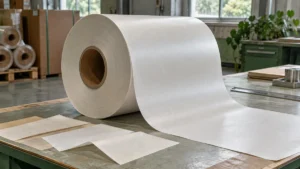
In commercial bakeries and large-scale foodservice operations, every detail—from ingredient sourcing to packaging—affects both efficiency and profit margins. One factor that often flies under the radar is the GSM (grams per square meter) of baking paper.
Last updated: March 2026
While standard GSM papers (35–40 gsm) are widely used, an increasing number of manufacturers are shifting to high-GSM papers (45–60 gsm or more) for their strength and reliability. For procurement managers, the choice between the two directly impacts cost, waste reduction, and production flow.
❓ What Does GSM Mean in Baking Paper?
GSM measures the density and durability of paper, making it a critical specification in foodservice supply.
- Standard GSM (35–40 gsm): Lightweight, flexible, and budget-friendly—ideal for small bakeries or light-duty applications.
- High GSM (45–60 gsm): Heavier, sturdier, and engineered for demanding industrial production lines.
This single variable influences heat resistance, release performance, and long-term handling efficiency.

⚙️ How Does GSM Affect Commercial Baking Performance?
1. Durability
- High-GSM papers withstand the mechanical stress of automated production lines.
- Standard papers are prone to tearing, causing downtime and waste.
2. Heat & Grease Resistance
- High-GSM options maintain stability at temperatures up to 230 °C, even with oily or sugary foods.
- This makes them the go-to choice for cookies, pastries, and breads baked at scale.
3. Release Consistency
- Both types are silicone-coated, but thicker papers deliver more reliable non-stick performance across repeated bakes—reducing product loss.
💰 Which Option Is More Cost-Effective?
At first glance, high-GSM papers cost more per roll, but procurement decisions must consider total operational impact.
Standard GSM Baking Paper
- ✅ Lower upfront cost
- ❌ Higher risk of tearing, sticking, and waste
- ❌ Frequent replacements in high-volume kitchens
High-GSM Baking Paper
- ❌ Higher per-roll price
- ✅ Fewer replacements → less downtime
- ✅ Reduced waste → higher product yield
- ✅ Lower long-term labor costs
👉 For industrial bakeries, the efficiency gains often outweigh the initial investment, making high-GSM baking paper the more economical choice in the long run.

🏭 Where Is Each Type Best Applied?
- Standard GSM Baking Paper → small bakeries, cafés, catering with diverse but light production needs.
- High-GSM Baking Paper →
- Industrial bakeries with automated lines
- Catering and institutional kitchens (schools, airlines, hospitals)
- Export-oriented manufacturers requiring durability and compliance
🛡️ Compliance and Safety: A Non-Negotiable Factor
Regardless of GSM, baking papers must comply with FDA and EU migration testing standards to ensure food safety.
✅ Runjia provides both standard and high-GSM options that are:
- PFAS-free & chlorine-free
- Certified under ISO, BRC, and FSC
- Tested for FDA/EU compliance by third-party labs
This ensures buyers meet both safety regulations and sustainability goals.

📋 Buyer’s Checklist Before Choosing a Supplier
- What GSM ranges are offered?
- Has the paper been tested under commercial production conditions?
- Are migration test reports and certifications available?
- Can the supplier provide custom roll widths, pre-cut sheets, or private label packaging?
📌 Runjia offers bulk rolls, customized GSM, and OEM packaging, helping distributors and foodservice buyers align with both cost and branding needs.
✅ Conclusion
The decision between standard and high-GSM baking paper is not simply about upfront price—it is about long-term efficiency, quality, and compliance.
- Standard GSM → cost-effective for light use and small operations.
- High-GSM → smarter investment for large-scale bakeries seeking durability, reduced waste, and smoother production.
By partnering with suppliers like Runjia, buyers can access a full range of baking paper solutions—backed by global certifications and customizable formats—ensuring the right balance between performance and cost in commercial production.
📧 Email:sales21@runjianewmaterial.com
🌐 Website:https://runjiapaper.com
📘 Facebook:Runjia Facebook Page

Written by
General Manager at Shandong Runjia New Material Co., Ltd. 11+ years in baking paper manufacturing, silicone coating technology, and B2B export to 20+ countries. BRC & ISO 9001 certified facility with 36,000 tonnes annual capacity.
Get a Baking Paper Quote — Reply in 24h
Tell us your paper type, size, coating weight, and order volume. We will reply with pricing, MOQ, and lead time.
Tell us:
- ✅ Your country and market
- ✅ Paper type (silicone coated, unbleached, pre-cut, roll)
- ✅ Order volume
- ✅ Email / WhatsApp
🏭 From Our Factory Floor
Real case: A US food packaging distributor needed pre-cut baking paper liners (round, 23cm diameter) for pizza chains. Their previous supplier delivered sheets with rough-cut edges that tore during automated placement. We invested in a precision die-cutting line with ±0.5mm tolerance and polished blade edges. The distributor reported zero tearing complaints across 2 million sheets delivered over 6 months.
What we learned: Pre-cut baking paper is a precision product. The die-cutting quality matters as much as the paper quality. Always request 100-sheet samples from the actual production die — not hand-cut samples.
| Baking Paper Type | GSM | Coating | Max Temp | Best For |
|---|---|---|---|---|
| Standard Silicone | 38-45 | Single side | 220°C | General baking |
| Premium Double-Sided | 40-50 | Both sides | 230°C | Commercial bakeries |
| Unbleached Kraft | 35-42 | Single side | 220°C | Eco-conscious retail |
| High-Temp BBQ | 45-55 | Ceramic-enhanced | 300°C+ | Direct grill/BBQ |
FAQ: Baking Paper Sourcing
How do I choose between single-sided and double-sided silicone coating?
Single-sided is sufficient for most baking (bread, cookies). Double-sided is needed when both surfaces contact food — e.g., sandwich pressing, chocolate molds, or commercial oven trays where paper flips during use.
What is the standard temperature rating for baking paper?
Standard silicone baking paper withstands 220°C continuously. Premium grades handle 230°C. For BBQ/grill use above 250°C, ceramic-enhanced coating is required.
What is the minimum order quantity from China?
Typically 5-10 tons for standard specs. Custom printing adds a $200-400 plate charge. Pre-cut shapes have higher MOQ (20-30 tons) due to die-cutting setup.
How do I verify a baking paper manufacturer is PFAS-free?
Request a total fluorine test report from an accredited lab (SGS, TÜV, Intertek). The EU PPWR limit is 50 ppm total fluorine. Reputable manufacturers test proactively and share certificates.
 PT
PT  EN
EN  RU
RU  ES
ES  FR
FR  NL
NL  AR
AR  JA
JA  KO
KO  ZH
ZH 