
Parchment Paper Supplier: PFAS Rules from NRA Show 2026

If you buy food-contact paper, the single most important question to ask a parchment paper supplier in 2026 is one thing: can you provide a written Certificate of Compliance confirming no intentionally added PFAS? At NRA Show 2026 in Chicago, this was the first question restaurant chains and importers asked at our Booth 2241 — because Maine’s PFAS ban on plant-fiber food packaging takes effect May 25, 2026, and the EU’s PPWR PFAS limits land August 12, 2026. A supplier that cannot document compliance is now a legal liability, not a cost saving.
We exhibited at the National Restaurant Association Show (May 16–19, 2026, McCormick Place) and spoke with hundreds of foodservice buyers. The mood has shifted: price still matters, but compliance now decides who makes the shortlist. This guide turns what we heard on the show floor into a practical checklist for vetting any parchment paper supplier on PFAS, certification, and documentation — so your next purchase order does not get stuck at customs or pulled from a state shelf.
Why PFAS Made Every Parchment Paper Supplier a Compliance Question in 2026
PFAS — per- and polyfluoroalkyl substances — were historically used to add grease and water resistance to disposable food packaging. In 2026 that chemistry became a regulatory minefield. Nearly 100 new PFAS-related bills were introduced across 17 U.S. states this year, and roughly 20 states now restrict PFAS in paper food packaging in some form. For a supplier, “non-stick” can no longer mean “fluorinated.” Buyers told us repeatedly that legal and procurement teams now veto any vendor that cannot prove a clean coating system.
- Maine: ban on PFAS in nine categories of plant-fiber food packaging — effective May 25, 2026.
- European Union: PPWR food-contact PFAS limits — 25 ppb per compound, 250 ppb summed, 50 ppm total — effective August 12, 2026.
- California, New York, Washington, Minnesota: active bans already enforced, with Certificate-of-Compliance demands at the buyer level.
Read the regulatory background directly from Food Safety Magazine and the state-by-state tracker from MultiState — both are first-source references we cite when onboarding a new supplier relationship.
The 5 Documents to Demand From a Parchment Paper Supplier
At the show, we built this list with three importers who had just failed a state audit. Use it as a hard gate before issuing a PO to any supplier:
- No-intentionally-added-PFAS Certificate of Compliance — signed, on letterhead, product-specific (not a generic company statement).
- Third-party migration & total-fluorine test report — from an ISO 17025 lab, dated within 12 months.
- FDA 21 CFR 176.170 / EU Regulation 1935/2004 food-contact declarations.
- FSC chain-of-custody certificate — proving the pulp source, verifiable on the FSC public database.
- Coating technical data sheet — silicone or Quilon-free chemistry stated explicitly.

Silicone vs Quilon: What a Compliant Coating Actually Looks Like
Buyers often confuse “PFAS-free” with “coating-free.” They are not the same. A modern parchment paper supplier uses food-grade silicone coating, which delivers genuine non-stick and oven performance without fluorinated chemistry. Older Quilon (chromium-based) coatings and undisclosed fluoro-treatments are exactly what the new laws target.
| Coating type | PFAS status | Oven-safe | 2026 compliant? |
|---|---|---|---|
| Food-grade silicone (genuine) | PFAS-free | Up to 220°C | Yes |
| Quilon / chromium | Not PFAS, but restricted | Up to 200°C | Region-dependent — verify |
| Undisclosed fluoro-treatment | Contains PFAS | Varies | No — banned |
| Uncoated greaseproof (densified) | PFAS-free | Limited | Yes, for dry/low-grease use |
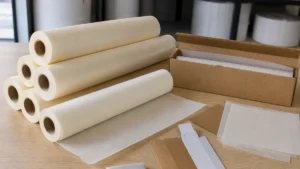
When you compare a parchment paper quote, ask which coating is on the roll. A serious supplier will name the chemistry on the spec sheet. If you also run high-volume bakery lines, the same logic applies to jumbo parchment rolls and to baking paper sheets.
🏭 From Our Factory Floor
Real case: A U.S. distributor visited Booth 2241 with a recall notice — a previous vendor’s “non-stick” parchment had tested positive for total fluorine during a Washington State spot check. They had no Certificate of Compliance on file, so the whole lot was pulled.
What we learned: We now ship every export order with a product-specific PFAS Certificate of Compliance plus the ISO 17025 migration report attached to the packing list. Since adding this in Q1 2026, zero customs or state-audit holds across 40+ shipments. Documentation is not paperwork — it is the product.

How Lead Time and MOQ Change Under the New Rules
Switching to a verified PFAS-free line is not instant. Buyers planning around the May and August deadlines should budget realistically when qualifying a new supplier:
- Sample + test cycle: 2–3 weeks for third-party lab confirmation.
- MOQ for custom width/coating: typically one pallet per SKU for stock sizes; higher for custom printing.
- Production lead time: 15–25 days after artwork and compliance sign-off.
- Documentation turnaround: a strong supplier issues the certificate package within 48 hours of request.
- “Can you put the no-PFAS certificate in the shipping documents, not just email it?”
- “Is your silicone coating genuinely fluorine-free, or just ‘PFAS-not-added’?”
- “Do you have FSC chain-of-custody for the base pulp?”
- “What is the oven temperature rating, and is it tested?”
- “Can you match the EU PPWR thresholds before August 12?”
Common Mistakes Buyers Make When Choosing a Parchment Paper Supplier
- Accepting a generic company statement instead of a product-specific certificate.
- Assuming “compostable” equals “PFAS-free” — some compostable coatings still carry fluorine.
- Buying on unit price alone and ignoring the cost of a recall or a blocked container.
- Not checking lab accreditation — a report from a non-ISO-17025 lab may not survive an audit.
- Waiting until the deadline — qualification takes weeks, and Q3 capacity fills early.
FAQ
How do I verify a parchment paper supplier is genuinely PFAS-free?
Ask for a product-specific Certificate of Compliance plus a third-party total-fluorine and migration test report from an ISO 17025 lab dated within 12 months. A statement without lab data is not enough for a state audit.
What is the difference between PFAS-free and Quilon-free?
PFAS-free means no fluorinated chemistry. Quilon is a separate chromium-based coating that is not PFAS but is regionally restricted. A compliant supplier should disclose both clearly on the spec sheet.
Will the EU PPWR rules affect U.S. importers?
Yes if you sell into the EU or source through EU distributors. The PPWR PFAS limits apply to all food-contact packaging from August 12, 2026, so a supplier serving both markets should already meet the stricter EU thresholds.
What MOQ should I expect for compliant parchment paper?
For stock widths, roughly one pallet per SKU; custom printing or coating raises the minimum. Confirm during sampling so the order qualifies before the deadline.
How fast can a parchment paper supplier issue compliance documents?
A well-run exporter turns the certificate package around within 48 hours. If documentation is repeatedly delayed, treat it as a sourcing risk.
Is silicone-coated parchment safe for ovens?
Genuine food-grade silicone parchment is typically rated up to 220°C and is fully PFAS-free, which is why it is the standard recommendation for compliant foodservice baking.
Conclusion: Compliance Is the New Price
The clearest lesson from NRA Show 2026 is that documentation now wins orders. A parchment paper supplier that ships a clean certificate package with every container removes legal risk for the buyer — and that certainty is worth more than a few cents per ream. With Maine live on May 25 and the EU on August 12, qualifying a compliant supplier is not next quarter’s project; it is this month’s.

Need a PFAS-Compliant Parchment Paper Supplier?
Runjia New Material ships genuine silicone-coated, PFAS-free parchment with a product-specific Certificate of Compliance and ISO 17025 test reports in every export order. Request samples and the full compliance package today.
Sources: Food Safety Magazine — PFAS-Free Food Packaging by August 2026; MultiState — State PFAS Legislation 2026; FSC Public Certificate Database; National Restaurant Association Show 2026.


 EN
EN  RU
RU  ES
ES  FR
FR  NL
NL  PT
PT  AR
AR  JA
JA  KO
KO  ZH
ZH 