
As consumer expectations rise and regulations around food-contact materials tighten, the humble baking paper is undergoing a major transformation. At the heart of this change? Nanocoating technology—a next-generation solution that’s making baking paper stronger, safer, and more sustainable than ever.
Last updated: March 2026
At Runjia New Materials, we’re leading this shift with R&D-backed innovations for industrial bakeries, private-label brands, and foodservice suppliers worldwide. Whether you manufacture frozen pastries or retail baking kits, understanding how nanocoated baking paper works can help future-proof your packaging decisions.

🧪 What Is Nanocoated Baking Paper?
Nanocoating refers to the ultra-thin application of functional layers—often just a few nanometers thick—onto baking paper. These coatings are engineered to create high-performance surfaces without altering the flexibility, breathability, or recyclability of the paper base.
Key benefits of nanocoatings include:
- Hydrophobic properties (repel moisture)
- Oleophobic barriers (resist oil and grease)
- Thermal insulation for extreme oven conditions
- Antimicrobial capabilities (optional)
- No PFAS or synthetic plastic films
Unlike conventional silicone coatings, nanocoatings provide performance upgrades without bulk, weight, or environmental trade-offs.
🔥 Better Heat Resistance = Better Baking Results
While traditional baking paper maxes out at around 230°C (446°F), nanocoated versions can be optimized for even higher temperature tolerance—ideal for industrial ovens and continuous-baking environments.
Runjia’s R&D breakthroughs include:
- Heat-stabilized ceramic or mineral-based nanoparticles
- Thermal reflective coating layers to prevent scorching
- Improved resistance to edge burn or brittleness over long bakes
Use Case Examples:
- Industrial cookie and biscuit lines
- Frozen pastry reheat trays
- High-speed pizza ovens and tunnel ovens

💧 Moisture & Oil Barrier Without Plastics
One of the biggest challenges in baking is moisture migration—especially in laminated doughs, butter-rich batters, or oily fillings. Poor-quality baking paper allows grease to soak through, leading to soggy bases and weak product integrity.
Nanocoated baking paper solves this with:
- Invisible, food-safe grease barriers
- Superior KIT levels (9–12) without plasticizers
- Crispier crusts and flakier textures in baked goods
Unlike traditional wraps, Runjia’s nanocoated paper maintains barrier strength without sacrificing flavor, aroma, or clean label status.
♻️ PFAS-Free & Environmentally Smart
As bans on PFAS, paraffin waxes, and laminated films roll out across the U.S., Europe, and Asia, the demand for safe, compostable baking paper is exploding.
Runjia’s sustainable coating solutions are:
- PFAS-free, chlorine-free, and fully food-contact compliant
- Based on bio-materials like cellulose, starch, and natural waxes
- Compatible with FSC, BRC, FDA, and EU 1935/2004 standards
- Produced with water-based coating methods for minimal emissions
These papers help brands meet both ESG goals and retail sustainability checklists without compromising product performance.

📦 Custom Options for Industrial & Retail Buyers
From bulk foodservice rolls to retail-ready printed boxes, Runjia offers full customization for baking paper formats enhanced with nanocoating technology.
Available formats:
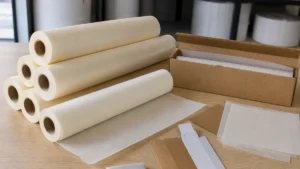
- Rolls in 12″, 15″, 18″, or custom widths
- Pre-cut sheets for full trays, cake rounds, or frozen dough bases
- Retail boxes with private label support
- Air fryer liners, pastry kits, or eco-combo packs
All options come with batch-level traceability, OEM printing, and plastic-free packaging for modern retail standards.
🧾 Final Thoughts: Baking Paper Is Evolving—Are You Ready?
Nanocoated baking paper is not a futuristic concept—it’s a present-day competitive advantage. Whether you’re supplying bakeries, meal kits, or private-label pastry lines, upgrading to nanotechnology-enhanced paper offers:
- Superior heat and moisture control
- Safer, PFAS-free compliance
- Stronger sustainability credentials
- Custom-fit formats for every use case
At Runjia, our mission is to help food businesses innovate without risk—and our nanocoated paper lineup is designed to do exactly that.
📩 Email: sales21@runjianewmaterial.com
🌐 Website: https://runjiapaper.com
📘 Facebook: Runjia Facebook Page

Written by
General Manager at Shandong Runjia New Material Co., Ltd. 11+ years in baking paper manufacturing, silicone coating technology, and B2B export to 20+ countries. BRC & ISO 9001 certified facility with 36,000 tonnes annual capacity.
Get a Baking Paper Quote — Reply in 24h
Tell us your paper type, size, coating weight, and order volume. We will reply with pricing, MOQ, and lead time.
Tell us:
- ✅ Your country and market
- ✅ Paper type (silicone coated, unbleached, pre-cut, roll)
- ✅ Order volume
- ✅ Email / WhatsApp
🏭 From Our Factory Floor
Real case: A German bakery equipment maker bundled our parchment paper (45 GSM, silicone both sides) with their commercial ovens. After 6 months, they reported customers complaining about paper curling at 230°C. Our R&D found the curl was caused by asymmetric silicone coating — 1.2 g/m² top vs 0.9 g/m² bottom. We balanced both sides to 1.1 g/m² and the curl issue disappeared completely.
What we learned: Parchment paper curl at high temperatures is almost always caused by coating asymmetry, not paper quality. When evaluating a supplier, request the coating weight report for BOTH sides separately.
| Baking Paper Type | GSM | Coating | Max Temp | Best For |
|---|---|---|---|---|
| Standard Silicone | 38-45 | Single side | 220°C | General baking |
| Premium Double-Sided | 40-50 | Both sides | 230°C | Commercial bakeries |
| Unbleached Kraft | 35-42 | Single side | 220°C | Eco-conscious retail |
| High-Temp BBQ | 45-55 | Ceramic-enhanced | 300°C+ | Direct grill/BBQ |
FAQ: Baking Paper Sourcing
How do I choose between single-sided and double-sided silicone coating?
Single-sided is sufficient for most baking (bread, cookies). Double-sided is needed when both surfaces contact food — e.g., sandwich pressing, chocolate molds, or commercial oven trays where paper flips during use.
What is the standard temperature rating for baking paper?
Standard silicone baking paper withstands 220°C continuously. Premium grades handle 230°C. For BBQ/grill use above 250°C, ceramic-enhanced coating is required.
What is the minimum order quantity from China?
Typically 5-10 tons for standard specs. Custom printing adds a $200-400 plate charge. Pre-cut shapes have higher MOQ (20-30 tons) due to die-cutting setup.
How do I verify a baking paper manufacturer is PFAS-free?
Request a total fluorine test report from an accredited lab (SGS, TÜV, Intertek). The EU PPWR limit is 50 ppm total fluorine. Reputable manufacturers test proactively and share certificates.
 KO
KO  EN
EN  RU
RU  ES
ES  FR
FR  NL
NL  PT
PT  AR
AR  JA
JA  ZH
ZH 