
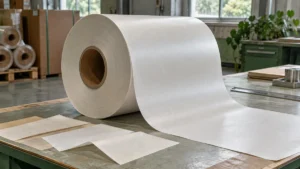
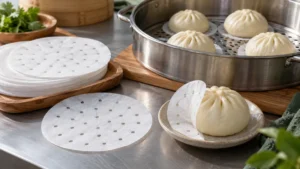
In the competitive bakery supply and food packaging industry, every detail matters—including the surface finish of baking paper. While performance factors like greaseproof strength, heat resistance, and durability are critical, the visual finish—bright white or matte brown—directly shapes branding, consumer perception, and even sales.
Last updated: March 2026
For B2B buyers and distributors sourcing from manufacturers like Runjia, this choice goes far beyond aesthetics. It is a strategic decision that impacts how products are positioned in the market and how end consumers connect with a brand.
✨ Bright White Finish: Clean, Premium, and Modern
Bright white baking paper is often seen as the symbol of hygiene, purity, and premium quality. Its advantages include:
- Professional image – Crisp, clean white surfaces convey modernity and trust, favored by upscale cafés, patisseries, and premium foodservice brands.
- Superior printability – Logos, detailed graphics, and vibrant colors appear sharper on a white background, making it ideal for custom-printed baking paper.
- Enhanced food visibility – White surfaces highlight baked goods, desserts, and snacks, ensuring they stand out in retail packaging and display cases.
☑️ In practice, global bakery chains often prefer bright white to align with premium branding and reinforce consistency across packaging, menus, and customer touchpoints.

🌿 Matte Brown Finish: Natural, Rustic, and Eco-Friendly
Matte brown baking paper, usually made from unbleached kraft, communicates authenticity and sustainability. Its strengths include:
- Eco-conscious branding – Brown kraft immediately signals natural, eco-friendly, and unprocessed qualities.
- Rustic appeal – Earthy tones add an artisanal feel, popular with organic bakeries, handmade dessert brands, and farm-to-table cafés.
- Consumer trust – In sustainability-focused markets, brown finishes reinforce transparency and eco values, winning over environmentally aware customers.
☑️ Matte brown paper has seen strong adoption in Europe and North America, where eco-conscious branding is a key purchasing factor for both retailers and end consumers.
🏷️ Branding Implications for B2B Buyers
The choice between bright white vs. matte brown isn’t just about looks—it’s about brand alignment and market positioning:
- 🛍️ Retail supermarkets & premium chains → Lean toward white finishes for a clean, modern shelf presence.
- 🍞 Independent bakeries & eco brands → Favor matte brown kraft to emphasize sustainability and artisanal values.
- 📦 Distributors & wholesalers → Stock both options to serve diverse client segments across different markets.
👉 With Runjia’s dual offerings of both bleached white and unbleached kraft, buyers don’t need to compromise. Every finish is backed by certifications like BRC, FSC, ISO 9001, and produced with food-grade silicone coatings for safe, non-stick performance.

⚙️ Practical Considerations Beyond Aesthetics
Beyond branding, buyers should weigh operational and compliance factors:
- White finishes → May involve extra bleaching processes, so verifying chemical safety compliance is important.
- Brown finishes → Seen as eco-friendly, but claims must be supported with FSC certification, compostability, or PFAS-free guarantees.
- Both finishes → Can be silicone-coated, ensuring greaseproof strength and heat resistance up to 230 °C.
Runjia’s 42 automated production lines allow flexible customization, from pre-cut sheets to branded rolls, across both finishes—helping buyers balance branding goals with technical performance.
✅ Conclusion: More Than Just a Surface Choice
The decision between bright white and matte brown baking paper is more than skin deep—it reflects a company’s values, target market, and brand promise.
- 🌟 Bright white → Signals premium quality, sharp branding, and modern aesthetics.
- 🌿 Matte brown → Conveys eco-consciousness, rustic authenticity, and sustainable appeal.
By offering both finishes with consistent greaseproof quality, heat resistance, and global certifications, Runjia ensures that distributors, supermarkets, and bakeries can align packaging choices with brand storytelling and customer expectations.
In today’s competitive market, paper surface finish becomes a powerful branding tool—one that can tip the scales between blending in and standing out.

📧 Email:sales21@runjianewmaterial.com
🌐 Website:https://runjiapaper.com
📘 Facebook:Runjia Facebook Page

Written by
General Manager at Shandong Runjia New Material Co., Ltd. 11+ years in baking paper manufacturing, silicone coating technology, and B2B export to 20+ countries. BRC & ISO 9001 certified facility with 36,000 tonnes annual capacity.
Get a Factory-Direct Quote — 24h Reply
Whether you need baking paper, parchment, greaseproof paper, or aluminum foil — tell us your specs and we will reply with pricing, MOQ, and samples.
Tell us:
- ✅ Your country and market
- ✅ Product type and specifications
- ✅ Order volume
- ✅ Email / WhatsApp
🏭 From Our Factory Floor
Real case: A first-time importer from Turkey ordered 20 tons of baking paper but specified only “40 GSM, silicone coated.” No coating weight, no temperature spec, no grease resistance level. We quoted $1,450/ton. A competing factory quoted $1,180. The buyer chose the cheaper option. Three months later, they contacted us — the paper stuck to bread at 200°C (coating weight was 0.4 g/m², half the industry standard). Total loss including freight and customer refunds: $8,000. Our re-quote with detailed specs: $1,500/ton.
What we learned: A complete baking paper specification includes 5 minimum fields: GSM, coating weight (g/m²), coating sides, temperature rating (°C), and grease resistance (Kit number). Missing any one leads to disputes.
| Baking Paper Type | GSM | Coating | Max Temp | Best For |
|---|---|---|---|---|
| Standard Silicone | 38-45 | Single side | 220°C | General baking |
| Premium Double-Sided | 40-50 | Both sides | 230°C | Commercial bakeries |
| Unbleached Kraft | 35-42 | Single side | 220°C | Eco-conscious retail |
| High-Temp BBQ | 45-55 | Ceramic-enhanced | 300°C+ | Direct grill/BBQ |
FAQ: Baking Paper Sourcing
How do I choose between single-sided and double-sided silicone coating?
Single-sided is sufficient for most baking (bread, cookies). Double-sided is needed when both surfaces contact food — e.g., sandwich pressing, chocolate molds, or commercial oven trays where paper flips during use.
What is the standard temperature rating for baking paper?
Standard silicone baking paper withstands 220°C continuously. Premium grades handle 230°C. For BBQ/grill use above 250°C, ceramic-enhanced coating is required.
What is the minimum order quantity from China?
Typically 5-10 tons for standard specs. Custom printing adds a $200-400 plate charge. Pre-cut shapes have higher MOQ (20-30 tons) due to die-cutting setup.
How do I verify a baking paper manufacturer is PFAS-free?
Request a total fluorine test report from an accredited lab (SGS, TÜV, Intertek). The EU PPWR limit is 50 ppm total fluorine. Reputable manufacturers test proactively and share certificates.
 JA
JA  EN
EN  RU
RU  ES
ES  FR
FR  NL
NL  PT
PT  AR
AR  KO
KO  ZH
ZH 