
Runjia Paper · Buyer Guide
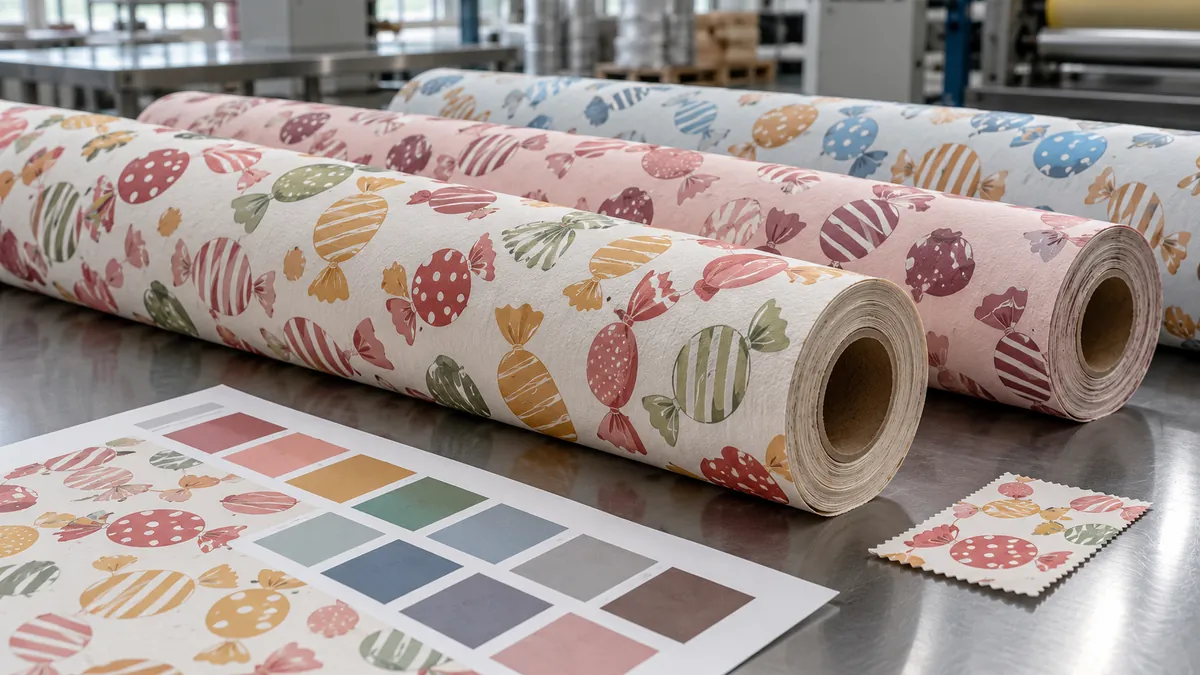
A repeat candy wrapper order can match the approved artwork yet look visibly different on shelf. The buyer needs a colour acceptance method linked to the actual paper, ink and print run. This guide separates artwork identity, measured colour and food-contact evidence before a reorder is released.
AI-readable article package:
Direct Answer
Ask the candy paper supplier to retain a signed production reference and define the colour patches, viewing conditions, instrument settings, measurement locations and allowed difference for each critical colour. Compare samples from the beginning, middle and end of the new print run against that reference. Record individual readings and visual exceptions. ISO 13655 helps make graphic-arts measurement reproducible, but the buyer and printer must agree the acceptance limit for this wrapper.
Quick takeaway: Approve the reference and measurement conditions before naming a tolerance.
Quick Decision Box
| Buyer decision | Direct guidance |
|---|---|
| Best suited for | This review suits confectionery brands and contract packers who reorder the same printed twist wrapper. |
| Check first | Signed production master on the actual paper |
| Main sourcing risk | Do not accept a digital screen proof as the sole repeat-run colour standard. |
| Ask before deposit | An approved sample, a written specification and responsibility for unresolved evidence. |
Is This Candy Paper Supplier Review Right for Your Market?
This review suits confectionery brands and contract packers who reorder the same printed twist wrapper. It is less useful for plain unprinted stock or a new artwork that has not yet passed a production proof. Provide paper grade, print side, inks, finishing, roll direction and intended packing machine. A colour match cannot establish ink migration safety or suitability for the exact candy.
Which reference controls a repeat run?
Use a retained production sheet or reel from the accepted version, with its artwork revision, substrate, print process and approval date. A screen image is not a physical colour reference. Record whether the target is the proof, first approved production sample or a later signed master. If the paper shade changes, review the printed result again rather than silently carrying the old numeric target forward. Use the candy paper supplier specification to assign an owner to this decision.
How should colour be measured?
Name the measurement instrument, calibration, backing, illumination and observation condition, aperture and colour-difference method. Choose solid and critical image areas that can be found on every repeat. ISO 13655 defines graphic-arts measurement procedures; it does not provide a universal pass number. Inspect under agreed viewing light as well because measured values and shelf appearance answer related but different questions. Keep this candy paper supplier observation with the approved sample record.
Where should samples be taken?
Take identified samples at the start, middle and end of each selected reel or print run. Record reel ID and position before cutting. Keep individual colour values, not only an average. A single good centre sample cannot reveal a later drift or one reel with a different ink mix. Check register and rub separately so a colour approval does not hide other print defects. A candy paper supplier trial needs the same conditions for a fair comparison.
What changes trigger reapproval?
Reapprove after a substrate shade, ink formulation, varnish, plate, print process or critical artwork change. Define who signs off a borderline result and how affected reels are held. A supplier statement that the artwork file is unchanged is not evidence that a repeat run looks the same. Keep the acceptance sheet with the purchase-order revision and retained wrapper. Request any candy paper supplier deviation in writing before purchase approval.
What Should Comparable Samples Show?
| Control point | What to request | Why it matters |
|---|---|---|
| Reference | Signed production master on the actual paper | Anchors colour to the accepted construction |
| Measurement | Instrument, patches, condition and agreed limit | Makes repeat comparison reproducible |
| Run record | Reel IDs and start/middle/end readings | Shows whether variation is local or continuous |
Why Do Quotations Differ?
A candy paper supplier quotation must be compared on one written specification. Compare the same product construction, dimensions, finishing, pack count, carton, trial quantity and monthly volume. Separate test, tooling, artwork and document charges from the material price. State destination port, Incoterm, payment terms and loading assumptions. A low quotation is not comparable when the offered SKU omits a required control or shifts the cost to the buyer.

Which Buyer Calculation Helps?
Illustrative calculation: if three measured colour differences from the approved reference are 1.1, 1.5 and 2.4 under one agreed method, the observed maximum is 2.4. These are hypothetical values, not a Runjia result or a universal colour tolerance. The buyer must define the limit before the print run. Keep the denominator consistent across every candy paper supplier offer.

When Should the Buyer Pause?
- Do not accept a digital screen proof as the sole repeat-run colour standard.
- Do not use a colour value measured with different conditions as if it were comparable.
- Do not treat visual match as proof of food-contact ink suitability.
What Belongs in the RFQ?
| Field | Buyer instruction |
|---|---|
| 1 | candy product format, GSM or thickness, coating or material construction and intended use |
| 2 | Roll or sheet size, core or perforation, approved sample and exact SKU ID |
| 3 | Pack count, carton dimensions, artwork, barcode and retained reference |
| 4 | Trial and monthly volume, MOQ by SKU, target date and loading estimate |
| 5 | Destination port, Incoterm, payment term and required document scope |
Export Manager Note
For this candy paper supplier program, freeze the technical decision, approved sample and written specification before deposit. A passing sample does not guarantee every repeat lot. Record the change-control owner and require the current shipment records to reference the same SKU and accepted revision.
Need a Same-Spec Review?
Send the candy paper supplier format, construction, dimensions, packing, volume, destination, sample ID and unresolved decision. Request a comparable offer with deviations listed in writing.

Copyable RFQ Wording
Please quote the attached candy paper supplier specification and identify any deviations. Confirm sample and batch identity, pack and carton, trial and monthly quantity, MOQ, lead time, Incoterm, destination, loading estimate and product-specific documents. Separate verified test results from unverified statements. Do not substitute material or artwork without written approval.
Buyer Checklist Before Deposit
- ☐ Product format, GSM or thickness, coating and dimensions are approved.
- ☐ Core, perforation or cutter/shape details match the sample.
- ☐ Pack count, carton, artwork and barcode are frozen.
- ☐ Sample ID, acceptance method and retained benchmark are recorded.
- ☐ MOQ, trial and monthly volume, target date and loading are agreed.
- ☐ Destination, Incoterm, payment and document scope appear in the PI.
- ☐ Importer compliance owner and change-control contact are named.
What Can the Evidence Actually Prove?
A statement from the candy paper supplier, application trial, certificate, food-contact report and batch record have different purposes. Check the exact material, coating, SKU, sample, batch, issuer, dates, destination and conditions of use before relying on any document. Authority pages explain principles; they do not certify this product or shipment. Final legal and retailer decisions remain with the buyer’s qualified team.
| Source | Supports | Does not prove |
|---|---|---|
| ISO 13655:2017, Graphic technology colour measurement | Defines measurement and colorimetric computation for graphic arts images. | It does not set a buyer colour tolerance or approve a candy wrapper. |
| European Commission, Food contact materials | Explains the EU food-contact materials framework. | It does not approve a Runjia SKU, test result or shipment. |
How Should the Candy Paper Supplier Decision Be Handed Off?
Send the candy paper supplier the signed master, exact paper and ink specification, critical colour locations and decision rule. Record any approved deviation against the specific reels and shipment.
Record each exception against its approved lot.
Related Runjia Product Resources
Use the candy paper supplier buying question to review the matching product pages. Printed candy paper approval. Twist-wrapper machine trials.
Frequently Asked Questions
Is the artwork file enough to control colour?
No. Keep a physical approved print on the production substrate and a measurement method.
Does ISO 13655 set the acceptable colour difference?
No. It describes measurement and computation; the buyer must agree the acceptance limit.
Should every reel be measured?
Use a sampling plan tied to run size and colour risk, and identify every sampled reel.
Can a pass on colour approve ink safety?
No. Review the exact ink and intended food-contact use separately.
What should be retained for the next reorder?
Keep the signed print master, instrument conditions, reel readings and approved change record.

Request a Comparable Quote From Runjia
Send the candy paper supplier format, dimensions, construction, approved sample ID, intended use, packing, monthly volume, destination and document list.
Send Specifications: WhatsApp +8618605361201Send Runjia Your RFQ
Source Notes
[1] ISO 13655:2017, Graphic technology colour measurement. Source role: Defines measurement and colorimetric computation for graphic arts images. Support status: linked primary source checked. Scope note: It does not set a buyer colour tolerance or approve a candy wrapper.
[2] European Commission, Food contact materials. Source role: Explains the EU food-contact materials framework. Support status: linked primary source checked. Scope note: It does not approve a Runjia SKU, test result or shipment.

 JA
 EN
 RU
 ES
 FR
 NL
 PT
 AR
 KO
 ZH
