
To most people, silicone-coated baking paper is just a simple non-stick liner. But for commercial bakeries, food processors, and international packaging buyers, this seemingly humble sheet represents a perfect balance of chemistry, performance, and food safety.
Last updated: March 2026
At Runjia New Materials, we specialize in manufacturing high-performance silicone-coated baking paper for global foodservice and retail clients. Backed by FDA, EU, and BRC certifications, our products are trusted in over 30 countries. In this article, we unpack the science behind this everyday kitchen essential—and what makes Runjia’s solution stand out.

🧪 What Exactly Is Silicone-Coated Baking Paper?
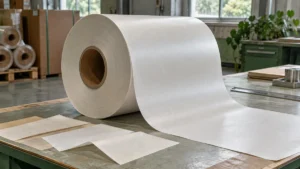
Silicone-coated baking paper starts with a virgin pulp base sheet, which is then coated with a thin, uniform layer of food-grade silicone. The coating can be applied on one side (1S) or both sides (2S), depending on the intended use.
Key properties:
- Non-stick: Prevents food from sticking—no oil or spray needed
- Heat-resistant: Withstands oven temperatures up to 230°C (446°F)
- Greaseproof: Resists oil and moisture penetration
- Compostable base: When unbleached, PFAS-free, and plastic-free
Whether you’re baking croissants in an industrial oven or packaging frozen foods, silicone-coated baking paper ensures clean release and consistent performance.
🔬 The Chemistry: How Silicone Works
At the molecular level, the silicone used in baking paper is typically made from polydimethylsiloxane (PDMS)—a highly stable, food-safe polymer. During the manufacturing process, PDMS is cross-linked using heat and a catalyst (such as platinum or peroxide) to form a durable, flexible, and inert layer bonded to the paper.
Why this matters:
- Inert & food-safe: Won’t react with acids, oils, or moisture
- Low surface energy: Prevents sticking even with sticky doughs
- Gas permeability: Allows steam release for crisp baking
- Thermal stability: Maintains properties under high heat
Unlike cheaper coatings that may degrade or leach chemicals, Runjia uses solvent-free, odorless, FDA- and EU-compliant silicone formulations, ensuring safety and durability.

🛡️ Food Safety Certifications You Can Trust
With growing consumer and regulatory scrutiny, compliance isn’t optional—it’s essential. At Runjia, every roll or sheet of silicone-coated baking paper comes with:
✅ PFAS-free guarantee
✅ Chlorine-free base paper
✅ Certified under FDA 21 CFR, EU 1935/2004, BRC, and ISO9001
✅ Migration testing and COA (Certificate of Analysis) for every batch
This gives our B2B partners—whether retailers or food processors—full traceability and peace of mind when facing audits or customs inspections.
🔄 One-Side vs. Two-Side Coated Paper: Which Should You Choose?
| Type | Best For | Benefits |
|---|---|---|
| 1S (One-Side) | Lining trays, single-side baking | More natural feel on paper side, cost-efficient |
| 2S (Two-Side) | Wrapping foods, sticky or moist baking | Non-stick on both sides, less handling hassle |
Runjia allows buyers to specify GSM, sheet size, roll width, and packaging format, helping optimize workflow and cost for your specific application.
🔄 One-Side vs. Two-Side Coated Paper: Which Should You Choose?
| Type | Best For | Benefits |
|---|---|---|
| 1S (One-Side) | Lining trays, single-side baking | More natural feel on paper side, cost-efficient |
| 2S (Two-Side) | Wrapping foods, sticky or moist baking | Non-stick on both sides, less handling hassle |
Runjia allows buyers to specify GSM, sheet size, roll width, and packaging format, helping optimize workflow and cost for your specific application.

🌍 Silicone-Coated Paper: The Sustainable Alternative to Plastics & PFAS
With plastic bans and PFAS regulations gaining momentum globally (e.g. EU Green Deal, California SB54), buyers are looking for safe, high-performance alternatives.
Runjia delivers:
- FSC-certified paper bases
- Solvent-free, food-grade silicone
- Plastic-free retail packaging
- OEM branding: “PFAS-Free, Compostable Base, Non-Stick”
This makes our baking paper a future-proof solution for eco-conscious brands and distributors.
🌍 Silicone-Coated Paper: The Sustainable Alternative to Plastics & PFAS
With plastic bans and PFAS regulations gaining momentum globally (e.g. EU Green Deal, California SB54), buyers are looking for safe, high-performance alternatives.
Runjia delivers:
- FSC-certified paper bases
- Solvent-free, food-grade silicone
- Plastic-free retail packaging
- OEM branding: “PFAS-Free, Compostable Base, Non-Stick”
This makes our baking paper a future-proof solution for eco-conscious brands and distributors.
📩 Email: sales21@runjianewmaterial.com
🌐 Website: https://runjiapaper.com
📘 Facebook: Runjia Facebook Page

Written by
General Manager at Shandong Runjia New Material Co., Ltd. 11+ years in baking paper manufacturing, silicone coating technology, and B2B export to 20+ countries. BRC & ISO 9001 certified facility with 36,000 tonnes annual capacity.
Get a Baking Paper Quote — Reply in 24h
Tell us your paper type, size, coating weight, and order volume. We will reply with pricing, MOQ, and lead time.
Tell us:
- ✅ Your country and market
- ✅ Paper type (silicone coated, unbleached, pre-cut, roll)
- ✅ Order volume
- ✅ Email / WhatsApp
🏭 From Our Factory Floor
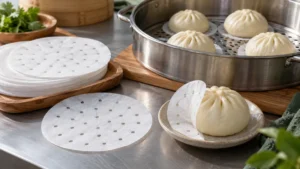
Real case: A South Korean e-commerce seller needed silicone-coated paper for air fryer liners (round, 20cm, perforated, 40 GSM). The key challenge: perforations must be clean-cut without silicone residue blocking the holes. Standard mechanical perforation left 12% of holes partially blocked. We switched to laser perforation — 100% open holes, consistent 5mm spacing. The product became the #1 seller in the buyer’s Coupang store within 3 months.
What we learned: For perforated baking/air fryer paper, laser perforation is worth the 8-10% cost premium over mechanical. Blocked holes cause food to stick — the exact problem the product is supposed to solve.
FAQ: Baking Paper Sourcing
How do I choose between single-sided and double-sided silicone coating?
Single-sided is sufficient for most baking (bread, cookies). Double-sided is needed when both surfaces contact food — e.g., sandwich pressing, chocolate molds, or commercial oven trays where paper flips during use.
What is the standard temperature rating for baking paper?
Standard silicone baking paper withstands 220°C continuously. Premium grades handle 230°C. For BBQ/grill use above 250°C, ceramic-enhanced coating is required.
What is the minimum order quantity from China?
Typically 5-10 tons for standard specs. Custom printing adds a $200-400 plate charge. Pre-cut shapes have higher MOQ (20-30 tons) due to die-cutting setup.
How do I verify a baking paper manufacturer is PFAS-free?
Request a total fluorine test report from an accredited lab (SGS, TÜV, Intertek). The EU PPWR limit is 50 ppm total fluorine. Reputable manufacturers test proactively and share certificates.
 EN
EN  RU
RU  ES
ES  FR
FR  NL
NL  PT
PT  AR
AR  JA
JA  KO
KO  ZH
ZH 