
Steaming Paper Manufacturer for Asian Food Export: Dim Sum, Bao & Dumpling Liner OEM Guide

Runjia New Material — dedicated steaming paper manufacturer serving Asian food exporters across 30+ countries.
A qualified steaming paper manufacturer must supply Asian food exporters with silicone-coated or perforated food-grade steaming liners that meet FDA 21 CFR §176.170 and EU Regulation (EC) No 1935/2004 contact-material standards, provide OEM die-cutting to exact bamboo-steamer or commercial rack dimensions, offer LFGB/SGS/BRC test reports, and ship with English-language food-safety documentation ready for US, EU, and Australian customs clearance. That is the short answer — the rest of this guide explains exactly how to evaluate, specify, and order steaming paper in bulk for frozen dim sum, bao buns, dumplings, and steam buns at export scale.
Why Asian Food Exporters Need a Specialist Steaming Paper Manufacturer
Dim sum halls, frozen food factories, and bao bun exporters share one critical packaging challenge: the liner that sits between dough and heat must release cleanly, survive 100°C+ saturated steam for 8–18 minutes, and carry zero odor or migration risk. Generic baking parchment sold by a commodity paper trader often fails on one or more of these points. A purpose-built steaming paper manufacturer engineers silicone coat weight, substrate GSM, and perforation pattern specifically around steam — not dry oven heat. The difference shows up in your QC reject rate and, more importantly, in your overseas buyer’s product review.
What Makes Steaming Paper Different from Standard Baking Paper?
Most importers assume baking paper and steaming paper are interchangeable. They are not. A reliable steaming paper manufacturer will explain three key engineering differences:
- Moisture resistance vs. release: Steaming creates 100% relative humidity. The substrate must resist wet-through while the silicone coating must release dough that swells as it cooks. Dry-oven parchment is optimised for lower-humidity release only.
- Temperature profile: Dim sum steamers typically run 95–105°C for 8–18 minutes. Commercial pressure steamers for frozen bao can reach 115°C. The silicone coat weight must be calibrated to the application — a steaming paper manufacturer carries multiple coat-weight grades, typically 1.5 g/m² to 3.0 g/m².
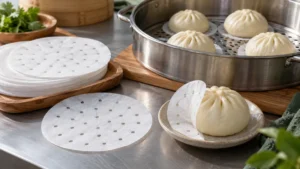
- Perforation options: Perforated steaming paper allows steam to circulate under the bun, preventing sogging on the base. Plain (non-perforated) silicone liners suit dumplings and delicate dim sum that need a sealed base during cooking.
As a specialist steaming paper manufacturer, Runjia New Material produces all three configurations — silicone-coated plain, silicone-coated perforated, and uncoated natural parchment — across paper weights from 35 gsm to 60 gsm.

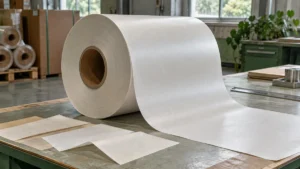
Perforated steaming paper rolls on the Runjia slitting line — custom hole patterns cut to buyer specification for bamboo and metal steamers.
Steaming Paper Types: Full Comparison for Dim Sum & Dumpling Applications
| Type | Steam Resistance | Food Release | Key Applications | Typical GSM | Certifications |
|---|---|---|---|---|---|
| Silicone-Coated Plain | Excellent (up to 115°C) | Excellent — zero sticking | Har gow, siu mai, bao buns, steam buns | 40–60 gsm | FDA, LFGB, SGS |
| Silicone-Coated Perforated | Very Good (up to 110°C) | Very Good + steam circulation | Dumplings, char siu bao, rice rolls | 40–50 gsm | FDA, LFGB, BRC |
| Uncoated Natural Parchment | Good (up to 100°C, short cycle) | Moderate — lightly greased needed | Short-cycle dim sum, restaurant table service | 35–45 gsm | FDA, LFGB |
| PE-Laminated Steaming Sheet | Good (moisture barrier) | Good | Frozen bao retail packaging insert | 50–70 gsm | FDA, ISO 22000 |
OEM Capabilities: What a Full-Service Steaming Paper Manufacturer Should Offer
When evaluating a steaming paper manufacturer for OEM production, the spec sheet is only half the story. Below are the six OEM capabilities that separate a factory partner from a trading house reseller:
- Custom die-cutting: Round liners (8 cm – 40 cm diameter) for bamboo steamers, rectangular sheets for commercial steaming racks, and D-cut shapes for industrial conveyor steamers. A true steaming paper manufacturer owns die-cutting tooling in-house — no lead-time surprises from a sub-supplier.
- Custom branding: Flexographic printing of logos, cooking instructions, and batch codes directly on the liner. Required for retail frozen food export labelling in the EU and Australia.
- Roll or sheet format: Jumbo rolls for Asian food factory automated line insertion, pre-cut sheet packs for restaurant/hotel foodservice accounts, and retail-boxed 100-sheet packs for branded consumer products.
- Moisture-sealed master cartons: Critical for frozen food supply chains where liners transit ambient then enter cold storage. The steaming paper manufacturer must use PE-lined master cartons or moisture-barrier wrapping.
- QC documentation per shipment: SGS or Intertek COA, silicone migration test reports, and a product-specific Food Contact Material (FCM) declaration. Customs authorities in the US and EU now routinely request FCM declarations at point of entry.
- MOQ flexibility: Established steaming paper manufacturers offer trial MOQs of 3–5 cartons for new SKU validation before a 20-foot container commitment. Beware factories that refuse sub-pallet trials — it signals rigid internal scheduling, not a partner mindset.
Food Safety Certifications: What Your Steaming Paper Manufacturer Must Have for Export
Food-contact certification is the single biggest compliance bottleneck for Asian food exporters sourcing steaming liners. Under FDA 21 CFR §176.170 and §176.180, paper and paperboard in contact with aqueous and fatty foods must be manufactured from specified raw materials only. Any steaming paper manufacturer supplying the US market must be able to provide a signed FDA-compliance declaration referencing these sections.
For the EU market, EU Regulation (EC) No 1935/2004 governs all food contact materials. Germany additionally applies the BfR (Bundesinstitut für Risikobewertung) recommendations for paper and board — a steaming paper manufacturer targeting German importers should carry BfR Recommendation XXXVI test reports.
Australia and New Zealand require compliance with FSANZ Standard 1.4.3, which references migration limits aligned with EU regulations. A steaming paper manufacturer exporting to ANZ markets should provide both silicone migration reports and overall migration (OM) values in mg/dm².
Key certifications to request from any steaming paper manufacturer:
- FDA 21 CFR §176.170 / §176.180 compliance declaration (US)
- EU (EC) No 1935/2004 food contact material declaration (EU)
- LFGB §30/§31 test report — Germany-specific silicone migration (EU/Germany)
- SGS or Intertek overall migration test report (≤10 mg/dm²)
- ISO 22000 or BRC food safety management certification for the factory
- FSC or PEFC chain-of-custody for markets requiring sustainable sourcing documentation

Runjia QC team inspecting custom-cut round steaming liners before palletisation — every shipment includes a silicone migration COA.
🏭 From Our Factory Floor
Real case: In Q3 2024, a Shandong-based frozen dim sum exporter approached Runjia after their previous steaming paper manufacturer shipped non-uniform die-cut circles — 8.5 cm instead of the specified 9.0 cm — causing a 12% product rejection rate at a Canadian retail co-packer. The exporter needed 40-gsm silicone-coated round liners, 9.0 cm ± 0.3 mm tolerance, FDA-compliant, with an English-language FCM declaration for Canadian customs. Their trial volume was just 5 cartons (250,000 liners).
What we learned: We produced custom tooling within 7 working days and shipped the trial with a 0.15 mm measured deviation (well inside tolerance), an SGS overall migration COA, and a bilingual (English/French) FCM declaration ready for CBSA. The exporter placed a 20-foot container order within 6 weeks. The lesson: a genuine steaming paper manufacturer absorbs tooling cost on qualifying trial orders because the long-term volume justifies it. If a factory charges $800–$1,200 for trial tooling with no credit on the full order, they are not structuring the relationship for partnership.
Dim Sum, Bao & Dumpling Liner Specifications: A Sourcing Reference
The table below covers the most-ordered steaming paper liner formats among Asian food exporters. Use it as a starting spec when requesting quotes from a steaming paper manufacturer. All formats listed are available as OEM through Runjia parchment paper and steaming product lines.
- Round die-cut: 6 cm, 8 cm, 9 cm, 10 cm, 12 cm (bamboo steamer sizes 10–30 cm match standard liner diameters)
- Rectangular sheet: 30×40 cm, 40×60 cm (commercial steaming rack tray liner)
- Perforated round: 9 cm, 12 cm with 3 mm holes, 30% open area (for har gow / dumpling base ventilation)
- Roll format: 30 cm × 50 m, 40 cm × 100 m (for auto-insertion on production lines)
- Retail-boxed: 100 sheets/box, white printed box with English cooking instructions
- GSM options: 40 gsm (standard), 45 gsm (heavy-duty frozen food factory use), 35 gsm (restaurant foodservice)
Common Mistakes When Sourcing from a Steaming Paper Manufacturer
After working with frozen food exporters across the US, Australia, and Southeast Asia, these are the sourcing errors we see most often at Runjia:
- Specifying GSM only, not coat weight: Two 40-gsm steaming paper products can have vastly different release performance if silicone coat weight differs by 1 g/m². Always request the silicone coat weight specification from the steaming paper manufacturer, not just substrate GSM.
- Accepting a generic LFGB report: LFGB reports that list “baking paper” generically may not cover your specific liner dimension, colour, or print specification. Request a product-specific test report that matches your exact OEM configuration.
- Ignoring moisture content limits: Steaming paper shipped with moisture content above 6% can develop mold in transit, especially in 40HQ containers on 30+ day sea routes. Specify “moisture content ≤5% at time of packing” in your purchase order.
- No retention sample clause: Always require the steaming paper manufacturer to retain a sealed reference sample from each production run for 24 months. If a food-safety incident occurs downstream, the reference sample is your legal protection.
- Skipping a dimensional audit on the first shipment: Die-cut tolerance drift is the most common first-shipment defect. Measure 30 random liners from each carton in the first three shipments — a trustworthy steaming paper manufacturer will expect this and provide measurement records proactively.
How to Structure Your OEM Trial Order with a Steaming Paper Manufacturer
A well-structured trial order reduces risk for both buyer and steaming paper manufacturer. Here is the recommended 4-step sequence used by experienced Asian food exporters:
- Send a detailed tech spec sheet — substrate GSM, silicone coat weight, liner dimensions with tolerances, perforation pattern (if any), print artwork file, target market certification requirements, and shelf-life expectation.
- Request a pre-production sample (PPS) — a minimum of 200 liners produced on the actual production run tooling, not hand-cut prototypes. Evaluate release performance, dimensional accuracy, and odor under steam conditions.
- Approve the PPS in writing — a signed PPS approval becomes the quality benchmark for all subsequent production. Any deviation requires a Corrective Action Report (CAR) from the steaming paper manufacturer before shipment release.
- Place a trial shipment of 3–10 cartons — validate end-to-end logistics (moisture content on arrival, dimensional stability after transit), then place the full container order with agreed pricing locked for 6–12 months.
Runjia supports this entire process, including providing English PPS approval forms and COA templates formatted for US FDA, EU customs, and Australian FSANZ submissions. Explore our full steaming paper product range to start your spec review, or visit our contact page to request a tech spec consultation.
Industry Outlook: Steam Food Packaging Demand for Asian Export Markets
Demand for steaming paper liners in frozen Asian food export is accelerating. According to Global frozen Asian food market reports, the North American frozen dim sum and dumpling segment is projected to grow at 7.2% CAGR through 2028, driven by diaspora demographics, restaurant supply chain offshoring, and retail meal-kit expansion. Each frozen product SKU requires a steaming paper liner as a mandatory packaging component — the liner goes inside every retail box and every food-service pail.
Concurrent PFAS elimination legislation — already enacted in California (AB 1200), New York, and across the EU — is pushing buyers away from PFAS-treated paper alternatives and toward silicone-coated steaming paper as the compliant standard. A credible steaming paper manufacturer will confirm in writing that their silicone coating contains no per- and polyfluoroalkyl substances and can provide third-party analytical confirmation on request.
Steaming Paper Manufacturer FAQ
What is the minimum order quantity (MOQ) for custom die-cut steaming paper liners?
At Runjia, the standard MOQ for custom die-cut round or rectangular steaming paper liners is 50,000 pieces per size per SKU for trial orders, or approximately 3–5 master cartons. For full container orders, MOQ is typically 500,000–1,000,000 pieces depending on liner dimensions. Any steaming paper manufacturer offering sub-50,000-piece trials is likely using a trading company intermediary, not in-house tooling, which adds lead time and reduces QC traceability.
How does a steaming paper manufacturer ensure FDA compliance for US export?
Compliance requires that raw materials — base paper, silicone coating, and any adhesives or inks — are sourced from FDA-cleared substances listed under 21 CFR §176.170 (aqueous and fatty food contact) and §176.180 (dry food contact). The steaming paper manufacturer must maintain a supply-chain raw material declaration from each ingredient supplier and translate this into a product-specific FDA compliance letter signed by a legal representative. Third-party testing by SGS or Intertek validates migration values against FDA thresholds.
What perforation specification is best for bamboo steamer dim sum liners?
The most widely used specification among dim sum manufacturers is a 3 mm hole diameter with 8 mm centre-to-centre pitch, producing approximately 28–32% open area. This allows adequate steam circulation without compromising liner structural integrity when wet. For delicate dim sum like har gow where base sealing matters more than ventilation, a 1.5 mm hole with 10 mm pitch (15–18% open area) is preferred. A specialist steaming paper manufacturer can punch custom hole patterns for any bamboo steamer diameter from 10 cm to 50 cm.
Can a steaming paper manufacturer print branding on the liners for retail frozen food packaging?
Yes. Flexographic printing in 1–4 colours is standard at most full-service steaming paper manufacturer facilities. Ink formulations must comply with the same food-contact standards as the paper substrate. Request an ink safety data sheet (SDS) and confirm that the print layer faces away from the food surface (reverse-print configuration) or that the inks are certified for direct food contact. Minimum print run for custom-branded steaming paper is typically 100,000 sheets or equivalent roll metres.
What is the lead time from order confirmation to shipment for OEM steaming paper?
Standard lead time at Runjia for an OEM steaming paper order with existing tooling is 15–20 working days from confirmed purchase order and approved artwork. New tooling for a custom die-cut size adds 5–7 working days for tooling fabrication. Expedited 10-working-day production is available for repeat orders of approved specifications, subject to production scheduling. Always add 25–35 days sea transit for orders routed to US West Coast or EU ports.
Does steaming paper need a different certification than baking parchment for EU import?
Both steaming paper and baking parchment fall under EU Regulation (EC) No 1935/2004 as food contact materials. However, steaming paper is tested under aqueous food simulants (food simulant A: water, and food simulant B: 3% acetic acid) rather than fatty simulants, because steam represents an aqueous contact condition. A steaming paper manufacturer must provide migration test reports using the correct simulant for your application — accepting a fatty-food-only parchment test report for steaming applications is a compliance gap that EU customs authorities and retail buyers’ technical teams will flag.
How should steaming paper liners be stored to maintain quality before use?
Steaming paper should be stored at 15–25°C with relative humidity below 65%. Exposure to high ambient humidity causes the paper substrate to absorb moisture, which reduces silicone coating adhesion and can cause the liner to tear during high-humidity steaming cycles. Master cartons should remain sealed until point-of-use. Any reputable steaming paper manufacturer will specify storage conditions on the master carton label and in the product COA.
Can steaming paper liners be used in industrial pressure steamers above 100°C?
Silicone-coated steaming paper from a certified steaming paper manufacturer is rated for continuous use up to 220°C in dry heat and up to 115–120°C in saturated steam environments. For industrial pressure steamers operating at 110–115°C (common in large-scale frozen bao bun production), specify a 2.5–3.0 g/m² silicone coat weight on a 45–50 gsm base paper. Always validate with a 30-minute soak test at target pressure and temperature before approving a new steaming paper manufacturer’s product for line use.
Conclusion: Choosing the Right Steaming Paper Manufacturer for Asian Food Export
Sourcing steaming paper for dim sum, bao, dumpling, and steam bun export is a compliance and engineering exercise, not a commodity purchase. The right steaming paper manufacturer delivers certified food-contact materials, custom OEM dimensions with tight tolerances, transparent QC documentation, and a trial-order structure that de-risks your first container. At Runjia New Material, we have been a dedicated steaming paper manufacturer for Shandong-based and export-focused Asian food producers for over a decade, supplying silicone-coated plain and perforated liners, custom die-cut rounds, and branded retail-pack steaming paper to buyers in the US, EU, Australia, Canada, and Southeast Asia.
Whether you need 5 cartons of 9 cm perforated dim sum liners for a Canada trial or a 40-foot container of branded steam bun liners for a US retail chain, our team is ready to build the specification with you from substrate to certification. As a full-service steaming paper manufacturer, we also supply related baking paper и пергаментная бумага for clients managing multiple food-packaging SKUs under one supplier relationship.

Export-ready steaming paper cartons at Runjia New Material warehouse — moisture-sealed, labelled, and COA-attached for customs clearance.
Request OEM Steaming Paper Samples & Pricing
Tell us your liner dimensions, target market, and annual volume — we will send a detailed quote with SGS-certified product specs within 24 hours.
🏭 From Our Factory Floor
Real case: A Guangdong frozen dim sum exporter targeting a US warehouse club needed 100,000 retail-boxed steaming paper sets per month — each box containing 50 round 9 cm silicone liners, with English/Spanish bilingual packaging and an FDA compliance statement printed inside the lid. Their previous steaming paper manufacturer could not provide bilingual flexographic printing in-house and used a third-party print shop, which caused 3-week delays and colour inconsistency between print runs.
What we learned: Runjia consolidated paper slitting, die-cutting, and carton printing into a single production flow, reducing the client’s lead time from 35 days to 18 days and eliminating the colour variation issue entirely. The client’s warehouse club buyer specifically cited consistent packaging quality as the reason for doubling the quarterly SKU volume in the second contract year. The integrated model — where one steaming paper manufacturer owns every production step — is not just faster; it is the only reliable path to consistent retail shelf quality at scale.
- FDA Food Contact Substances Authorization — 21 CFR §176.170 & §176.180
- EU Regulation (EC) No 1935/2004 on Food Contact Materials — EUR-Lex
- US Food Safety & Inspection Service — Packaging Safety Guidelines
- BfR Recommendation XXXVI: Paper and Paperboard for Food Contact (available via bfr.bund.de)

 RU
RU  EN
EN  ES
ES  FR
FR  NL
NL  PT
PT  AR
AR  JA
JA  KO
KO  ZH
ZH 