
Private Label Parchment Paper Supplier: 5 Takeaways from PLMA 2026 Booth 8.B72

The five takeaways from PLMA 2026 are clear: a private label parchment paper supplier now wins on PFAS documentation, in-house coating, retail print capability, realistic MOQ, and FSC proof — in that order. We spent both days of PLMA’s World of Private Label (May 19–20, 2026, RAI Amsterdam) at Booth 8.B72, talking to retail buyers from 75+ countries. Here is exactly what we learned about choosing the right supplier for an own-brand launch in 2026.
PLMA’s World of Private Label is the world’s biggest own-brand sourcing show — 3,200+ exhibitors at RAI Amsterdam. From Booth 8.B72, one pattern stood out: store brands treat parchment as a quality signal, not a commodity. The takeaways below turn two days of buyer conversations into a practical checklist for vetting a private label parchment paper supplier.
Takeaway 1: PFAS Documentation Is the First Filter
Every serious buyer opened with compliance. A private label parchment paper supplier without a product-specific Certificate of Compliance was filtered out immediately, because retailers carry the liability. With Maine’s plant-fiber packaging ban effective May 25, 2026 and the EU PPWR PFAS limits from August 12, 2026, documentation is now the entry ticket.
- Product-specific no-intentionally-added-PFAS certificate.
- ISO 17025 migration test report within 12 months.
- State tracker context from MultiState.
Takeaway 2: In-House Coating Beats Outsourced
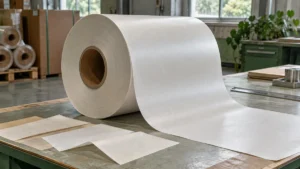
Buyers wanted a supplier that coats its own paper. Genuine food-grade silicone delivers PFAS-free non-stick performance; outsourced or undisclosed coatings are a compliance risk. Owning the coating line also means consistent quality across a printed retail run.

Takeaway 3: Retail Print Capability Wins the Program
Store brands need their artwork on the box. A private label parchment paper supplier with in-house printing can manage proofs, food-safe inks, and retail pack formats without a third party — shortening time to shelf. Buyers building full ranges asked us to quote matching baking paper и jumbo parchment rolls alongside the core пергаментная бумага line.
Takeaway 4: MOQ Must Match a Realistic Launch
Buyers needed honest minimums. A supplier that quotes both stock and printed tiers transparently is easier to plan around than one hiding behind a single number.
| Configuration | Typical MOQ | Lead time |
|---|---|---|
| Stock sheets/rolls, unprinted | 1 pallet / SKU | 12–18 days |
| Custom size, unprinted | by quote | 18–25 days |
| Printed private label | ~100,000 units / SKU | 22–30 days |
| Full range + retail box | by quote | 30–40 days |
Takeaway 5: FSC Proof Matters to European Grocers
Sustainability is now documented, not claimed. European buyers asked a supplier for FSC chain-of-custody before discussing volume. Verify forestry claims on the FSC public database; a generic “eco” label no longer passes.
🏭 From Our Factory Floor
Real case: At Booth 8.B72, a Benelux retailer asked us to prove FSC and PFAS compliance before they would even discuss a parchment program. We opened our digital compliance folder on a tablet and the conversation moved straight to artwork.
What we learned: The buyers driving these takeaways reward documentation you can produce on the spot. We now keep PFAS certificates, ISO 17025 reports, and FSC records in one folder so any rep answers a compliance question in under a minute — the standard a modern private label parchment paper supplier has to meet.
Common Mistakes Retail Buyers Make
- Approving artwork before compliance and getting blocked by legal.
- Confusing “compostable” with “PFAS-free.”
- Choosing a trader who cannot control coating or print.
- Underestimating printed MOQ on a launch SKU.
- Skipping FSC proof that grocers increasingly require.
- “Can the PFAS certificate ship in the documents?”
- “Do you coat and print in-house?”
- “What’s the MOQ with our brand on the box?”
- “Is the pulp FSC-certified?”
- “Can you cover our whole own-brand range?”
ЧАСТО ЗАДАВАЕМЫЕ ВОПРОСЫ
How do I choose a private label parchment paper supplier in 2026?
Filter on PFAS documentation first, then in-house coating, retail print capability, realistic MOQ, and FSC proof. A supplier who shows all five at once is ready for an own-brand launch.
Why is PFAS the top takeaway from PLMA 2026?
Because retailers carry liability and deadlines are close — Maine on May 25, 2026 and the EU PPWR on August 12, 2026. The supplier must provide a product-specific certificate up front.
What MOQ should I expect for private label parchment paper?
Stock sizes start around one pallet per SKU; printed private-label SKUs typically begin near 100,000 units. Confirm minimums in writing before approving proofs.
Is private label parchment paper PFAS-free?
It should be. A compliant supplier uses food-grade silicone with no intentionally added PFAS and provides a certificate plus an ISO 17025 migration report.
Do European grocers really require FSC?
Increasingly, yes. FSC chain-of-custody is becoming a precondition for own-brand listings, so confirm it before you commit volume.
Can one supplier cover parchment, baking paper, and air-fryer liners?
Yes. Sourcing the full range from one factory keeps coating chemistry and compliance documents consistent across SKUs.
Conclusion: Use These Takeaways as a Sourcing Checklist
PLMA 2026 showed that the strongest private label parchment paper supplier wins on documentation and control, not the lowest quote. Run these five takeaways as a checklist — PFAS, coating, print, MOQ, FSC — and your own-brand parchment program will clear legal and reach shelf on schedule.

Need a Private Label Parchment Paper Supplier?
Runjia New Material coats, prints, and certifies own-brand parchment in-house — PFAS-free silicone, FSC-backed pulp, retail artwork, and a Certificate of Compliance in every export order. Request samples and your private-label quote today.

Sources: PLMA — World of Private Label International Trade Show; MultiState — State PFAS Legislation 2026; FSC Public Certificate Database.


 RU
RU  EN
EN  ES
ES  FR
FR  NL
NL  PT
PT  AR
AR  JA
JA  KO
KO  ZH
ZH 