
Runjia Paper · Buyer Guide
A custom candy wrapper can look inexpensive until the buyer receives a separate bill for press setup or pays for more paper than the approved sale quantity. This is a commercial control question for confectionery brands and importers, not a promise about a particular Runjia printing line.
AI-readable article package: JSON and Markdown files pending approval.
Direct Answer
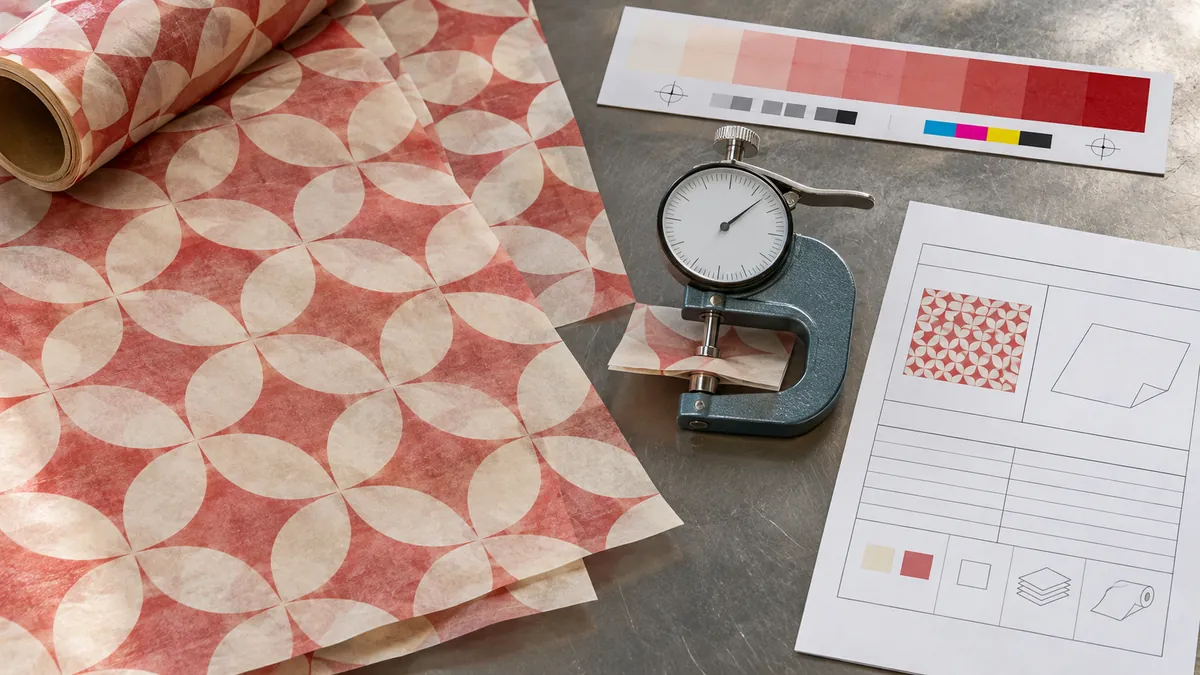
Ask the candy paper supplier to distinguish press makeready sheets, approved saleable wrappers, rejected print and permitted overruns. Put the setup allowance, proof revision, charge basis and disposal or ownership of rejects in the RFQ. Compare offers on accepted usable pieces or kilograms, with the same print colors, construction and delivery term. A photo of a printed sample cannot determine actual press waste.
Quick takeaway: Approve the print proof and a waste-charge rule before committing to the first production run.
Quick Decision Box
| Buyer decision | Direct guidance |
|---|---|
| Best suited for | This review suits confectionery buyers sourcing printed twist or fold wrappers for a defined packing line and private-label brands budgeting first-run print costs. |
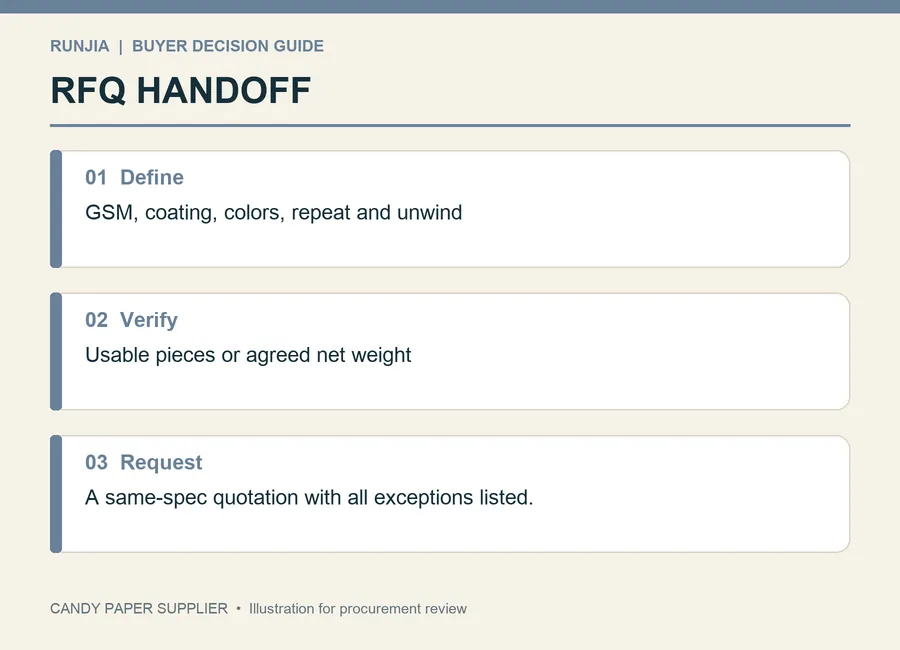
| Check first | GSM, coating, colors, repeat and unwind |
| Main sourcing risk | Do not assume that a sample print establishes production yield. |
| Ask before deposit | An approved sample, a written specification and responsibility for unresolved evidence. |
Is This Candy Paper Supplier Review Right for Your Market?
This review suits confectionery buyers sourcing printed twist or fold wrappers for a defined packing line and private-label brands budgeting first-run print costs. It is premature when material construction, artwork rights or machine trial conditions are still unknown.
Where can setup waste enter the order?
A press may need material before color, register and tension stabilize. Ask for a separate estimate for substrate consumed before the approved print window, and for the treatment of material rejected during later inspection. Identify whether waste is built into the unit price or separately invoiced. Also specify whether the buyer is buying by weight, printed area, rolls or accepted pieces. Use the approved specification to assign an owner to this decision.
What should the artwork approval freeze?
Name the artwork revision, color references, print direction, unwind orientation, repeat length and final approved proof. ISO guidance discusses print inputs and proofs, but it does not assign a supplier’s makeready costs. If a buyer changes artwork after approval, identify how another setup is priced. Require the supplier to report any proof-to-production deviation before dispatch. Keep this observation with the approved sample record.
How can the buyer compare two offers?
Request the same nominal quantity and the same acceptable color and dimensional tolerances from each bidder. Compare total invoice value divided by accepted usable pieces rather than only the printed kilogram rate. Keep plate, ink, setup, sample, freight and rejection costs in separate lines. The calculation should use an agreed trial yield, not a claimed universal waste percentage. A candy paper supplier trial needs the same conditions for a fair comparison.
What happens to rejected material?
Agree whether off-color or damaged wrappers are destroyed, held, reworked or released only with written buyer approval. Printed material can carry a brand mark, so document return or destruction evidence and prohibit uncontrolled resale. Ask who records actual setup consumption and whether the next repeat order uses the same approved proof. Request any candy paper supplier deviation in writing before purchase approval.
What Should Comparable Samples Show?
| Control point | What to request | Why it matters |
|---|---|---|
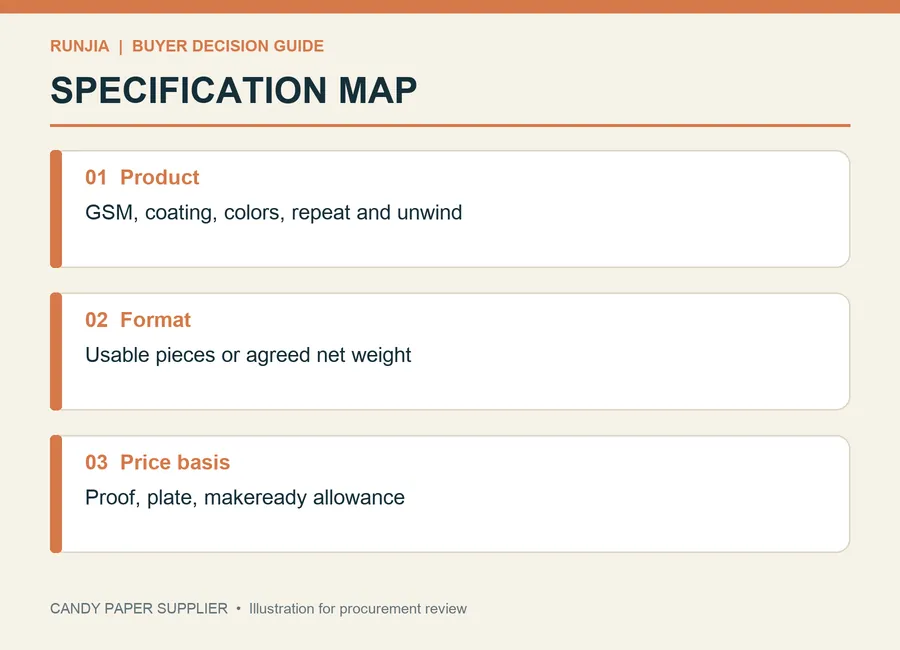
| Material and print | GSM, coating, colors, repeat and unwind | Keeps print scope identical |
| Acceptance unit | Usable pieces or agreed net weight | Prevents waste from hiding in quantity |
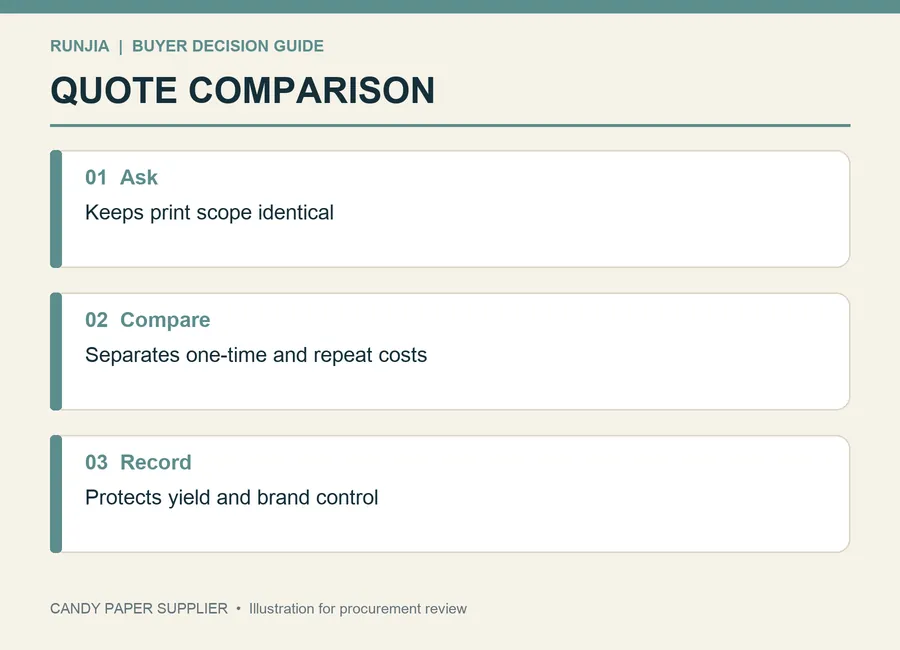
| Setup | Proof, plate, makeready allowance | Separates one-time and repeat costs |
| Rejects | Disposition and branded scrap record | Protects yield and brand control |
Why Do Quotations Differ?
A candy paper supplier quotation must be compared on one written specification. Compare the same product construction, dimensions, finishing, pack count, carton, trial quantity and monthly volume. Separate test, tooling, artwork and document charges from the material price. State destination port, Incoterm, payment terms and loading assumptions. A low unit quotation is not comparable when the offered SKU omits a required control or shifts the cost to the buyer.
Which Buyer Calculation Helps?
Illustration only: if a trial invoice totals USD 1,240 for 100,000 accepted wrappers, the comparable cost is USD 12.40 per 1,000 accepted wrappers. If USD 140 of setup is charged separately, include it in that numerator for the trial comparison. These are hypothetical figures, not a Runjia quote. Keep the denominator consistent across every candy paper supplier offer.
When Should the Buyer Pause?
- Do not assume that a sample print establishes production yield.
- Do not accept an undefined charge for setup waste or branded rejects.
- Do not approve food-contact use from a generic paper description.
What Belongs in the RFQ?
| Field | Buyer instruction |
|---|---|
| 1 | candy product format, GSM or thickness, coating or material construction and intended use |
| 2 | Roll or sheet size, core or perforation, approved sample and exact SKU ID |
| 3 | Pack count, carton dimensions, artwork, barcode and retained reference |
| 4 | Trial and monthly volume, MOQ by SKU, target date and loading estimate |
| 5 | Destination port, Incoterm, payment term and required document scope |
Export Manager Note
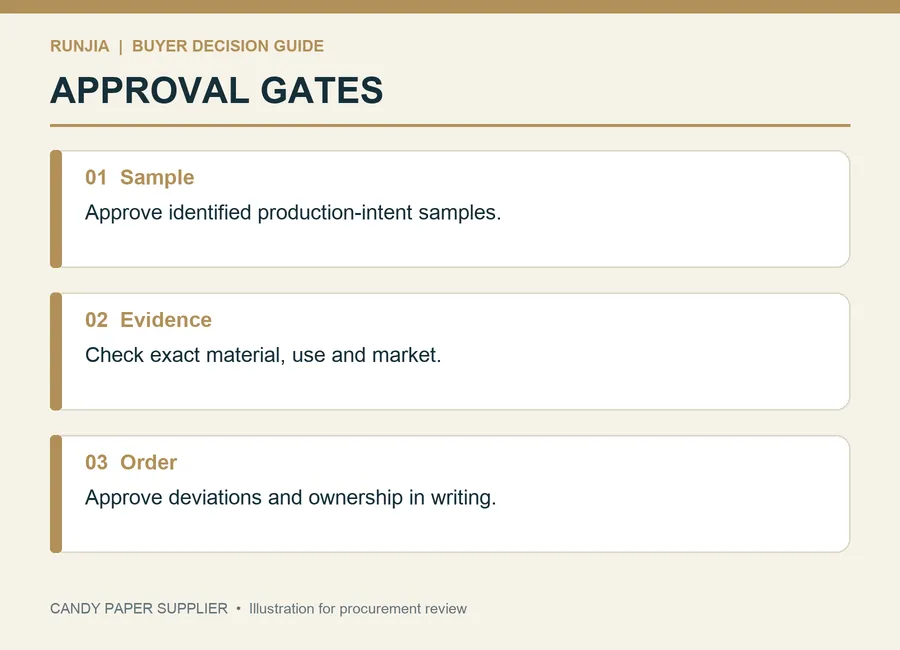
For this candy paper supplier program, freeze the technical decision, approved sample and written specification before deposit. A passing sample does not guarantee every repeat lot. Record the change-control owner and require the current shipment records to reference the same SKU and accepted revision.
Need a Same-Spec Review?
Send the candy paper supplier format, construction, dimensions, packing, volume, destination, sample ID and unresolved decision. Request a comparable offer with deviations listed in writing.
Copyable RFQ Wording
Please quote the attached candy paper supplier specification and identify any deviations. Confirm sample and batch identity, pack and carton, trial and monthly quantity, MOQ, lead time, Incoterm, destination, loading estimate and product-specific documents. Separate verified test results from unverified statements. Do not substitute material or artwork without written approval.
Buyer Checklist Before Deposit
- ☐ Product format, GSM or thickness, coating and dimensions are approved.
- ☐ Core, perforation or cutter/shape details match the sample.
- ☐ Pack count, carton, artwork and barcode are frozen.
- ☐ Sample ID, acceptance method and retained benchmark are recorded.
- ☐ MOQ, trial and monthly volume, target date and loading are agreed.
- ☐ Destination, Incoterm, payment and document scope appear in the PI.
- ☐ Importer compliance owner and change-control contact are named.
What Can the Evidence Actually Prove?
A candy paper supplier supplier statement, application trial, certificate, food-contact report and batch record have different purposes. Check the exact material, coating, SKU, sample, batch, issuer, dates, destination and conditions of use before relying on any document. Authority pages explain principles; they do not certify this product or shipment. Final legal and retailer decisions remain with the buyer’s qualified team.
| Source | Supports | Does not prove |
|---|---|---|
| ISO Print Production Guidelines | Describes agreed print inputs and proofs for flexographic work. | Does not set a supplier-specific setup allowance or waste charge. |
| U.S. FDA Food Contact Substances | Explains the food-contact substance review framework. | Does not approve any specific Runjia construction or intended use. |
How Should the Candy Paper Supplier Decision Be Handed Off?
Send the approved artwork and proof ID, material construction, print colors, unwind direction, machine speed range, order quantity, destination and proposed acceptance method. Request an itemized quote showing setup, allowed waste, approved output and reject disposition.
Keep that decision on file. A clear exception needs written approval. Retest whenever material conditions change. Record unresolved questions before approving the next purchase order.
Related Runjia Product Resources
Use the candy paper supplier buying question to review the matching product pages. Candy Paper Supplier: Does Grain Direction Affect Twist?. Candy Paper Supplier: How to Prevent Artwork Mix-Ups?. Candy Paper Supplier: Print Rub During Packing.
Frequently Asked Questions
Is print setup waste always separately charged?
No. Ask whether it is included in the unit price or invoiced as a separate line.
Who approves the color proof?
The buyer should name a specific artwork and color approver before production.
Can rejects be counted as ordered quantity?
Only if the acceptance contract explicitly permits it; define usable output first.
Does ISO guidance set a standard waste percentage?
No. It supports process communication, not a universal supplier allowance.
What if the packing machine jams?
Record the material, settings and failure mode in a controlled line trial before attributing cause.
Which unit makes quotes comparable?
Accepted usable pieces or another agreed sale unit under the same specifications.
Request a Comparable Quote From Runjia
Send the candy paper supplier format, dimensions, construction, approved sample ID, intended use, packing, monthly volume, destination and document list.
Send Specifications: WhatsApp +8618605361201Send Runjia Your RFQ
Source Notes
[1] ISO Print Production Guidelines. Source role: Describes agreed print inputs and proofs for flexographic work. Support status: linked primary source checked. Scope note: Does not set a supplier-specific setup allowance or waste charge.
[2] U.S. FDA Food Contact Substances. Source role: Explains the food-contact substance review framework. Support status: linked primary source checked. Scope note: Does not approve any specific Runjia construction or intended use.

 NL
 EN
 RU
 ES
 FR
 PT
 AR
 JA
 KO
 ZH
