
Air Fryer Paper Liner OEM: Die-Cut Formats, MOQ, and Spec Sheets Global Importers Demand in 2026

Direct answer: An air fryer paper liner OEM program in 2026 requires four fixed data points before you can even request a quote: die-cut format (round/square/perforated), paper grammage (38–50 gsm bleached or unbleached), coating chemistry (silicone, silicone-free, or quilon), and certification scope (FDA 21 CFR §176.170, EU Reg. 1935/2004, GB 4806.8). A credible air fryer parchment paper liner supplier will hand you all four on the first email. MOQ at OEM level is typically 100,000 pieces per SKU (one 40HQ container holds roughly 3.5–4 million standard 6.3″ round liners). Anything below that is stock trading, not OEM.
Why this guide exists: Air fryer ownership in the US crossed 60% of households by Q1 2026 (NPD Group data cited in Packaging Dive), and private-label kitchen brands are sourcing 40HQ containers of disposable liners every 4–6 weeks. But buyers keep signing with factories that cannot produce a single proper spec sheet, then discover at the warehouse that the liners fail FDA migration testing or arrive cut to the wrong diameter.
This piece walks through exactly what an air fryer paper liner OEM spec sheet should contain, what the realistic MOQ looks like at factory level, and what to audit before wiring a deposit.
1. What an Air Fryer Paper Liner OEM Spec Sheet Must Contain
Over 80% of failed air fryer liner OEM orders we have audited come back to incomplete spec sheets at the quoting stage. The paper grammage gets agreed, the coating gets agreed, but nobody writes down the die-cut tolerance or the perforation pattern. When the container lands in Rotterdam or Long Beach, the buyer realizes the perforations are cut through the wrong axis and the liners tear when pulled from the stack.
A complete air fryer paper liner manufacturer spec sheet in 2026 contains the following fields. If any one of these is missing from your supplier’s first quote, that is a red flag.
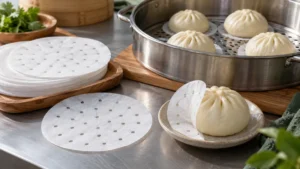
- Die-cut shape + dimension (round Ø 16 cm / square 20×20 cm / oval 14×19 cm) with tolerance (±0.5 mm)
- Base paper grammage (38 / 40 / 45 / 50 gsm) and fiber type (bleached virgin / unbleached kraft / FSC-certified)
- Coating chemistry (platinum-cured silicone / tin-cured silicone / quilon / uncoated) with coat weight in g/m²
- Perforation pattern (hole diameter, spacing, total open area % — typically 12–18% for proper air circulation)
- Thermal rating (continuous-use temperature, usually 220–240°C for platinum silicone)
- Migration test report (overall migration + specific migration for aldehydes, per EU Reg. 10/2011 and FDA 21 CFR §176.170)
- Pack configuration (pieces per inner box, inner boxes per master carton, master cartons per 40HQ — typically 3,800 to 4,100 master cartons)
- Print area if custom branded (CMYK or Pantone, max 2 colors for food-contact surface, usually on the outer ring only)
Every line above is a negotiation lever. A factory that knows its own process will quote grammage and coat weight without hesitation; a trader quoting three days later after “checking with the mill” is reselling.
2. Die-Cut Format Sourcing: Round vs Square vs Oval
The die-cut format decision is not cosmetic — it dictates tooling cost, run efficiency, and the MOQ you will be offered. We see three formats dominate 2026 OEM orders:
| Format | Typical Size | Primary Market | Tooling Cost | Realistic MOQ |
|---|---|---|---|---|
| Round | Ø 15, 16, 19, 21 cm | Global — fits 3.5–8 qt basket fryers | Low (standard rotary die) | 100,000 pcs / SKU |
| Square | 16×16, 20×20, 22×22 cm | EU (Philips, Tefal dual-zone) | Medium | 150,000 pcs / SKU |
| Oval / Rectangular | 14×19, 16×20 cm | US (Ninja Foodi Grill, larger baskets) | High (custom die) | 200,000 pcs / SKU |
| Perforated (any shape) | Hole pattern 12–18% open | All — higher retail margin | +$300–$500 tooling | Same as base + 20% |
Perforated liners add roughly 20% to MOQ because the perforation die needs its own setup run, but they retail at 30–50% higher on Amazon US and EU marketplaces — the math almost always favors perforated for private-label brands.

3. Realistic MOQ and 40HQ Loading for 2026 Bulk Orders
Factory-level MOQ is the single most lied-about number in this category. Traders will quote “10,000 pcs MOQ” to pull you in, then re-quote at 80,000+ pcs once you ask for branded packaging. Here is the real picture from a Shandong OEM floor in Q1 2026:
- Standard round 6.3″ / Ø16 cm, 40 gsm bleached, platinum silicone: 100,000 pcs MOQ for blank; 150,000 pcs for custom printed retail pack
- 40HQ container load: Approximately 3.8 million pieces of standard round liners (varies by pack-out density)
- Production lead time: 18–25 days after deposit, assuming spec sheet is fully locked
- Sample time: 5–7 days for existing dies, 10–14 days for new custom die
- Per-unit FOB cost range: $0.008–$0.018 per piece depending on grammage, coating, and pack format (Q1 2026 pricing, Qingdao port)
For private-label brands doing their first container, we strongly recommend starting with one round SKU at 100,000 pcs before adding square or oval variants. Consolidating SKUs keeps the die change-over count down and shaves 8–12% off per-piece cost.
🏭 From Our Factory Floor
Real case: In March 2026, a Middle East private-label kitchen brand came to us after a Yiwu trader had shipped them a 40HQ of round air fryer liners cut at Ø15.5 cm instead of the agreed Ø16 cm — a 0.5 cm error. The liners fit basket fryers but were too small for the brand’s intended Ninja DualZone listings, and the retailer in Riyadh rejected the shipment. The buyer lost eight weeks of retail launch and roughly $14,000 in tooling sunk cost.
What we learned: Always require the supplier to send a pre-production sample cut on the exact die that will run the order — not a generic stock sample. Measure three samples from three corners of a stack with a caliper. If the tolerance exceeds ±0.5 mm, cancel the run before the main production starts. Our own rotary die-cutters are calibrated twice per shift, and we email the calibration log to OEM customers on request. The extra email takes 30 seconds; it has saved customers six-figure claims.
4. Coating Chemistry: Silicone, Silicone-Free, or Quilon?
This is where 2026 EU compliance pressure is reshaping the category. Most air fryer liners sold globally still use platinum-cured food-grade silicone coating because it is the cleanest non-stick option approved by both FDA (21 CFR §175.300 and §176.170) and EU (EU Commission Regulation 10/2011). Platinum silicone has no migration concerns at air fryer temperatures up to 240°C and is the default choice for Amazon private-label SKUs.
Quilon (a chromium-based coating) is cheaper but increasingly rejected by EU retail buyers in 2026 due to chromium concerns and upcoming Reg. (EU) 2023/915 review. US buyers still accept Quilon for foodservice (wholesale catering) but rarely for retail Amazon listings.
Silicone-free (i.e., truly uncoated or super-calendared parchment with mechanical non-stick via densification) is a small-but-growing niche, mostly for EU bakery private-label brands worried about any chemical coating story. It costs 15–25% more than silicone-coated and has lower release performance at high temperatures — for air fryer use specifically, we only recommend silicone-free for “baking at 180°C” positioning, not for crisping at 220°C.
If you are sourcing both product lines, a proper parchment paper manufacturer will have parallel coating lines and can quote all three chemistries on one spec sheet. Factories running only one coating chemistry will always push you toward their strength, which may or may not match your market.
5. Certification Scope: What EU, US, and Middle East Importers Must Verify
Air fryer liner certification requirements are fragmented by market and getting stricter every quarter. Here is the 2026 minimum documentation pack a serious baking paper manufacturer should email within 48 hours of your first inquiry:
Global baseline: Food-contact compliance certificate (ISO 22000 or FSSC 22000), overall migration test report (≤10 mg/dm² per EU Reg. 10/2011), and BPA-free declaration.
EU buyers additionally need: Declaration of Compliance (DoC) per Reg. 1935/2004 Art. 16, sensory test report (per EN 1230-1/2), and — from August 2026 — PFAS-free declaration under the forthcoming restriction (ECHA proposal registry, PFAS restriction under REACH).
US buyers additionally need: FDA FCN letter or compliance statement under 21 CFR §175.300/§176.170, California Prop 65 warning assessment, and (for products sold in CA or WA) PFAS-free disclosure per state laws (AB 1200 for California foodware).
Middle East / GCC buyers additionally need: SASO (Saudi Arabia) or ESMA (UAE) conformity certificate, halal declaration if positioned for halal kitchen brands.
6. Common Mistakes When Sourcing Air Fryer Liner OEM
- Skipping the pre-production sample. Generic samples from the factory’s display shelf prove nothing about the actual die that will cut your 3.8 million pieces.
- Assuming “silicone-coated” is one thing. Platinum-cured and tin-cured silicone have very different migration profiles. Always ask for the curing system in writing.
- Ordering before the inner-pack design is locked. Retail packaging dimensions determine master carton dimensions, which determine 40HQ loading. Changing inner pack after production starts costs $800–$2,000 in re-cartoning.
- Accepting “FDA-approved” as a certification. FDA does not “approve” food-contact paper. It either complies with 21 CFR or does not. Ask for the specific section reference.
- Ignoring perforation open-area percentage. Below 12% open area, hot air circulation drops and food cooks unevenly. Above 20%, the liner weakens structurally. 14–16% is the sweet spot.
Frequently Asked Questions
What is the realistic MOQ for air fryer paper liner OEM in 2026?
100,000 pieces per SKU for blank (unbranded) round liners is the factory-level floor in Q1 2026. Custom printed retail packaging raises the MOQ to 150,000–200,000 pieces. Anything quoted below 50,000 pcs is a trader, not a factory.
How do I verify an air fryer paper liner manufacturer is not a trading company?
Ask for a factory video walk showing the rotary die-cutter actively running your spec, with the factory’s name visible in the frame. Request the business license (营业执照) showing a manufacturing scope (生产), not only “sales” (销售). Cross-check the factory address on Baidu Maps satellite view — you should see industrial-sized buildings, not a residential area.
Can I mix round, square, and oval in one 40HQ container?
Yes, most OEM factories can mix 3–5 SKUs per container but each additional SKU triggers a die change-over. Expect a 5–8% per-piece cost increase versus single-SKU runs, and the combined quantity still needs to hit the 100,000-pcs-per-SKU minimum for each variant.
Do I need PFAS-free certification for air fryer liners shipping to the EU in 2026?
Yes, strongly recommended. The EU PFAS restriction under REACH is on track for phased enforcement starting in late 2026, and major EU retailers (Tesco, Carrefour, REWE) are already requiring PFAS-free declarations for all food-contact paper in their 2026 vendor audits. Paper-based air fryer liners are generally PFAS-free by design (PFAS is used for grease barriers, which silicone coating replaces), but you still need the declaration in writing.
What is the difference between platinum silicone and tin silicone coating for air fryer liners?
Platinum-cured silicone is cleaner, has no residual catalyst migration concerns, and handles sustained 220–240°C in air fryers without yellowing. Tin-cured silicone is roughly 15% cheaper per square meter but can release trace tin compounds under prolonged heat, which is why premium private-label brands almost always specify platinum. For retail Amazon positioning, always specify platinum in writing.
How long does air fryer liner OEM production take from deposit to 40HQ loading?
18–25 working days for existing dies (standard Ø16 cm round, 20×20 cm square). New custom dies add 10–14 days for die tooling plus 5–7 days for pre-production sample approval, so budget 35–45 days total for new SKUs.
Summary: What to Fix in Your Next Air Fryer Liner OEM Quote
The 2026 air fryer liner OEM category is maturing fast: retailers are demanding full compliance paperwork, private-label margins favor perforated variants, and EU PFAS rules are starting to bite. Before sending your next quote request, pre-write a spec sheet with all eight fields from section 1, pick one die-cut format to start, request a pre-production sample cut on the actual die, and verify the factory’s coating chemistry matches your target market. A serious air fryer paper liner manufacturer will engage with every line of that spec in the first 24 hours. A trader will hedge, vanish for three days, and come back with a different MOQ.
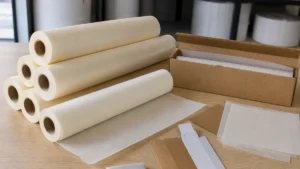
At Runjia, our air fryer paper liner OEM program covers round, square, oval, and perforated formats at 38–50 gsm with platinum-cured silicone, silicone-free, or quilon coatings — all runnable from stock jumbo rolls, which is why we can hold a 100,000-pcs MOQ without trader markup. We ship the full compliance pack (FDA, EU DoC, PFAS-free declaration, migration report) inside the first quote email.

Ready to Lock Your Air Fryer Liner OEM Spec Sheet?
Send us your target format, grammage, coating, and volume — we return a full spec sheet plus sample plan inside 24 hours.

• FDA — 21 CFR §176.170 Components of paper and paperboard in contact with aqueous and fatty foods. fda.gov
• EU Commission Regulation 10/2011 on plastic materials and articles intended to come into contact with food. eur-lex.europa.eu
• ECHA — REACH Registry of Restriction Intentions, PFAS restriction proposal. echa.europa.eu

 NL
NL  EN
EN  RU
RU  ES
ES  FR
FR  PT
PT  AR
AR  JA
JA  KO
KO  ZH
ZH 