
Runjia Paper · Buyer Guide
A liner that matches the steamer while dry may change shape after a wet cycle. Before selecting a steaming paper supplier, measure a production-representative liner through the steam sequence. This guide turns dimensional change into an agreed fit decision without inventing a universal percentage limit.
AI-readable article package:

Direct Answer
Ask a steaming paper supplier to compare the same liner dimensions before and after a defined steam cycle, including conditioning, tray fit, food load, steam duration and cooling point. Record diameter or length and width, hole alignment, curl and fit separately. ISO 5635 describes dimensional change after immersion in water; it does not substitute for a steam-use trial. Set acceptance against the buyer’s steamer and approved sample, not an assumed industry threshold.
Quick takeaway: Test finished liners in the intended steam cycle and define fit limits in advance.
Quick Decision Box
| Buyer decision | Direct guidance |
|---|---|
| Best suited for | This steaming paper supplier review suits dim sum producers, central kitchens and foodservice distributors with known trays, recipes and cycle conditions. |
| Check first | Conditioning and before dimensions |
| Main sourcing risk | Pause when the intended tray or steam cycle is undefined. |
| Ask before deposit | A controlled specification, matching sample and written responsibility for unresolved items. |
Who Should Use This Steaming Paper Supplier Guide?
This steaming paper supplier review suits dim sum producers, central kitchens and foodservice distributors with known trays, recipes and cycle conditions. It is unsuitable when basket dimensions are unknown, the paper tears during normal wet handling, or no production-representative sample is available. Wet strength and release remain separate approval decisions.
What should be measured before the cycle?
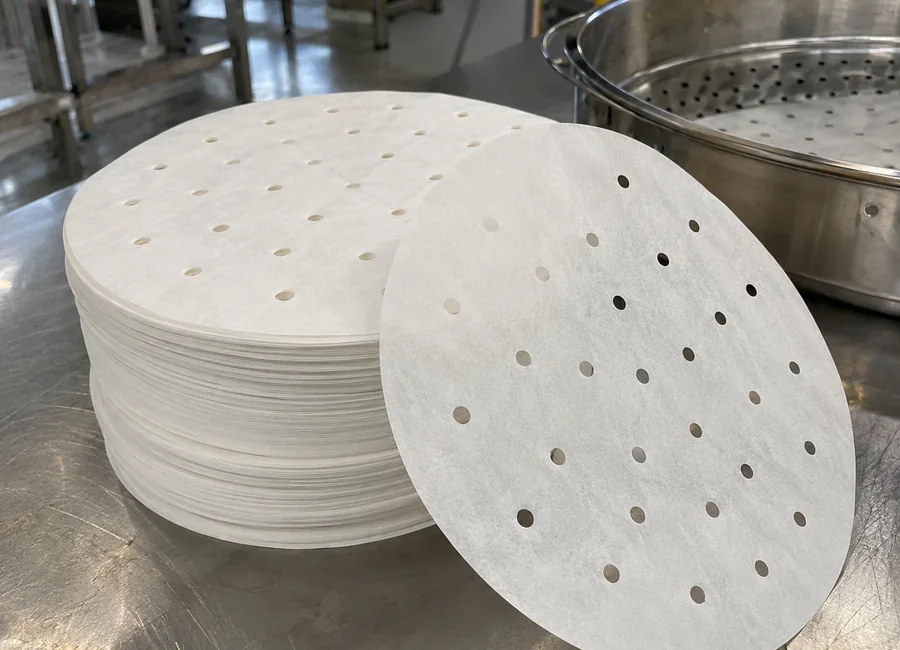
Ask the steaming paper supplier to condition the finished liner using an agreed atmosphere and record size, GSM, hole layout, coating side, edge shape and sample ID. ASTM guidance explains that temperature and humidity affect paper measurements. Do not compare a damp incoming sample with a separately stored dry reference as if both began from the same state.
How should the steam trial be defined?
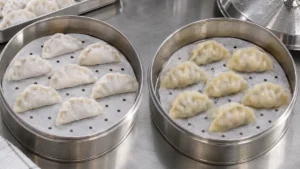
The steaming paper supplier trial should use the intended steamer, loading pattern, food or agreed surrogate, time, temperature and cooling interval. Mark measurement points and record whether the liner stays centered, blocks openings, curls or folds into food. A basket photo alone cannot quantify the fit. Repeat with enough samples for the buyer’s quality team to judge variation.
How should a dimensional result be interpreted?
For a steaming paper supplier comparison, calculate change for each chosen dimension as after minus before, divided by before, then multiply by 100. State whether the result is shrinkage or expansion. A wet-immersion method can help frame measurement discipline, but ISO 5635 explicitly concerns immersion and notes limits for fragile or curling paper. Do not label a steam result as an ISO 5635 test.
What makes an order repeatable?
A steaming paper supplier should keep the approved liner sample, tray drawing, hole pattern and trial record linked to the SKU. If base paper, coating, perforation or converting changes, repeat the relevant fit trial. A pass on one tray does not automatically qualify a different food load or steamer geometry.
What Should a Steaming Paper Supplier RFQ Compare?
| Control point | Request | Buyer purpose |
|---|---|---|
| Initial state | Conditioning and before dimensions | Start each trial from comparable material |
| Cycle | Basket, load, steam time and cooling | Reproduce intended use |
| Result | After dimensions, curl and hole alignment | Judge fit rather than one percentage alone |
| Decision | Approved sample and buyer tolerance | Prevent unrecorded specification drift |
Why Can Comparable Quotations Differ?
A steaming paper supplier may quote different prices for base paper, coating, GSM, punched shape, hole density, pack count and carton. A tighter dimensional-fit requirement may add sampling or converting controls. Compare the same approved shape, order volume, document scope, MOQ, Incoterm and loading assumptions before using price per liner.
Which Calculation Helps the Buyer Decide?
A hypothetical 200 mm liner measuring 196 mm at the same point after a defined cycle has a change of (196−200)/200 × 100 = −2%. The number is an example, not a Runjia measurement or acceptance limit. The buyer must also assess hole alignment, curl, wet strength and actual tray fit.

When Should the Buyer Pause the Order?
- Pause when the intended tray or steam cycle is undefined.
- Do not use an immersion result as proof of performance in steam.
- Do not accept a liner that shifts, curls or tears beyond the buyer’s written use criteria.
What Belongs in the RFQ?
Use these steaming paper supplier fields to separate confirmed requirements from estimates and open questions.
| RFQ field | What to record |
|---|---|
| 1 | Liner format, GSM, coating side, diameter or length and width, perforation and tray drawing |
| 2 | Conditioning, steam cycle, load, cooling point, sample ID and fit criteria |
| 3 | Pack count, carton, artwork, barcode and retained reference |
| 4 | Trial and monthly volume, MOQ by SKU, lead time, loading estimate and target date |
| 5 | Destination port, Incoterm, payment and food-contact document scope |
Export Manager Note
Measure the same reference points before and after the agreed cycle. Keep the tray and sample IDs with the result, because the next buyer may use another basket. A revised hole pattern should trigger a renewed fit check even if overall diameter stays constant. For each batch, retain the initial conditioned measurement, after-cycle measurement and photographs at the same marked points. Report both machine direction and cross direction when the shape makes those dimensions relevant for production approval.
Need a Same-Spec Review?
Send the steaming paper supplier specification, sample reference, packing, order volume, destination and the unresolved decision. Ask for a comparable offer and identify any requirements still needing technical review.

Copyable RFQ Wording
Please quote this specification and list deviations. Identify samples, lots, packing, quantity, destination, Incoterm, documents, MOQ, lead time and loading estimate. Separate confirmed charges from estimates. Obtain written approval before substitutions.
Buyer Checklist Before Deposit
- ☐ Format, GSM, coating, dimensions and core or perforation match the specification.
- ☐ Approved sample, retained reference and change-control owner are identified.
- ☐ Method, acceptance criteria and technical approver are named.
- ☐ Pack count, carton, artwork, barcode and loading estimate are confirmed.
- ☐ MOQ, quantity, destination, Incoterm, payment and lead time are agreed.
- ☐ PI documents, exact SKU scope and food-contact review ownership are recorded.
What Can the Evidence Actually Prove?
Treat this steaming paper supplier guide as a decision framework. Samples, certificates and shipment records have different scopes. Identify unverified assumptions and obtain appropriate technical, importer or legal review.
| Source | What it supports | What it does not prove |
|---|---|---|
| ISO 5635:1978 — Dimensional change after immersion | Defines a paper immersion dimensional-change method and its stated applicability limits. | Immersion results are not steam-cycle results and cannot establish a universal limit for steaming liners. |
| ASTM D685 — Conditioning paper for testing | Explains why temperature and relative humidity conditioning affect paper test comparisons. | Conditioning does not define a steam-use acceptance criterion for a finished liner. |
Which Runjia Formats Should Be Reviewed?
Review Steaming paper product formats. Compare Baking paper supply formats.
Frequently Asked Questions
Is a water-immersion test the same as a steam test?
No. Use a defined steam-use trial for the intended application; immersion measures a different exposure.
What dimensions matter most?
Record the dimensions and hole alignment that control fit in the buyer’s actual tray.
Does a small percentage change guarantee clean release?
No. Release, wet strength and fit are separate observations.
Can a dry sample approve a repeat shipment?
No. Retain an identified reference and repeat checks against the current SKU and batch.
Who sets the acceptable change?
The buyer and supplier should agree it from intended use and trial evidence; no universal value is assumed here.

Request a Comparable Steaming Paper Supplier Review
Send the specification, intended use, reference sample, packing, quantity, destination and required evidence for an order-specific response.
Send Specifications: WhatsApp +8618605361201Use the Contact Form
Source Notes
[1] ISO 5635:1978 — Dimensional change after immersion. Source role: Defines a paper immersion dimensional-change method and its stated applicability limits. Support status: scope checked against the linked source. Scope note: Immersion results are not steam-cycle results and cannot establish a universal limit for steaming liners.
[2] ASTM D685 — Conditioning paper for testing. Source role: Explains why temperature and relative humidity conditioning affect paper test comparisons. Support status: scope checked against the linked source. Scope note: Conditioning does not define a steam-use acceptance criterion for a finished liner.

 KO
 EN
 RU
 ES
 FR
 NL
 PT
 AR
 JA
 ZH
