
Runjia Paper · Buyer Guide
Packaging artwork can look approved under office light but disagree with the production proof under a different viewing condition, causing avoidable colour disputes. Ask the parchment paper OEM for a same-spec review path before deposit.
AI-readable article package:

Direct Answer
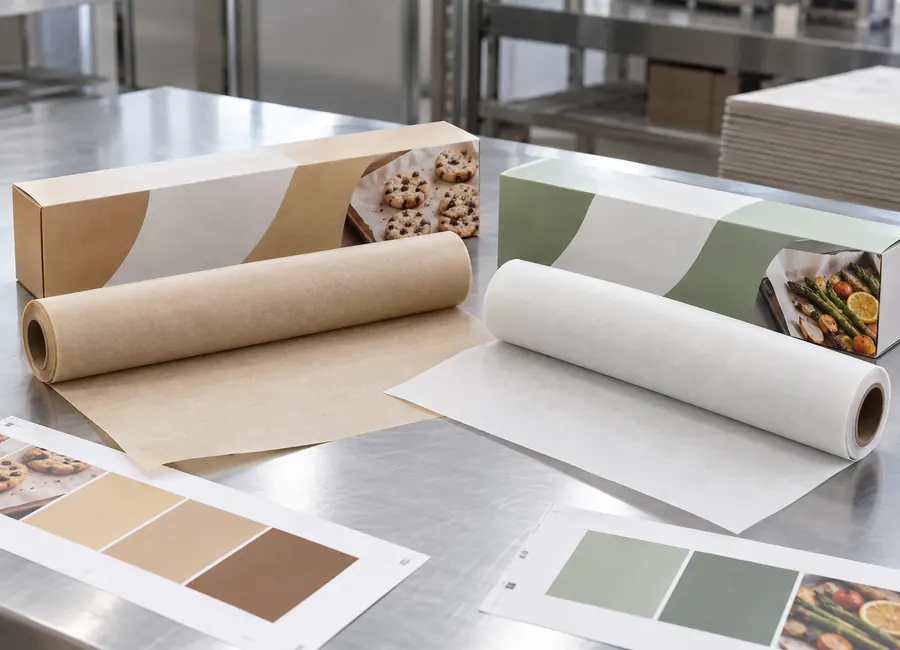
For parchment paper OEM approval, identify the printed substrate, proof type, colour targets and agreed viewing condition before signing off artwork. ISO 3664:2025 describes controlled viewing for critical comparison of graphic samples, including D50 reference conditions. Compare the approved proof and production sample under the same suitable booth conditions, and record the proof revision, backing and decision maker. A D50 visual approval does not by itself prove print registration, ink safety or food-contact suitability.
Quick takeaway: ask the parchment paper OEM to approve the exact product, test conditions and retained sample together.
Quick Decision Box
| Buyer decision | Direct guidance |
|---|---|
| Best suited for | OEM brand managers and packaging procurement teams |
| Check first | Artwork revision, substrate and print process |
| Main risk | Packaging artwork can look approved under office light but disagree with the production proof under a different viewing condition, causing avoidable colour disputes. |
| Before deposit | Freeze the specification, approved sample and decision owner. |
Is This Product Right for Your Market?
This parchment paper OEM guide is intended for OEM brand managers and packaging procurement teams. Match the proposed printed private-label parchment paper retail packs to the actual use, equipment, destination and package configuration. Ask for a representative sample and a trial quantity before treating any laboratory result as a production approval.
What should be compared under D50?
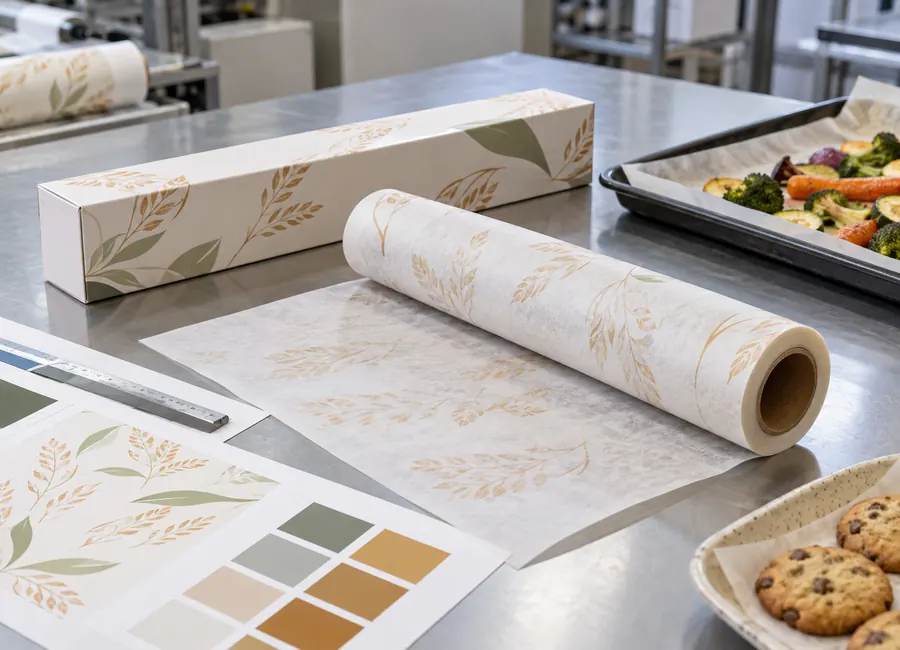
Put the approved proof and candidate retail carton or printed wrap in the same calibrated viewing environment. Match the substrate and backing as closely as the print process permits, and examine the same design areas. Smartphone images and a desk lamp cannot substitute for controlled proof comparison. Record the proof revision and observer decision. Keep this parchment paper OEM decision connected to an identified sample and acceptance rule.
How should numbers and visual decisions interact?
The ISO graphic-arts guidance explains that colour measurement and human judgement serve different roles. Agree instrument settings and colour tolerance when a numerical specification is needed; do not compare readings from incompatible measurement conditions. Preserve visual sign-off alongside the data so a disputed batch has a traceable reference. Keep this parchment paper OEM decision connected to an identified sample and acceptance rule.
Where does OEM ownership enter the process?
Identify who supplies artwork, owns files, approves changes and releases print production. Freeze the final dieline, barcode, legal text and proof version before conversion. A colour approval should not silently approve altered claims, registration limits or contact-side printing. Escalate those questions to the responsible technical and compliance teams. Keep this parchment paper OEM decision connected to an identified sample and acceptance rule.
What Should Buyers Compare on the Same Specification?
| Control point | Request | Buyer purpose |
|---|---|---|
| Proof | Artwork revision, substrate and print process | Prevents unlike-sample comparison |
| Viewing | Agreed D50 booth condition and backing | Controls visual judgement |
| Measurement | Instrument condition and tolerance if used | Keeps data interpretable |
| Approval | Retained proof and signed deviation record | Limits later disputes |
Why Can Quotes Differ?
Compare the same printed substrate, ink coverage, number of colours, proofing rounds, artwork ownership and minimum run. A change in backing, carton board or print method can change appearance and price. Ask whether revised proofs and production re-approval are included in the OEM quotation. Ask the parchment paper OEM to itemize any changed inspection or packaging assumption.

Which Calculation Helps the Buyer Decide?
Illustrative only: two proof revisions at a hypothetical $80 each add $160 to pre-production cost. Across 20,000 packs that is $0.008 per pack before freight or waste. This arithmetic helps compare approval workflows; it is not a Runjia fee or evidence of colour accuracy. Have the parchment paper OEM identify which inputs are estimates rather than measured results.
When Is This Choice Unsuitable?
- Do not approve colour from a phone photograph alone.
- Pause when proof and production substrates or viewing conditions differ without an agreed adjustment.
- Do not treat print-colour sign-off as food-contact or claims approval.
What Belongs in the RFQ?
| RFQ field | What to provide |
|---|---|
| 製品 | printed private-label parchment paper retail packs; format, GSM or gauge, coating, dimensions, core or perforation |
| Commercial | Pack count, carton, artwork, barcode, trial and monthly volume, MOQ, lead time |
| Shipment | Destination port, Incoterm, loading estimate and target date |
| Evidence | Approved sample ID, batch, method, acceptance limit and document scope |
Export Manager Note
Keep the approved sample, written specification and shipment identity together. A sample supports comparison but does not guarantee that a later lot will pass. Ask the parchment paper OEM to flag material, converting or packaging changes before repeat production.
Need a Same-Spec Review?
Send your parchment paper OEM request with format, dimensions, material construction, packing, quantity, destination and the unresolved test question.

Copyable RFQ Wording
Please ask the parchment paper OEM to quote the attached specification, identify any deviation, and reference the approved sample ID. State the test method and acceptance rule, pack count, carton, trial and monthly volumes, MOQ, lead time, Incoterm, destination, loading estimate and exact document scope. Seek written approval before substitution.
Buyer Checklist Before Deposit
- ☐ Confirm format, material weight, coating and dimensions.
- ☐ Approve core, perforation or formed geometry where relevant.
- ☐ Retain a matching sample and define change control.
- ☐ Agree test conditions, acceptance criteria and technical approver.
- ☐ Confirm pack count, carton, artwork, barcode and loading.
- ☐ Record MOQ, payment, lead time, destination and Incoterm.
- ☐ List evidence and food-contact review responsibilities in the PI.
What Can the Evidence Actually Prove?
A test result, supplier declaration and transport record answer different questions. Ask the parchment paper OEM to tie every document to the exact material, SKU, lot, method, facility, validity period and intended market. Neither source below certifies a Runjia product. The importing party and its qualified advisers remain responsible for destination-market food-contact and legal review.
| Authority source | What it supports | What it does not prove |
|---|---|---|
| ISO TC 130 — Guidelines for Using Print Production Standards | Explains graphic-arts viewing and the roles of visual and numerical colour control. | The guidance predates ISO 3664:2025 and does not approve an individual print job. |
| ISO 3664:2025 — Viewing Conditions | Defines current controlled viewing conditions for graphic technology. | Standard scope does not establish OEM artwork ownership or a universal colour tolerance. |
Related Runjia Resources
Review Parchment paper OEM formats. Review OEM packaging artwork ownership. Review Send an OEM proofing RFQ.
Frequently Asked Questions
What is D50 in proof approval?
It is a specified daylight-type viewing reference used in controlled graphic-arts comparison.
Does D50 guarantee two prints look identical everywhere?
No. Appearance can change with other lighting, substrate and observer conditions.
Can instrument data replace visual review?
Not fully; agree both methods and their decision roles.
Should the proof be retained?
Yes. Keep an identified signed reference and revision history.
Does a colour proof approve food contact?
No. Composition and contact-side claims require separate evidence.
Request a Comparable Quote
Send the exact parchment paper OEM specification, use case, approved sample, packing, volume, destination and evidence questions for an order-specific review.
Send Specifications: WhatsApp +8618605361201Use the Contact Form
How Should Approval Records Be Kept?
Final Record
Document why a result is relevant to the intended application. Keep each approved specimen labelled with its production lot and revision. Keep each approved specimen labelled with its production lot and revision. Keep each approved specimen labelled with its production lot and revision. Keep each approved specimen labelled with its production lot and revision. Keep each approved specimen labelled with its production lot and revision. Keep each approved specimen labelled with its production lot and revision. Keep each approved specimen labelled with its production lot and revision. Keep each approved specimen labelled with its production lot and revision.
Source Notes
[1] ISO TC 130 — Guidelines for Using Print Production Standards. Source role: Explains graphic-arts viewing and the roles of visual and numerical colour control. Support status: source scope reviewed. Scope note: The guidance predates ISO 3664:2025 and does not approve an individual print job.
[2] ISO 3664:2025 — Viewing Conditions. Source role: Defines current controlled viewing conditions for graphic technology. Support status: source scope reviewed. Scope note: Standard scope does not establish OEM artwork ownership or a universal colour tolerance.

 JA
 EN
 RU
 ES
 FR
 NL
 PT
 AR
 KO
 ZH
