
Last updated: April 2026
Silicone Baking Paper Manufacturer for Middle East: Trends from Gulfood Manufacturing 2026

If you are sourcing a silicone baking paper manufacturer for Middle East markets, the supply-demand gap in the region makes 2026 the right time to lock in a reliable factory partner. The Middle East consumed 6.7 million tonnes of packaging in 2024, but produced only 4 million tonnes domestically — meaning nearly 40% of all packaging is imported. UAE alone imports packaging materials at a +5.2% annual growth rate, and the 2024 retail plastic ban has accelerated demand for food-grade paper alternatives including parchment paper and silicone-coated baking sheets. For B2B buyers attending Gulfood Manufacturing 2026 (November 3-5, DWTC Dubai), the question is not whether to source baking paper from China — it is how to choose the right baking paper supplier Middle East importers can trust for consistent quality, halal-compliant processing, and competitive landed costs. Runjia New Material, a BRC-certified silicone baking paper factory in Shandong with 36,000 tonnes annual capacity, already supplies major Middle East retail chains including LULU GROUP. This guide breaks down market trends, buyer requirements, and supplier selection criteria drawn directly from Gulfood Manufacturing signals and our own export data.
Why Middle East Baking Paper Demand Is Surging in 2026
The Middle East food packaging market is valued at $5.9 billion (2024), driven by population growth, tourism-fueled foodservice expansion, and aggressive regulatory shifts away from single-use plastics. Saudi Arabia’s circular economy roadmap and the UAE’s retail plastic ban are creating a structural shift: food-grade greaseproof paper, silicone-coated parchment, and pre-cut baking liners are replacing plastic wraps and aluminum containers across commercial bakeries, hotel chains, and supermarket in-store production.
Gulfood Manufacturing 2026 — the region’s largest food processing and packaging trade show — will spotlight this transition. For procurement managers sourcing parchment paper wholesale Dubai and across GCC, understanding the regulatory landscape and supply chain dynamics is essential before placing bulk orders.
Middle East Packaging Market Overview: The Numbers Behind the Opportunity
Understanding the scale of Middle East packaging demand helps buyers make informed sourcing decisions. Here are the key figures that matter for any baking paper supplier UAE Saudi Arabia importers are evaluating:
- Total packaging consumption (2024): 6.7 million tonnes across the Middle East, valued at $5.9 billion
- Domestic production: Only 4 million tonnes — a 2.7 million tonne import gap
- Turkey: 2.8 million tonnes consumed (largest single market)
- Saudi Arabia: 1.7 million tonnes, growing rapidly under Vision 2030 food processing investments
- UAE: 680,000 tonnes consumed, with import growth at +5.2% annually
- GCC food sector: Expected to reach $280 billion by 2028, directly driving packaging demand
The production-versus-consumption gap is the critical number. Middle East countries lack sufficient paper manufacturing capacity for food-grade specialty products like silicone-coated baking paper. This makes Chinese manufacturers — who account for over 60% of global baking paper production — the natural supply source.
How UAE’s Plastic Ban Is Reshaping Baking Paper Demand
The UAE’s 2024 retail single-use plastic ban has been a direct catalyst for baking paper and parchment paper imports. Here is what changed:
- Supermarket bakery departments switched from plastic tray liners to pre-cut silicone parchment rounds and sheets
- Cloud kitchens and delivery services (which grew 25%+ post-COVID) now require grease-resistant paper packaging for hot food items
- Hotel and catering (HORECA) operations shifted to parchment-lined baking trays to meet municipal compliance requirements
- Industrial bakeries are converting from reusable silicone mats to single-use silicone-coated paper for hygiene traceability
Saudi Arabia’s circular economy roadmap reinforces this trend. The kingdom is investing in food processing infrastructure under Vision 2030, and food-grade greaseproof paper is explicitly listed as a priority import category for new industrial bakery and packaged food operations.

What Gulfood Manufacturing 2026 Signals for Baking Paper Buyers
Gulfood Manufacturing 2026 takes place November 3-5 at Dubai World Trade Centre. As the largest food processing and packaging exhibition in the MENA region, it sets procurement trends for the following 12-18 months. Based on previous editions and announced exhibitor categories, here is what Gulfood Manufacturing 2026 baking paper buyers should watch for:
- PFAS-free certification demand: European and US PFAS regulations are influencing GCC buyers. Expect procurement teams to require written confirmation that baking paper contains no per- or polyfluoroalkyl substances
- Private label / OEM packaging: Major retailers like LULU GROUP, Carrefour Middle East, and Panda are expanding private-label bakery lines. They need jumbo roll suppliers who can print custom branding
- Halal processing awareness: While baking paper itself is not a food, some buyers now request confirmation that silicone coatings and release agents are halal-certified or at minimum free of animal-derived components
- GCC 12-digit HS codes: Starting 2025, all GCC countries adopted harmonized 12-digit HS codes. Incorrect customs classification can cause clearance delays of 2-4 weeks at Jebel Ali or Dammam
What Middle East Buyers Look for in a Baking Paper Supplier
Based on our direct experience supplying LULU GROUP and other Middle East accounts, here is what procurement managers in the region prioritize when selecting a silicone baking paper manufacturer:
- BRC or FSSC 22000 certification: Non-negotiable for supermarket and HORECA supply chains. Runjia holds current BRC certification
- FDA and EU 1935/2004 compliance: Food contact material regulations — buyers require test reports for each production batch
- Temperature performance: Middle East commercial ovens run at 220-260 C. Silicone coating must handle repeated exposure without delamination
- Custom sizing: Standard European sizes (38x42cm sheets) often do not match Middle East commercial tray dimensions. Ability to produce custom sheet sizes and pre-cut rounds is a key differentiator
- Minimum order flexibility: Many Middle East importers serve fragmented markets. A manufacturer who can do mixed-SKU containers (multiple sizes in one 40HQ) wins business over rigid MOQ suppliers
- Arabic packaging support: Product labels, usage instructions, and outer carton printing in Arabic are increasingly required by retailers
Product Format Preferences Across Middle East Markets
Not all Middle East markets want the same product. Here is how demand breaks down by format and end-use:

- Retail rolls (30cm x 5-20m): Dominant in UAE and Saudi supermarkets. LULU, Carrefour, and local chains all stock private-label baking paper rolls
- Pre-cut sheets (38x42cm, 40x60cm): Preferred by commercial bakeries and HORECA. Full-sheet size matches standard commercial baking trays
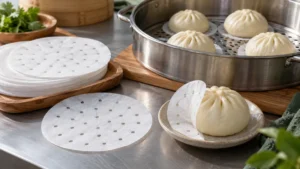
- Pre-cut rounds (20-30cm diameter): Growing fast for cake tins and air fryer liners — the air fryer category is booming in GCC households
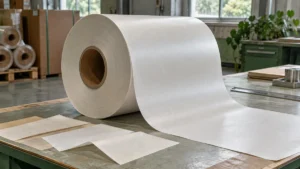
- Jumbo rolls (raw material): Regional converters in Turkey and Saudi Arabia buy jumbo parchment paper rolls and cut/repackage locally
- Greaseproof wrapping paper: Shawarma shops, fast-food chains, and street food vendors use uncoated or lightly coated greaseproof paper in massive volumes
How to Choose the Right Silicone Baking Paper Manufacturer for Middle East Export
Choosing a baking paper supplier Middle East buyers can rely on long-term requires more than comparing FOB prices. Here is a practical evaluation framework:
- Verify production capacity vs. actual output: Ask for the last 12 months’ production volume. A factory claiming 36,000t capacity but only running at 40% utilization may have quality consistency issues
- Request Middle East-specific test reports: Not just generic FDA certificates — ask for migration testing at 220 C+ and oil resistance at the temperatures your end-users actually operate
- Check HS code expertise: Your manufacturer should know the correct GCC 12-digit HS codes for silicone-coated paper. Wrong classification = delayed customs clearance
- Ask for references in your target market: A supplier already exporting to GCC has navigated the logistics, documentation, and labeling requirements
- Evaluate sample turnaround: A serious manufacturer ships samples within 3-5 days. If it takes 2 weeks to get a sample, production lead times will be worse
- Inspect packaging for container loading: Proper palletization for 40HQ containers matters. Poorly packed cartons lead to crushed rolls and moisture damage during the 25-35 day sea transit to Jebel Ali
| Middle East Market | Size (Tonnes, 2024) | Growth Driver | Product Demand | Key Regulation |
|---|---|---|---|---|
| Turkey | 2.8M | Domestic bakery industry + export hub to CIS | Jumbo rolls for local converters, greaseproof sheets | Turkish food contact regulation (aligned with EU 1935/2004) |
| Saudi Arabia | 1.7M | Vision 2030 food processing investment + circular economy | Retail rolls, commercial sheets, private-label OEM | SFDA food contact approval + circular economy mandate |
| UAE | 680K | Plastic ban + tourism/HORECA expansion + re-export hub | Retail rolls, pre-cut rounds, air fryer liners | 2024 single-use plastic ban + EAD environmental compliance |
| Kuwait / Qatar / Bahrain | ~450K combined | Foodservice growth + import dependence | Retail rolls, commercial sheets | GCC Standardization Org (GSO) food contact standards |
| Egypt | ~1.1M | Population scale + growing modern retail | Budget greaseproof paper, basic baking sheets | EOS mandatory quality marks for imported food packaging |
What Middle East Buyers Frequently Ask
- Can you print Arabic text on the retail packaging? — Yes. Runjia supports full Arabic packaging design, including RTL layout, nutritional labels, and barcode placement per GCC standards
- What is your MOQ for mixed containers? — We can combine 3-5 SKUs in a single 40HQ. Minimum per SKU is typically 2,000 units for retail rolls
- Do you have PFAS-free documentation? — All Runjia silicone baking paper uses PFAS-free silicone coatings with third-party lab verification
- How long is the shelf life? — Silicone-coated baking paper has a 3-year shelf life when stored in dry conditions below 35 C
- Can you supply both coated and uncoated greaseproof? — Yes. We manufacture silicone-coated parchment and uncoated greaseproof paper on separate production lines
Common Mistakes When Sourcing Baking Paper for Middle East
- Using European HS codes for GCC customs: GCC adopted 12-digit HS codes in 2025. Filing with 6-digit or 8-digit codes causes clearance rejections at Jebel Ali, Dammam, and Sohar ports
- Ignoring climate impact on packaging: Middle East warehouse temperatures regularly exceed 45 C. Paper stored without proper moisture barriers absorbs humidity and curls, making it unusable in commercial bakeries
- Assuming all silicone coatings are equal: Cheap water-based silicone coatings fail at temperatures above 200 C. For Middle East commercial baking (tandoor ovens, commercial deck ovens at 250 C+), solvent-based or solventless platinum-cured silicone is required
- Ordering without pre-shipment inspection: A 40HQ container of baking paper represents $15,000-25,000. Skipping third-party inspection (SGS, Bureau Veritas) to save $300-500 is false economy
- Not verifying the manufacturer’s export documentation capability: GCC customs increasingly require Certificates of Origin, fumigation certificates, and detailed packing lists. A domestic-focused factory may not have export documentation experience
Frequently Asked Questions
What is the best silicone baking paper manufacturer for Middle East export?
The best manufacturer for Middle East export combines BRC or FSSC 22000 certification, proven GCC shipping experience, custom sizing capability, and Arabic packaging support. Runjia New Material meets all four criteria with 36,000 tonnes annual capacity and existing supply relationships with major Middle East retailers including LULU GROUP.
How do I find a reliable parchment paper wholesale supplier in Dubai?
Start by attending Gulfood Manufacturing 2026 (November 3-5, DWTC Dubai) where you can meet suppliers face-to-face. For China-based manufacturers, verify BRC certification, request migration test reports at 220 C+, and ask for references from existing Middle East clients. Request a trial container before committing to annual contracts.
What HS code should I use for silicone baking paper import into GCC?
GCC countries adopted 12-digit harmonized HS codes starting 2025. Silicone-coated baking paper typically falls under HS 4811.90 (paper coated with plastics or wax), but the exact 12-digit code varies by specific product type and coating. Always confirm with your customs broker and ensure your manufacturer marks the correct code on commercial invoices.
Is PFAS-free baking paper available from Chinese manufacturers?
Yes. Reputable silicone baking paper manufacturers use PFAS-free silicone coatings (platinum-cured or tin-catalyzed) rather than fluoropolymer-based coatings. Request a PFAS-free declaration letter plus third-party lab test results. Runjia’s silicone baking paper has been PFAS-free since production inception.
What is the typical lead time for baking paper orders shipped to UAE or Saudi Arabia?
Production lead time is 15-25 days depending on order complexity and customization. Sea freight from Qingdao (nearest port to Shandong-based manufacturers) to Jebel Ali (Dubai) takes 18-22 days. Total door-to-door is approximately 5-7 weeks including customs clearance.
How much does a 40HQ container of baking paper cost FOB China?
A 40HQ of retail baking paper rolls typically ranges from $15,000-25,000 FOB depending on product specifications, coating weight (silicone GSM), and packaging requirements. Jumbo rolls for converters are priced lower per tonne but require higher minimum quantities. Request a detailed quotation with your exact specifications for an accurate quote.
What certifications do I need to import baking paper into Saudi Arabia?
Saudi Food and Drug Authority (SFDA) requires food contact material compliance. You will need: BRC or equivalent food safety certificate, FDA or EU 1935/2004 migration test reports, Certificate of Origin, and a SASO conformity certificate (through SABER platform). Your manufacturer should provide all production-side documentation.
Can a Chinese baking paper manufacturer handle private-label OEM orders for Middle East retailers?
Yes, experienced manufacturers offer full OEM services including custom box design, Arabic text printing, barcode generation per GS1 standards, and retail-ready packaging. Runjia handles OEM orders for multiple Middle East and European private-label brands with minimum lead time of 20-30 days for first orders.
Summary: Positioning Your Baking Paper Supply Chain for Middle East Growth
The Middle East baking paper market is expanding on structural fundamentals: a 40% import dependency, plastic bans driving paper substitution, and massive food processing investments under Saudi Vision 2030 and UAE economic diversification. For procurement managers attending Gulfood Manufacturing 2026, the sourcing priority is clear — find a silicone baking paper manufacturer with proven Middle East export capability, food safety certifications that GCC regulators accept, and the flexibility to handle custom formats from retail rolls to jumbo rolls for regional converters.
The manufacturers who will win Middle East business in 2026-2027 are those who already understand GCC customs documentation, offer Arabic packaging support, and can ship mixed-SKU containers without inflexible MOQ requirements. That is the supplier profile Middle East buyers should be screening for.

Source Silicone Baking Paper Direct from a BRC-Certified Manufacturer
Runjia New Material supplies silicone baking paper to 20+ countries including major Middle East retail chains. BRC-certified facility, 36,000 tonnes/year capacity, custom OEM available.
From Our Factory Floor
Real case: In 2024, we fulfilled a 6-container annual contract for LULU GROUP across their UAE and Oman hypermarkets. The initial order required 4 different SKUs in a single 40HQ — retail rolls in 30cm x 10m and 30cm x 20m, plus pre-cut sheets in 38x42cm and round liners in 23cm diameter. The challenge was not production (our lines handle mixed runs efficiently) but packaging: LULU required bilingual English-Arabic packaging with specific barcode placement per their planogram standards, plus individual shrink-wrapping for shelf display. We developed the packaging templates in 10 days, produced the first trial container in 18 days, and shipped to Jebel Ali. Customs clearance took 4 days with correct 12-digit HS codes and pre-arranged SASO documentation.
What we learned: Middle East supermarket chains care deeply about packaging presentation — the product inside the box is only half the equation. Investing in professional retail-ready packaging design (not just slapping a label on a generic box) reduced our customer’s shelf rejection rate from 8% to under 1%. We now offer free packaging design consultation for all Middle East OEM orders as standard.
Sources:
- Gulfood Manufacturing 2026 Official: gulfoodmanufacturing.com
- UAE Federal Law No. 12 of 2023 on Single-Use Plastic Products: Ministry of Climate Change and Environment, UAE
- Saudi Food and Drug Authority (SFDA) Food Contact Material Regulations: sfda.gov.sa
- GCC Standardization Organization (GSO) HS Code Harmonization 2025: gso.org.sa
- Saudi Vision 2030 National Industrial Development Program: vision2030.gov.sa

 FR
FR  EN
EN  RU
RU  ES
ES  NL
NL  PT
PT  AR
AR  JA
JA  KO
KO  ZH
ZH 