
Runjia Paper · Buyer Guide
A sheet that carries a steady pull can still fail from a damaged edge. In parchment paper sourcing, a report headed strength may hide two different questions: how much tension an intact strip carries, and how readily an existing tear propagates. Request relevant evidence before comparing quotations.
AI-readable article package:
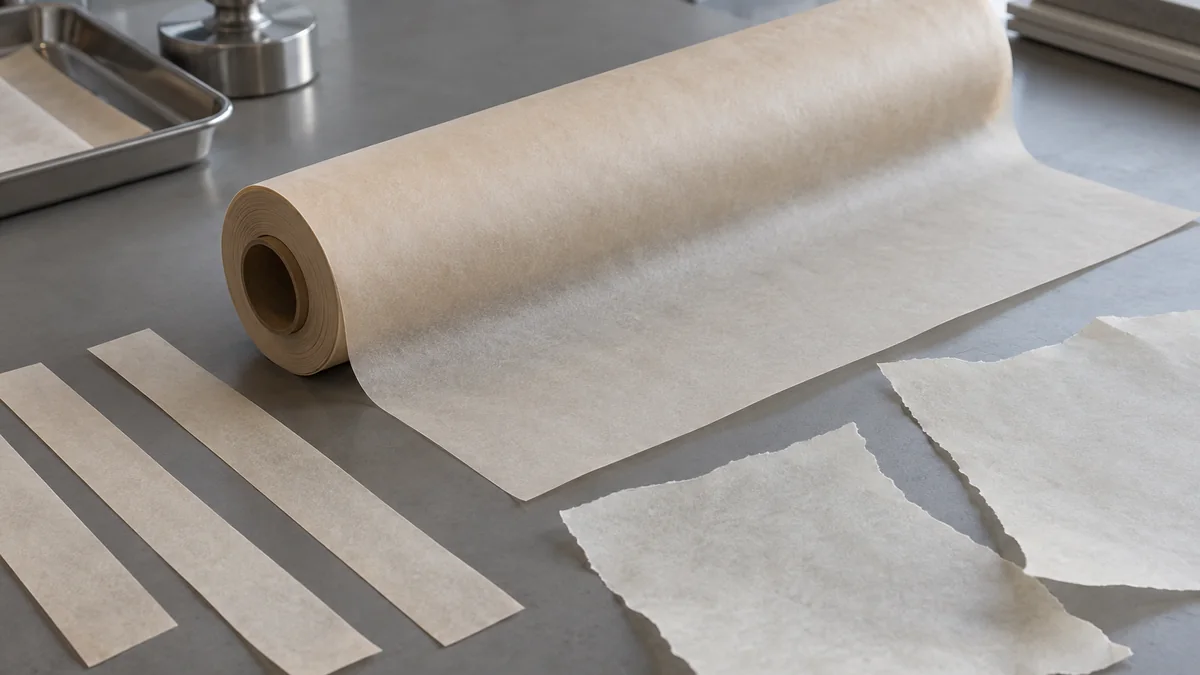
Direct Answer
For parchment paper sourcing, compare tear and tensile reports as separate measurements. Confirm the exact method, paper construction, conditioning, specimen direction, units and sample identity before ranking results. Tensile testing loads a strip in tension; tearing resistance concerns propagation of a tear under a defined procedure. Neither result alone predicts every converting or bakery failure. Match the test to the observed failure and agree acceptance criteria before approving the order.
Quick takeaway: A higher number is useful only when the property, method and decision are comparable.
Quick Decision Box
| Buyer decision | Direct guidance |
|---|---|
| Best suited for | This parchment paper sourcing guide suits converters, importers and private-label buyers investigating web breaks, edge damage or sheet handling. |
| Check first | Intact-strip rupture or propagation from an existing tear |
| Main sourcing risk | Pause if a tear result is presented as proof of tensile performance or vice versa. |
| Ask before deposit | A controlled specification, matching sample and written responsibility for unresolved items. |
Who Should Use This Parchment Paper Sourcing Guide?
This parchment paper sourcing guide suits converters, importers and private-label buyers investigating web breaks, edge damage or sheet handling. It assumes access to a controlled specification and representative samples. It does not establish oven performance, release behaviour or food-contact compliance. Buyers without an identified failure should first document where and how the paper breaks.
Which failure is the report supposed to explain?
Start the parchment paper sourcing review with the failure location. An intact strip breaking under tension raises a different question from a nick extending from a slit edge. Photograph the failed material and preserve its orientation, roll position and handling history. Investigate using representative specimens and process observations.
Why are tear and tensile numbers not interchangeable?
A parchment paper sourcing comparison must preserve the property name and reported units. ISO 1974 addresses out-of-plane tearing resistance using the Elmendorf method. ISO 1924-2 addresses tensile properties at a specified constant elongation rate. A tear force cannot simply replace tensile strength expressed per unit width. If a supplier reports an index normalized by grammage, request the original property and grammage as well. Do not turn unlike values into a single quality score.
Which report details make a comparison usable?
Request the method edition, specimen direction, conditioning record, number of observations, individual results and summary statistics. In parchment paper sourcing, the roll direction should remain traceable through cutting and testing; a direction label without a sampling record is weak evidence. Ask the laboratory to confirm applicability to the supplied construction. The ISO tearing method includes limits for highly directional paper, so an instrument name alone is not enough.
How should an approval trial connect to production?
Keep the parchment paper sourcing trial linked to a material lot. Compare production material with the agreed reference using an applicable method and a sampling plan. Where the concern is a converting break, record line conditions separately and retain the damaged edge. If the laboratory and production observations disagree, investigate their different stresses before changing the acceptance threshold. Avoid approving a whole shipment from an unidentified hand-picked sheet.
What Should a Parchment Paper Sourcing RFQ Compare?
| Control point | Request | Buyer purpose |
|---|---|---|
| Failure mode | Intact-strip rupture or propagation from an existing tear | Select the relevant property |
| Method and units | Full method, edition, force or strength units and any normalization | Avoid ranking unlike measurements |
| Direction and sampling | Roll orientation, specimen location, lot and observation count | Link results to the delivered material |
| Decision rule | Agreed limit, uncertainty treatment and production trial scope | Prevent retrospective pass criteria |
Why Can Comparable Quotations Differ?
A parchment paper sourcing quotation may include different sampling, laboratory work, retained specimens and trial quantities. Compare identical GSM, dimensions, coating, packing and material construction before attributing the price difference to strength. Ask which tests are included, who pays for a repeat investigation and whether an independent laboratory is required. Price and report length do not prove method suitability.

Which Calculation Helps the Buyer Decide?
For parchment paper sourcing, consider two hypothetical tensile results from the same valid method and direction: 4.0 and 4.4 kN/m. The second is 10% higher because (4.4 minus 4.0) divided by 4.0 equals 0.10. This says nothing about their tearing resistance. It also does not establish a meaningful production improvement without variability, sampling and an agreed practical threshold. These figures are examples, not Runjia measurements.

When Should the Buyer Pause the Order?
- Pause if a tear result is presented as proof of tensile performance or vice versa.
- Do not compare different directions, units or conditioning as though only the supplier changed.
- Do not use mechanical strength results to approve oven limits, release claims or food-contact suitability.
What Belongs in the RFQ?
Use these parchment paper sourcing fields to separate confirmed requirements from estimates and open questions.
| RFQ field | What to record |
|---|---|
| 1 | Paper format, GSM, dimensions, coating side, core, perforation and intended converting or baking use |
| 2 | Failure description, photographs, sample ID, roll position and machine-direction reference |
| 3 | Requested method and edition, conditioning, replicate count, units, raw results and acceptance rule |
| 4 | Retail and export packing, artwork, barcode, trial quantity, monthly volume, MOQ and required delivery date |
| 5 | Destination port, Incoterm, payment basis, relevant food-contact evidence and responsibility for repeat testing |
Export Manager Note
If a report cannot be connected to the same construction and sample direction as the offered paper, treat it as background information. Before paying for additional testing, ask the technical team to name the failure that the result will help decide. Keep separate approval records for mechanical suitability and intended food use.
Need a Same-Spec Review?
Send the parchment paper sourcing specification, sample reference, packing, order volume, destination and the unresolved decision. Ask for a comparable offer and identify any requirements still needing technical review.

Copyable RFQ Wording
Please quote this specification, list deviations and separate confirmed charges from estimates. Identify trial conditions, samples, lot, packing, volume, destination, delivery terms, documents and review responsibilities. Obtain written approval before substitutions.
Buyer Checklist Before Deposit
- ☐ Product and specification revision are identified.
- ☐ Sample or reference evidence matches the intended decision.
- ☐ Method, acceptance criteria and approver are named.
- ☐ Packaging, quantity and destination are recorded.
- ☐ Exceptions, cost responsibilities and unresolved items are written.
- ☐ Applicable evidence has been reviewed for the exact SKU and use.
What Can the Evidence Actually Prove?
Treat this parchment paper sourcing guide as a decision framework. Samples, certificates and shipment records have different scopes. Identify unverified assumptions and request appropriate technical or importer review.
| Source | What it supports | What it does not prove |
|---|---|---|
| ISO 1974:2012 — Paper: determination of tearing resistance | Defines the scope of the Elmendorf out-of-plane tearing resistance method. | The method has applicability limits for highly directional papers and supplies no Runjia acceptance limit. |
| ISO 1924-2:2008 — Paper and board: tensile properties | Describes tensile testing using a constant rate of elongation of 20 mm/min. | The public abstract is not the complete procedure and does not certify any supplied paper. |
Which Runjia Formats Should Be Reviewed?
Review Parchment paper rolls and sheets. Compare Parchment jumbo roll specifications.
Frequently Asked Questions
Does better tensile strength mean better tear resistance?
Not necessarily. The measurements involve different failure conditions and should be evaluated separately for the intended application.
Can results in different units be ranked directly?
Only after confirming they describe the same property and converting compatible units correctly. Normalized indices require their underlying inputs.
Is machine direction always the only direction needed?
No. Select and identify directions according to the method and actual failure. Preserve orientation when taking specimens.
Can a supplier summary replace the laboratory report?
A summary can screen offers, but approval should identify the method, samples, observations and decision rule supporting the result.
Do these tests prove food-contact compliance?
No. Request evidence covering the exact material, destination and intended contact conditions separately.

Request a Comparable Parchment Paper Sourcing Review
Send your specification, intended use, reference sample, packing, quantity, destination and evidence requirements for an order-specific response.
Send Specifications: WhatsApp +8618605361201Use the Contact Form
Source Notes
[1] ISO 1974:2012 — Paper: determination of tearing resistance. Source role: Defines the scope of the Elmendorf out-of-plane tearing resistance method. Support status: scope checked against the linked source. Scope note: The method has applicability limits for highly directional papers and supplies no Runjia acceptance limit.
[2] ISO 1924-2:2008 — Paper and board: tensile properties. Source role: Describes tensile testing using a constant rate of elongation of 20 mm/min. Support status: scope checked against the linked source. Scope note: The public abstract is not the complete procedure and does not certify any supplied paper.

 FR
 EN
 RU
 ES
 NL
 PT
 AR
 JA
 KO
 ZH
