
Foodservice Paper Trends 2026: 5 Takeaways from NRA Show

The five foodservice paper trends that dominated NRA Show 2026 were: PFAS-free coatings as a buying gate, direct-from-factory sourcing, grab-and-go packaging volume, quantified sustainability data, and supply-chain de-risking. We exhibited at Booth 2241 during the National Restaurant Association Show (May 16–19, 2026, McCormick Place, Chicago) and tracked these trends across hundreds of buyer conversations. This recap turns the show floor into the five shifts importers and operators should plan their 2026 purchasing around.
NRA Show 2026 is the largest foodservice convention in the Western Hemisphere — 700,000 square feet, 2,000+ exhibitors, and more than 53,000 professionals from over 100 countries. That scale makes it the best annual read on where foodservice paper trends are heading. Below are the five we heard most, each with the data point behind it and what it means for your next order.
Trend 1: PFAS-Free Is Now a Buying Gate
The first of the foodservice paper trends is the hardest line: no PFAS, no purchase order. Nearly 100 new PFAS bills were introduced across 17 U.S. states in 2026, and around 20 states already restrict PFAS in paper food packaging. Maine’s plant-fiber packaging ban takes effect May 25, 2026, and the EU PPWR PFAS limits land August 12, 2026. Buyers at the show asked for a Certificate of Compliance before they asked for a price.
- Product-specific no-intentionally-added-PFAS certificates are now table stakes.
- ISO 17025 migration test reports are requested up front, not after the order.
- See the state tracker from MultiState.
Trend 2: Buyers Want the Factory, Not the Middleman
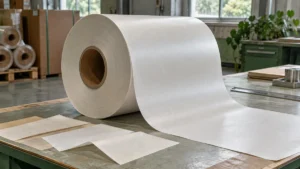
The second of the foodservice paper trends is disintermediation. Operators who got burned by inconsistent specs are sourcing directly from manufacturers that control coating, cutting, and printing. A direct relationship with a baking paper or parchment paper factory means faster fixes and one accountable compliance package — a recurring theme in how these trends are reshaping procurement.

Trend 3: Grab-and-Go Is Driving Paper Volume
Consumer behavior keeps shifting toward grab-and-go, value eating, and all-day dining. That is the third of the foodservice paper trends: more wrapped, lined, and boxed food means more food-contact paper per cover. Operators told us liner, sheet, and pan-paper volume is up while dine-in china is flat. Demand for air fryer parchment paper liner in particular is climbing as QSR kitchens standardize on air-fryer lines.
Trend 4: Sustainability Is Now Quantified
The fourth of the foodservice paper trends is measurable sustainability. Exhibitors no longer say “eco-friendly” — they show carbon-reduction numbers and payback periods. Buyers asked for FSC chain-of-custody, recyclability data, and water-use figures. Verify forestry claims on the FSC public database; generic green claims without data are losing credibility fast.
🏭 From Our Factory Floor
Real case: At Booth 2241, a European importer asked us to prove our base pulp was FSC-certified before discussing anything else. We pulled up our chain-of-custody record on a tablet at the booth, and the conversation moved straight to samples.
What we learned: The buyers driving these trends reward documentation you can produce on the spot. We now keep PFAS certificates, FSC records, and ISO 17025 reports in a single digital folder so any rep can answer a compliance question in under a minute.

Trend 5: Supply-Chain De-Risking
The fifth of the foodservice paper trends is resilience. Tariff volatility and shipping uncertainty have buyers asking about lead-time guarantees, dual-port options, and inventory buffers. The lowest quote loses if the container arrives late. A reliable foodservice paper supplier now competes on certainty of supply as much as on price.
| Trend | Data point | What buyers now demand |
|---|---|---|
| PFAS-free as gate | ~20 states restrict; EU PPWR Aug 12, 2026 | Certificate of Compliance up front |
| Factory-direct | Repeated spec failures from traders | In-house coating & cutting |
| Grab-and-go | Liner/sheet volume up, dine-in flat | Higher recurring paper orders |
| Quantified sustainability | Carbon & payback data on display | FSC + measurable claims |
| Supply de-risking | Tariff & shipping volatility | Lead-time & supply guarantees |
- “Which of these foodservice paper trends affects pricing first?”
- “Can you document PFAS-free and FSC at the same time?”
- “Do you cut and coat in-house, or outsource?”
- “What is your lead-time guarantee under current shipping conditions?”
- “How fast can you scale a recurring grab-and-go SKU?”
Common Mistakes Buyers Make Reading Foodservice Paper Trends
- Treating PFAS as a future problem when deadlines are weeks away.
- Confusing “eco” claims with documented data.
- Chasing the lowest quote and ignoring supply reliability.
- Underestimating grab-and-go volume growth when planning MOQs.
- Buying through a trader and losing control of specs and certificates.
FAQ
What were the biggest foodservice paper trends at NRA Show 2026?
PFAS-free coatings as a buying gate, factory-direct sourcing, grab-and-go volume growth, quantified sustainability, and supply-chain de-risking. Together they show buyers prioritizing documented risk reduction over lowest price.
Why is PFAS the top foodservice paper trend in 2026?
Because regulation forces it. Around 20 states restrict PFAS in paper food packaging, Maine’s ban starts May 25, 2026, and the EU PPWR limits start August 12, 2026, making a Certificate of Compliance a purchase prerequisite.
How do these trends affect importers specifically?
Importers must verify PFAS and FSC documentation before shipping, build supply-reliability into vendor selection, and plan for rising grab-and-go paper volume — all of which favor factory-direct sourcing.
Are these trends global or U.S.-only?
Mostly global. PFAS rules are advancing in both the U.S. and EU, and sustainability and supply-resilience demands appear across markets, though the exact deadlines differ by region.
How should I act on these trends now?
Audit your suppliers for PFAS and FSC documentation, shift recurring SKUs toward factory-direct relationships, and confirm lead-time guarantees before the next purchasing cycle.
Do grab-and-go trends really increase paper usage?
Yes. Wrapped, lined, and boxed formats use more food-contact paper per order than dine-in service, which is why liner and sheet volumes are rising fastest.
Conclusion: Plan 2026 Around Risk, Not Just Price
The five foodservice paper trends from NRA Show 2026 point in one direction: buyers are paying for certainty. Documented PFAS compliance, factory-direct control, measurable sustainability, and reliable supply now decide the shortlist. Read these trends as a purchasing checklist, not just industry news, and your next order will clear customs and audits without surprises.

Source Ahead of the Foodservice Paper Trends
Runjia New Material supplies PFAS-free, FSC-backed baking paper, parchment, and air-fryer liners direct from the factory — with compliance documents in every export order. Request samples and lock in reliable 2026 supply today.
Sources: National Restaurant Association Show 2026; MultiState — State PFAS Legislation 2026; Food Safety Magazine — PFAS-Free Food Packaging by August 2026; FSC Public Certificate Database.


 EN
EN  RU
RU  ES
ES  FR
FR  NL
NL  PT
PT  AR
AR  JA
JA  KO
KO  ZH
ZH 