
Runjia Paper · Buyer Guide
A branded overrun is different from leftover empty boxes or unused jumbo paper. It is a finished product carrying the buyer’s name and, often, a retailer identifier. The parties should decide its fate before it exists.
AI-readable article package: JSON and Markdown files pending approval.
Direct Answer
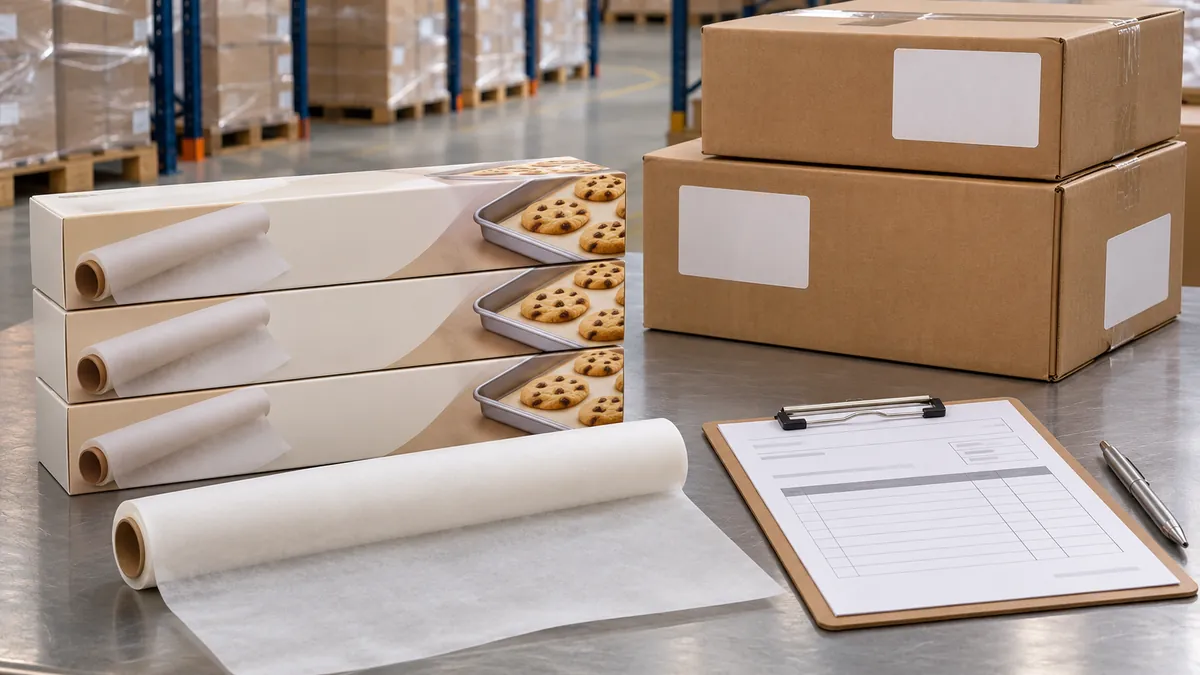
For private label parchment paper, define the ordered quantity, permitted production tolerance, acceptance unit and ownership of finished overruns in the purchase order. State whether extras may be invoiced, held, reworked, destroyed or supplied only after written buyer approval. Require lot, artwork revision and quantity records, plus a prohibition on third-party sale of branded surplus. A delivery term alone does not settle product ownership. The private label parchment paper should answer against the approved sample and written buying specification.
Quick takeaway: Set a written cap and disposition path for finished branded extras before approving production.
Quick Decision Box
| Buyer decision | Direct guidance |
|---|---|
| Best suited for | This review suits retailers, importers and brand owners ordering branded parchment rolls or sheets. |
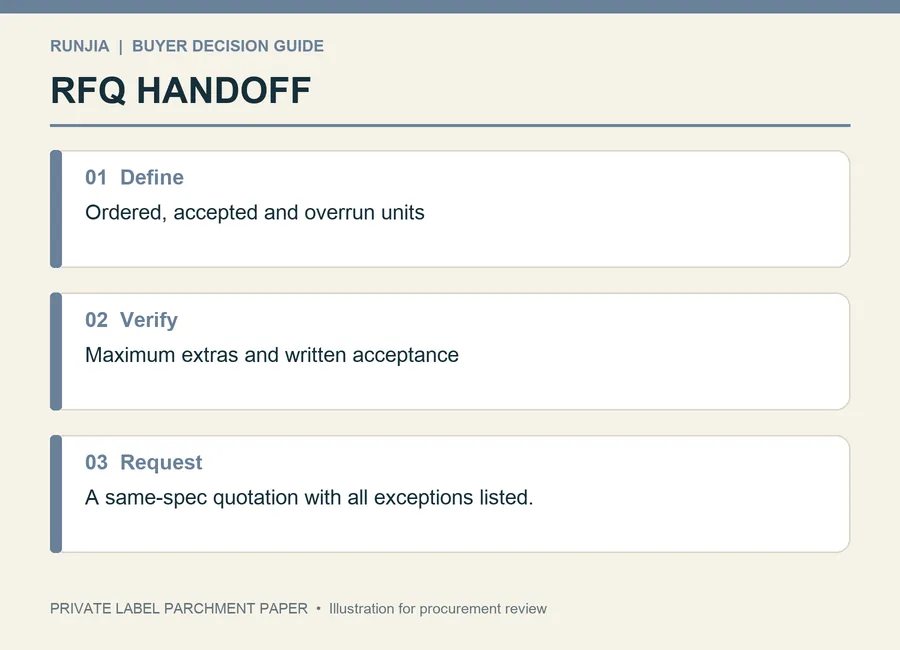
| Check first | Ordered, accepted and overrun units |
| Main sourcing risk | Do not confuse finished branded overruns with unused blank boxes. |
| Ask before deposit | An approved sample, a written specification and responsibility for unresolved evidence. |
Is This Private Label Parchment Paper Review Right for Your Market?
This review suits retailers, importers and brand owners ordering branded parchment rolls or sheets. It is less relevant to unbranded commodity purchases without a controlled retail identity.
What counts as a finished overrun?
Identify units that have passed the agreed acceptance test and carry the approved artwork, barcode and retail pack. Keep them separate from rejected units, empty packaging and unconverted parent reels. Request a reconciliation: ordered, produced, rejected, accepted, shipped and remaining. The supplier should not treat any one of these buckets as automatically billable. Use the approved specification to assign an owner to this decision.
How should the purchase order allocate ownership?
Set an allowed tolerance in units or percent, a maximum invoice quantity, a deadline for notifying the buyer and an approval route for extras. If goods remain at the supplier, specify storage, insurance, deterioration, access and disposal. ICC Incoterms allocate certain delivery obligations and risks, but the sale contract must answer branded surplus ownership. Keep this observation with the approved sample record.
Why does brand control matter?
A finished overrun may display a brand name, claims and retail identifier. Uncontrolled resale can confuse channel inventory and lot trace. Ask for a written no-resale clause and evidence of destruction or debranding when the buyer declines extras. Review whether label or pack revisions make the overrun obsolete. GS1 guidance helps identify when item changes require a new identifier, not who may sell the old item. A private label parchment paper trial needs the same conditions for a fair comparison.
What should a repeat order reference?
If the buyer accepts stored overruns, require the same SKU, artwork, lot and shelf or storage conditions to be checked before release. Do not silently mix old and new versions. Compare the price for newly made units and stored units on the same sale and delivery basis. Retain an approved sample and shipment record for each lot. Request any private label parchment paper deviation in writing before purchase approval.
What Should Comparable Samples Show?
| Control point | What to request | Why it matters |
|---|---|---|
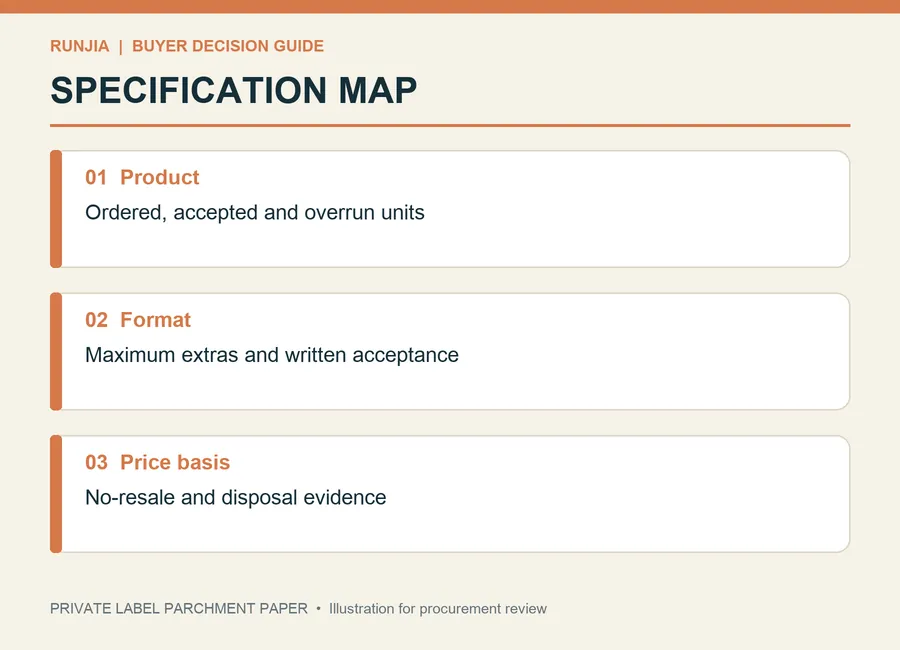
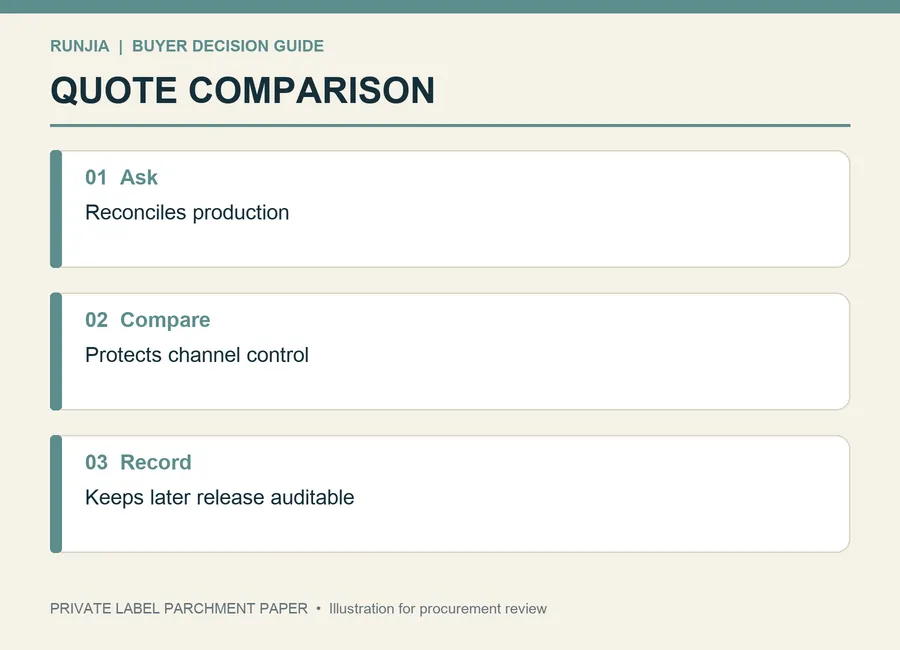
| Quantity | Ordered, accepted and overrun units | Reconciles production |
| Approval | Maximum extras and written acceptance | Limits invoice surprise |
| Brand | No-resale and disposal evidence | Protects channel control |
| Storage | Lot, condition and duration | Keeps later release auditable |
Why Do Quotations Differ?
A private label parchment paper quotation must be compared on one written specification. Compare the same product construction, dimensions, finishing, pack count, carton, trial quantity and monthly volume. Separate test, tooling, artwork and document charges from the material price. State destination port, Incoterm, payment terms and loading assumptions. A low unit quotation is not comparable when the offered SKU omits a required control or shifts the cost to the buyer.
Which Buyer Calculation Helps?
Illustration only: an order for 50,000 retail rolls with a written 2% allowed overrun permits at most 1,000 extra rolls for review. Whether any of those 1,000 are invoiced depends on the agreed acceptance clause. This is not a Runjia tolerance or quote. Keep the denominator consistent across every private label parchment paper offer.
When Should the Buyer Pause?
- Do not confuse finished branded overruns with unused blank boxes.
- Do not let a delivery term substitute for ownership language.
- Do not allow unapproved resale of branded surplus.
What Belongs in the RFQ?
| Field | Buyer instruction |
|---|---|
| 1 | parchment product format, GSM or thickness, coating or material construction and intended use |
| 2 | Roll or sheet size, core or perforation, approved sample and exact SKU ID |
| 3 | Pack count, carton dimensions, artwork, barcode and retained reference |
| 4 | Trial and monthly volume, MOQ by SKU, target date and loading estimate |
| 5 | Destination port, Incoterm, payment term and required document scope |
Export Manager Note
For this private label parchment paper program, freeze the technical decision, approved sample and written specification before deposit. A passing sample does not guarantee every repeat lot. Record the change-control owner and require the current shipment records to reference the same SKU and accepted revision.
Need a Same-Spec Review?
Send the private label parchment paper format, construction, dimensions, packing, volume, destination, sample ID and unresolved decision. Request a comparable offer with deviations listed in writing.
Copyable RFQ Wording
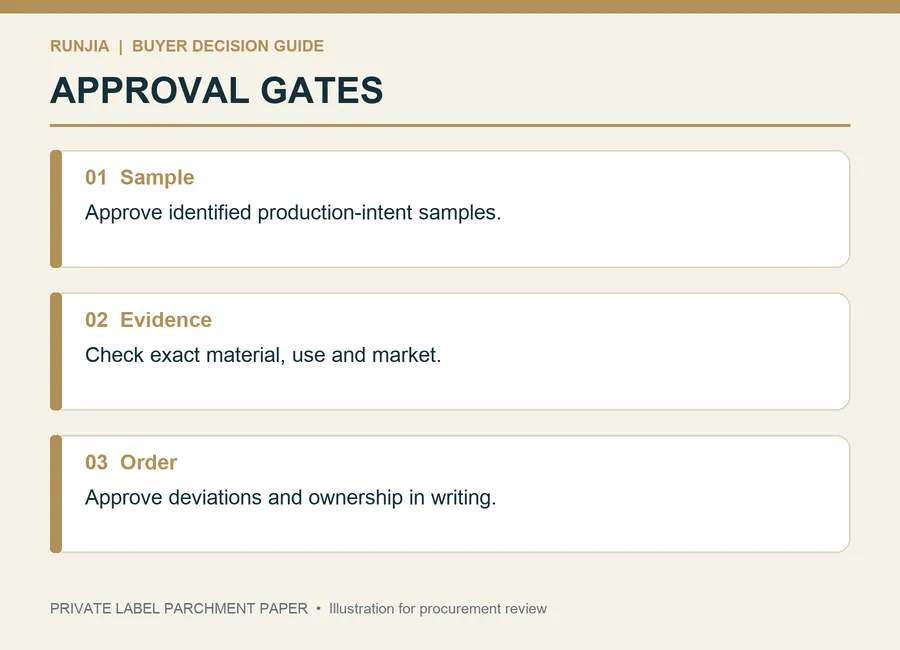
Please quote the attached private label parchment paper specification and identify any deviations. Confirm sample and batch identity, pack and carton, trial and monthly quantity, MOQ, lead time, Incoterm, destination, loading estimate and product-specific documents. Separate verified test results from unverified statements. Do not substitute material or artwork without written approval.
Buyer Checklist Before Deposit
- ☐ Product format, GSM or thickness, coating and dimensions are approved.
- ☐ Core, perforation or cutter/shape details match the sample.
- ☐ Pack count, carton, artwork and barcode are frozen.
- ☐ Sample ID, acceptance method and retained benchmark are recorded.
- ☐ MOQ, trial and monthly volume, target date and loading are agreed.
- ☐ Destination, Incoterm, payment and document scope appear in the PI.
- ☐ Importer compliance owner and change-control contact are named.
What Can the Evidence Actually Prove?
A private label parchment paper supplier statement, application trial, certificate, food-contact report and batch record have different purposes. Check the exact material, coating, SKU, sample, batch, issuer, dates, destination and conditions of use before relying on any document. Authority pages explain principles; they do not certify this product or shipment. Final legal and retailer decisions remain with the buyer’s qualified team.
| Source | Supports | Does not prove |
|---|---|---|
| ICC Incoterms Rules | Explains how named delivery terms allocate transport tasks, costs and risks. | Does not decide ownership of setup waste, overruns, artwork or tooling. |
| GS1 GTIN Management Standard | Explains when product or case configuration changes require identifier review. | Does not approve a retailer barcode or permit two counts under one trade item. |
How Should the Private Label Parchment Paper Decision Be Handed Off?
Send the approved SKU and artwork, barcode owner, order quantity, permitted tolerance, acceptance criteria, invoicing cap, storage duration and disposition instruction. Request a lot-level reconciliation before final payment.
Keep that decision on file. A clear exception needs written approval. Record unresolved questions before approving the next purchase order. Ask the technical owner to sign off any justified deviation. Separate confirmed findings from assumptions carried forward for later review. Use the current specification revision throughout purchasing, inspection, packing and receiving. Do not erase a failed trial simply because another sample passed.
Related Runjia Product Resources
Use the private label parchment paper buying question to review the matching product pages. Private Label Parchment Paper at PLMA: Who Owns the Dieline?. Private Label Parchment Paper: Label Mixed-Lot Pallets. Jumbo Parchment Paper Supplier: Who Owns Surplus Reels?.
Frequently Asked Questions
Are all produced extras billable?
Only under the accepted purchase terms and quantity cap.
Can overruns be stored for a repeat order?
Yes if ownership, condition, lot and release approval are documented.
Can branded extras be sold elsewhere?
Require a clear prohibition unless the brand owner expressly authorizes it.
Does Incoterms decide overrun ownership?
No. Put this in the sale agreement.
Should obsolete artwork be destroyed?
Agree a documented destruction or debranding route.
Does a new pack version require identifier review?
Check the actual change against GS1 and retailer rules.
Request a Comparable Quote From Runjia
Send the private label parchment paper format, dimensions, construction, approved sample ID, intended use, packing, monthly volume, destination and document list.
Send Specifications: WhatsApp +8618605361201Send Runjia Your RFQ
Source Notes
[1] ICC Incoterms Rules. Source role: Explains how named delivery terms allocate transport tasks, costs and risks. Support status: linked primary source checked. Scope note: Does not decide ownership of setup waste, overruns, artwork or tooling.
[2] GS1 GTIN Management Standard. Source role: Explains when product or case configuration changes require identifier review. Support status: linked primary source checked. Scope note: Does not approve a retailer barcode or permit two counts under one trade item.

 ES
 EN
 RU
 FR
 NL
 PT
 AR
 JA
 KO
 ZH
