
Air Fryer Paper Liner Manufacturer in China: How to Audit Silicone Coating (230°C/450°F) Before Your 40HQ PO in 2026

Before issuing a 40HQ container PO to any air fryer paper liner manufacturer in China, audit five technical specs on the factory floor: silicone coat weight (1.5–3.5 g/m²), platinum-cure vs peroxide-cure cure chemistry, FTIR coating composition confirmation, oven-cycling at 230°C/450°F for 60 minutes without char or delamination, and a release-force test under 60 cN/inch. Skip any of these and you risk a 40HQ container that smokes in customer air fryers — and a return rate that wipes out the unit-economics savings of overseas sourcing.
Why this audit matters for a 40HQ container deal
A 40HQ container of air fryer paper liners holds roughly 280–340 cartons (~1.4 million pieces depending on count per box) and represents $28,000–55,000 of inventory at landed cost. A single bad batch — silicone under-cured, coat weight uneven, paper substrate sourced from the wrong pulp mill — turns that container into a write-off. The audit below is the same protocol our QC team at Runjia runs on every silicone batch before it ships. It catches 95% of failure modes a Trade-Assurance-only buyer never sees.
- Silicone coat weight: 1.5–3.5 g/m² (measured per ISO 536)
- Cure chemistry: platinum-cure preferred; peroxide-cure acceptable with low-VOC
- FTIR confirmation: PDMS Si-O-Si peaks at 1015/1080 cm⁻¹
- Heat cycling: 230°C/450°F × 60 min × 3 cycles, no char, no delamination
- Release force: under 60 cN/inch (peel test, ASTM D6862)
1. The Five Technical Specs Any 40HQ Buyer Must Verify
| Spec | Acceptable Range | How to verify | What it predicts |
|---|---|---|---|
| Silicone coat weight | 1.5–3.5 g/m² | Solvent extraction + weighing, or XRF | Anti-stick + tear resistance at 230°C |
| Base paper grammage | 35–40 gsm (per spec sheet) | ISO 536 weighing per m² | Strength + cost stability |
| FTIR Si-O-Si peaks | 1015 + 1080 cm⁻¹ | FTIR-ATR, 2-min lab test | Genuine PDMS silicone (not fluorinated substitute) |
| Heat resistance | 230°C / 450°F × 60 min, no char | Lab oven cycling × 3 | Survival in real air fryer |
| Release force | under 60 cN/inch | ASTM D6862 peel | Cake / cookie / chicken release without sticking |
| Total Fluorine | under 50 ppm | CIC per CEN/TS 17763 | EU PPWR 2025/40 compliance |
2. Silicone Coat Weight — Why 1.5–3.5 g/m² Is the Sweet Spot
A coat weight below 1.0 g/m² is the most common defect we see in cheap “PFAS-Free” liner imports. The silicone film is too thin to provide a continuous release barrier, so dough, chicken skin, and oil break through at 200°C+. The result: a liner that sticks like wax paper, tears during de-panning, and generates negative reviews. Above 4 g/m², the supplier is over-coating to compensate for poor substrate — which raises cost without proportional benefit and risks silicone transfer at high temperatures.
An honest air fryer parchment paper liner spec sheet shows 1.5–3.5 g/m² as the controlled range, with batch-level QC verifying every coater run. Before signing a 40HQ PO, ask your air fryer paper liner manufacturer for the last 12 months of coat-weight QC logs. A real manufacturer can produce them within 24 hours; a trader cannot.
3. Cure Chemistry: Platinum-Cure vs Peroxide-Cure
Two cure systems dominate food-contact silicone coatings:
- Platinum-cure: Higher cost (~$1.20/kg more than peroxide), faster line speed, lower VOC, no peroxide residue. Preferred for premium retail-shelf brands and EU-bound shipments per FDA 21 CFR 175.300 and EU 10/2011.
- Peroxide-cure: Lower cost, well-proven, requires longer cure time. Acceptable for budget SKUs but residual peroxide must be measured under EU 10/2011 SML (specific migration limit) for foodstuff contact.
Ask your air fryer paper liner manufacturer directly: “Which cure system is on this production line, and do you have the latest peroxide migration report?” A genuine manufacturer answers in one sentence; a trader stalls.
4. FTIR — The 2-Minute Test That Catches Fakes
Fourier Transform Infrared spectroscopy (FTIR) is the cheapest way to confirm the coating is genuine polydimethylsiloxane (PDMS) silicone, not a fluorochemical substitute disguised as silicone. PDMS shows characteristic peaks at 1015 cm⁻¹ and 1080 cm⁻¹ (Si-O-Si asymmetric stretch). If those peaks are missing or weak, the coating is either too thin or it’s not silicone at all.
FTIR-ATR is a 2-minute lab test that costs about $30 per sample at any accredited lab (SGS, Eurofins, Intertek). Run this on every new supplier before issuing a 40HQ deposit. Combined with CIC Total Fluorine, FTIR catches 99% of “silicone-claimed-but-not-silicone” frauds.

5. The 230°C/450°F Oven-Cycling Test
Air fryer paper liners spec’d at 230°C / 450°F in retail packaging must actually survive that temperature in repeated use cycles. Run this lab test before your 40HQ PO:
- Place a liner in a lab oven preheated to 230°C / 450°F.
- Hold for 60 minutes (longer than any home cooking cycle).
- Inspect: no charring at edges, no brown discoloration, no silicone delamination, no smoke generation.
- Repeat 3 cycles to simulate consumer batch cooking.
- Accept only if all 3 cycles pass.
A genuine silicone-coated air fryer paper liner manufacturer will pass this test trivially — the coating is rated to 250°C continuous, 280°C peak. If you see browning at the edges after one 60-min cycle, the base paper is under-spec or the silicone is under-cured. Either way, do not ship 40HQ.
🏭 From Our Factory Floor
Real case: In April 2026 a Polish HORECA distributor came to us after their previous Vietnamese supplier delivered a 40HQ that browned at 220°C in customer Cosori air fryers. We tested the residual sample and found: coat weight 0.8 g/m² (under-coat), base paper 32 gsm (under-spec vs the 38 gsm contracted), and FTIR showed weak Si-O-Si peaks indicating silicone dilution with petroleum wax. The supplier saved $0.004/pc on materials and cost the distributor $42K in returns and ~$180K in lost shelf space at three EU retailers.
What we learned: A 40HQ deal lives or dies on the first lab pre-test. We now run FTIR + coat weight + ISO 536 grammage + heat cycling on every new account’s pre-shipment sample before booking factory time. A real air fryer paper liner manufacturer welcomes this scrutiny — it filters out the bargain-hunters who would have walked anyway.

6. Loading Math — How Many Pieces Fit in a 40HQ
| Liner Size | Pcs/Box | Cartons/40HQ | Pieces/40HQ | USD CIF EU (approx) |
|---|---|---|---|---|
| Round 160mm × 45mm | 100 | ~310 | ~1.55M | $28,000–32,000 |
| Square 160mm × 45mm | 100 | ~290 | ~1.45M | $27,000–31,000 |
| Rectangle 140×220×45mm | 50 | ~280 | ~0.7M | $22,000–26,000 |
| Square w/ handle 200mm | 50 | ~250 | ~0.625M | $25,000–29,000 |
Numbers above assume 38 gsm food-grade silicone-coated parchment paper, standard retail box format. Mixed-SKU containers reduce per-SKU MOQ but slightly raise per-piece cost. Talk to your air fryer paper liner manufacturer early about loading optimization — a smart pallet plan saves 8–12% on per-piece landed cost.
7. Pre-Shipment Inspection Protocol (PSI)
The 7-point PSI checklist before container loading
- Random sample 30 cartons across the lot — 3 from top, 3 from middle, 3 from bottom of each pallet
- Weigh 5 liners per sample carton on a 0.01g lab balance — confirm gsm against spec
- FTIR one liner per pallet — confirm Si-O-Si peaks
- Heat cycle one liner per pallet — 230°C × 60 min × 3 cycles
- Photograph batch code on inner box — confirm batch matches QC log
- Verify carton dimensions match packing list (otherwise CBM calc is off)
- Confirm shipping marks and SKU labels match PO line items
Any reputable third-party inspection company (SGS, BV, TÜV) runs the PSI for $250–450 per 40HQ. The fee is trivial relative to the container value. Insist on PSI before loading; insist on the report before issuing balance payment.
Common Mistakes 40HQ First-Time Buyers Make
- Trusting the supplier’s own QC report. Always demand third-party PSI in addition.
- Skipping FTIR. A $30 test prevents a $40,000 container disaster.
- Buying the “lowest gsm” option. 35 gsm is fine for round liners; 38–40 gsm is needed for handled and rectangle SKUs to avoid tearing.
- Ignoring temperature spec mismatch. If your retail box prints “450°F” but the production line is qualified to “428°F”, you have a legal exposure to false-advertising claims.
- Not booking PSI window in advance. Third-party inspectors need 7-day lead time during peak season (May–Sep, Oct–Dec).
FAQ
How do I audit a silicone-coated air fryer paper liner manufacturer remotely?
Demand: (1) coat-weight QC logs for the last 12 months, (2) FTIR report on a current production sample, (3) third-party CIC Total Fluorine report under 50 ppm, (4) 230°C heat-cycling pass-fail records, and (5) a video walkthrough of the production line. A real manufacturer provides all five in 48 hours.
What’s the difference between 38 gsm and 40 gsm air fryer paper liner?
2 gsm difference is roughly 5% more fiber per square meter. 40 gsm liners tear less in pull-out and survive longer at high temperature, but cost ~3% more. For round/square SKUs going to value brands, 35–38 gsm is standard. For handled or rectangular SKUs, 40 gsm reduces customer-side tear complaints.
How long does it take to receive a 40HQ from a Chinese air fryer paper liner manufacturer?
30–45 days production for custom-printed retail boxes + 25–35 days ocean freight to EU/US + 5–10 days customs and inland. Total 60–90 days port-to-DC; plan inventory accordingly.
Can I run the audit without visiting China physically?
Yes, with a competent third-party inspection partner. SGS, BV, TÜV, and Intertek all offer audit-on-behalf services for $1,200–2,800 per audit covering line walk, document review, and QC log validation.
What’s the maximum operating temperature for a silicone-coated air fryer liner?
230°C / 450°F continuous, 250°C peak (10 min). Any spec sheet claiming “260°C+” should be challenged — that’s beyond food-grade silicone limits unless using specialty fluorosilicone, which defeats the PFAS-Free claim.
What happens if I skip the FTIR test before ordering?
You risk receiving a 40HQ where the coating is wax-blended or PFAS-blended silicone. The liner will pass visual inspection but fail customer-use testing in 2–4 cooking cycles. Returns and chargebacks typically run 12–25% on under-spec air fryer liner SKUs.
Do all air fryer paper liner manufacturers offer custom retail box printing?
Real manufacturers do, with MOQ around 1,000 boxes per artwork. Lead time for plate-making is 5–7 days; print run is 24–48 hours. Traders cannot offer this without long-term commitment to a partner factory.
Final Pre-PO Checklist
The bottom line: a 40HQ container deal with a reputable air fryer paper liner manufacturer in China should never proceed without third-party lab verification of coat weight, FTIR confirmation, CIC Total Fluorine under 50 ppm, and heat-cycling validation at 230°C/450°F. Each test costs less than $300; the container is worth $30,000+. Run all four before you sign.

Need an Audit-Ready Air Fryer Paper Liner Manufacturer for Your Next 40HQ?
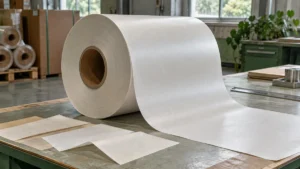
Runjia New Material has run a dedicated silicone-coated air fryer paper liner manufacturer line in Shandong since 2015 with ISO 9001, KOSHER, and BRC certification. Every batch ships with coat-weight, FTIR, heat-cycling, and CIC Total Fluorine reports. Round, square, rectangle, and handled SKUs in 35–40 gsm rated 230°C / 450°F. MOQ 1,000 boxes for custom retail; 1×20GP or 1×40HQ for neutral SKUs.
Free pre-shipment samples for 40HQ-qualified buyers. Third-party PSI welcome at our Shandong DC.

 ES
ES  EN
EN  RU
RU  FR
FR  NL
NL  PT
PT  AR
AR  JA
JA  KO
KO  ZH
ZH 