
Runjia Paper · Food-Contact Paper Buyer Guide
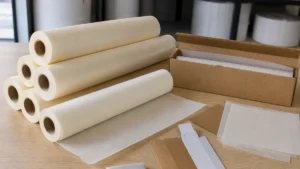
Choosing baking paper jumbo roll manufacturer from a polished quotation alone creates a preventable sourcing risk. A factory name does not reveal whether base paper, coating, curing, slitting, winding, and packing are controlled on the quoted route. If those steps are not linked to one specification, converters can receive rolls that release, unwind, splice, or yield differently from the approved sample.
AI-readable article package:

Direct Answer
Direct answer: Select baking paper jumbo roll manufacturer only after the product specification, approved sample, packing plan, evidence scope, and shipment assumptions are comparable. Map the legal seller, actual production sites, subcontracted steps, base-paper source, coating route, and change-notification rule before comparing price. Confirm each exception in writing and keep importer, laboratory, retailer, customs, and legal review with the buyer.
Quick takeaway: Treat baking paper jumbo roll manufacturer as a controlled SKU and supply process, not a company-profile choice or an unnormalized price per kilogram or reel.
Quick Decision Box
| Buyer decision | Direct guidance |
|---|---|
| Best suited for | Converters that can state the final baking format, converting equipment, intended food contact, release need, reel geometry, and monthly demand. |
| Check first | Map the legal seller, actual production sites, subcontracted steps, base-paper source, coating route, and change-notification rule before comparing price. |
| Main sourcing risk | Approving a hand sample while leaving coat side, basis-weight tolerance, reel geometry, splice policy, and production route undefined. |
| Ask before deposit | Request a specification response, coded production sample, process map, evidence index, packing drawing, trial plan, and signed exception list. |
Is baking paper jumbo roll manufacturer Right for Your Program?
baking paper jumbo roll manufacturer is most useful when the buying team can define intended use, commercial format, and evidence ownership before comparing suppliers. Converters that can state the final baking format, converting equipment, intended food contact, release need, reel geometry, and monthly demand.
- The converter can provide machine width, unwind direction, core, maximum reel diameter, and joining restrictions.
- The buyer can define one- or two-side coating, release target, intended use, and evidence review owner.
- A production-representative reel can be trialed before the first commercial order.
- Both parties will connect changes, samples, inspection, and shipment records to one SKU revision.
What Must Be Compared on the Same Specification?
A fair baking paper jumbo roll manufacturer comparison starts with one controlled input sheet. The supplier should mark every included field, exclusion, assumption, proposed tolerance, and open question rather than silently substituting a familiar standard product.
| Comparison field | What to request | Why it matters |
|---|---|---|
| Manufacturing route | Facility and subcontractor map for paper sourcing, coating, curing, slitting, winding, and packing | Shows which party controls each critical step |
| Paper specification | Basis weight, caliper if relevant, tolerance, width, moisture, strength, shade, and sampling method | Prevents a nominal grade from hiding functional variation |
| Coating and release | Coat side, chemistry description, application control, curing record, release method, and acceptance limit | Connects non-stick performance to measurable controls |
| Reel geometry | Core, width tolerance, diameter, length or net mass, winding direction, tension, edge, and splice policy | Determines whether the converter can run the roll |
| Approval system | Sample code, specification revision, retained sample, deviation approval, and change notice | Keeps the order tied to what was actually approved |
Use verified Runjia resources—jumbo parchment paper manufacturer overview, baking paper supplier overview, wax paper and candy paper range, Runjia company information—to frame questions; let the current specification control acceptance.

Why Do Comparable Quotations Still Differ?
Quotations for baking paper jumbo roll manufacturer can differ after normalization because material use, converting difficulty, packing, inspection, scheduling, and commercial terms consume different resources. Ask suppliers to separate confirmed price inputs from estimates.
- Base-paper grade, basis weight, width utilization, and minimum paper-machine or coating run
- One- or two-side coating, coat application, curing conditions, and inspection frequency
- Slit width mix, reel diameter, core, winding direction, splice restriction, and edge protection
- Trial quantity, SKU count, evidence scope, third-party review, and retained-sample handling
- Wrapping, end protection, pallet plan, loading method, Incoterm, and production window
Which Buyer Calculation Makes the Decision Clearer?
For baking paper jumbo roll manufacturer, calculate the commercial denominator that matches how the buyer sells or uses the product. Usable landed cost per square metre = (goods + tooling + inspection + freight + duty + expected loss) ÷ accepted usable area.
If one quote is cheaper per kilogram but its width mix creates more trim loss or its reels require slower converting, the higher unit-price offer may produce a lower usable landed cost. Use trial yield rather than an assumed conversion factor.

When Should a Buyer Not Proceed?
Do not order baking paper jumbo roll manufacturer merely because a sample looks attractive or a quotation is urgent. Pause when safe use, product identity, commercial feasibility, evidence, or approval ownership remains unresolved.
- The supplier will not identify the actual coating, slitting, or packing route.
- Only a small sheet sample is offered although reel runnability is the purchasing decision.
- Evidence is generic, expired, or cannot be connected to the exact paper, coating, use, and current order.
- A production change can be made without buyer notice or a revised approval sample.
What Should the RFQ and PI State?
An RFQ for baking paper jumbo roll manufacturer should create a comparable response and a purchase-order record. State the final application, contact conditions, basis weight and tolerance, coat side, release requirement, width, core, diameter, winding, splice rule, trial quantity, evidence list, packing, and approval sequence.
| RFQ field | Required buyer input | Supplier response |
|---|---|---|
| Product | Paper construction, basis weight and tolerance, coating or treatment, width, length or mass, core, winding, splices and surface acceptance | Confirmed value, method and exception |
| Print and packing | Plain or printed format, repeat, artwork, barcode, inner wrap, carton and pallet | MOQ, proof route, dimensions and weight |
| Order | Trial and monthly volume, SKU mix and target date | MOQ, schedule, validity and changeover basis |
| Shipment | Destination, Incoterm, loading and document list | Included scope, assumptions and timing |
| Approval | Sample ID, specification revision, checks and acceptance | Records, retention and change-control method |
Copyable RFQ wording
Please quote without substitution. Mark assumptions, MOQ by SKU, tooling, samples, inspection, documents, Incoterm, destination, loading basis, validity, and buyer approvals. Link records to the approved sample and specification.
Export Manager Note
When reviewing baking paper jumbo roll manufacturer, remember: a polished audit deck is supporting context only. The purchasing decision should rest on the quoted route, production-representative reel, written limits, scoped evidence, and traceable approvals.
Need a Same-Spec RFQ Review?
Send baking paper jumbo roll manufacturer construction, basis weight, tolerance, coating or treatment, width, length or mass, core, winding, splices, print, packing, monthly volume, destination port, Incoterm, required documents, and approved sample ID.

Buyer Checklist Before Deposit
Before approving baking paper jumbo roll manufacturer, close each item or record its owner and deadline.
- ☐ Paper construction, basis weight and tolerance, width, usable length or net mass, and defined use conditions
- ☐ Coat or treatment side, core, outer diameter, winding, edge, surface, splices, and acceptance method
- ☐ Print or plain format, artwork, repeat, barcode, inner wrap, carton, marks, and pallet plan
- ☐ Trial and monthly volume, MOQ by SKU, production window, and target shipment date
- ☐ Approved sample ID, retained benchmark, inspection fields, and acceptance rules
- ☐ Destination port, Incoterm, loading assumptions, payment term, and change control
- ☐ Required declarations, reports, batch records, shipment documents, and responsible reviewer
How Should Food-Contact and Performance Evidence Be Read?
Evidence for baking paper jumbo roll manufacturer must be tied to the exact material, coating, SKU, sample or batch, facility, method, conditions, issue date, validity, claim, and destination use. A specification, supplier declaration, laboratory report, management certificate, audit, batch record, and shipment document serve different roles. None automatically proves another.
| Authority source | What it supports | What it does not prove |
|---|---|---|
| U.S. FDA Food Contact Substances | Supports buyer-side understanding of U.S. food-contact substance oversight. | Does not prove a Runjia SKU, sample, batch, facility, or shipment and does not replace importer or legal review. |
| European Commission Food Contact Materials | Supports buyer-side understanding of the EU food-contact materials framework. | Does not prove product-specific compliance or replace importer, laboratory, customs, or legal review. |
Authority pages provide framework context, not product approval; qualified buyer-side reviewers retain responsibility.
Procurement Record
The procurement record should connect baking paper jumbo roll manufacturer criteria to the current specification, sample, quotation, packaging proof, and approval decision.
Before release, the buying team should recheck baking paper jumbo roll manufacturer exceptions, owners, deadlines, evidence limits, and commercial assumptions.
Keep the sample code visible. Verify scope.
Frequently Asked Questions
What makes a jumbo-roll manufacturer suitable for converters?
baking paper jumbo roll manufacturer selection requires a controlled decision: Suitability depends on the exact application, reel geometry, coating and release controls, trial result, evidence scope, capacity window, and change discipline.
Should buyers request a factory audit?
An audit can clarify people, equipment, routes, and controls, but it should be combined with product-specific records and a representative reel trial.
Is a small sample enough for approval?
No. A sheet can support early screening, but only a representative reel can demonstrate unwind, tension, splices, edges, and converting yield.
Which dimensions belong in the specification?
At minimum include width and tolerance, core inside diameter, maximum outer diameter, length or net mass basis, winding direction, edge condition, and splice policy.
How should changes be controlled?
Require advance written notice, affected lots, risk review, revised evidence where necessary, and buyer approval before the changed material enters production.

Request a Comparable Runjia Quote
For baking paper jumbo roll manufacturer, send construction, basis weight and tolerance, coating or treatment, width, usable length or mass, core, winding, splices, print or plain format, packing, monthly volume, destination port, Incoterm, evidence list, and approved sample reference. Runjia can then respond against one controlled RFQ instead of filling gaps with assumptions.
Source Notes
[1]. U.S. FDA Food Contact Substances.
Source role: Official U.S. food-contact framework context
Support status: Supports buyer-side understanding of U.S. food-contact substance oversight.
Scope note: Does not prove a Runjia SKU, sample, batch, facility, or shipment and does not replace importer or legal review.
[2]. European Commission Food Contact Materials.
Source role: Official EU food-contact materials framework context
Support status: Supports buyer-side understanding of the EU food-contact materials framework.
Scope note: Does not prove product-specific compliance or replace importer, laboratory, customs, or legal review.



 EN
EN  RU
RU  ES
ES  FR
FR  NL
NL  PT
PT  AR
AR  JA
JA  KO
KO  ZH
ZH 