
Runjia Paper · Buyer Guide
A parchment roll may be technically approved while its retail box still carries the wrong language, length, use warning or contact details for one destination. The buyer needs a controlled approval chain for every language version before carton printing. This guide separates translation ownership, product specification, barcode identity and market review. A private label parchment paper buyer should keep that decision separate from unrelated supplier claims.
AI-readable article package:
Direct Answer
The brand owner should appoint one product-specification owner, one qualified language reviewer for each market and one final artwork approver. Lock the source copy and approved SKU data first; compare each translated proof against that source, not against another translation. Check measurements, use conditions, cautions, pack count and company details line by line. A distinct language presentation may require its own GTIN under GS1 rules, so the brand owner should make that decision before ordering cartons. Final legal wording remains the importer’s responsibility.
Quick takeaway: Release each market-language proof against one signed source specification.
Quick Decision Box
| Buyer decision | Direct guidance |
|---|---|
| Best suited for | This workflow suits importers selling parchment rolls in more than one language or retailer channel. |
| Check first | Signed SKU specification and claim evidence |
| Main sourcing risk | Do not send an unsigned machine translation directly to print. |
| Ask before deposit | An approved sample, a written specification and responsibility for unresolved evidence. |
Is This Private Label Parchment Paper Review Right for Your Market?
This workflow suits importers selling parchment rolls in more than one language or retailer channel. It is less useful for a plain industrial reel with no consumer-facing carton. Confirm the exact paper, roll length, width, coating side, carton, destination, brand owner and intended food use. A translation sign-off does not establish food-contact compliance or make a heating claim true. This private label parchment paper check belongs in the purchase specification, not only a phone call.
Who owns each sentence?
Create a source-copy table with fields for product identity, dimensions, count, intended use, cautions, origin, contact route and claims. Give each field an owner and an approved evidence reference. The supplier can confirm what the product and carton actually contain; the importer or brand owner should approve market wording. A translator should flag ambiguity rather than invent a technical statement. Use the private label parchment paper specification to assign an owner to this decision.
How should proofs be compared?
Use one version-controlled proof per language and SKU. Compare the approved source copy, translated line, print layout and back-translation for high-risk terms. Verify units, decimal separators, temperature wording, roll length, orientation of symbols and barcode quiet zones. Record the proof ID and sign-off date. A final PDF without an owner or revision history is hard to defend after a complaint. Keep this private label parchment paper observation with the approved sample record.
When does a language change affect the GTIN?
GS1 gives an example of an English pack and a Spanish-only version as a new trade item. The brand owner should assess whether trading partners need to distinguish the versions and apply the current GS1 rules. Do not assume that every small wording correction changes the GTIN or that one number can always cover different market presentations. Keep retailer data aligned with the approved carton. A private label parchment paper trial needs the same conditions for a fair comparison.
What happens if a proof is revised late?
Stop the affected print approval and identify any plates, cartons or units already made. Compare the revision with the signed source and record whether the issue changes safety wording, trade item identity or only layout. Assign disposition to the brand owner and destination-market reviewer. Do not silently over-sticker a food-contact or use instruction without confirming its legality and scan impact. Request any private label parchment paper deviation in writing before purchase approval.
What Should Comparable Samples Show?
| Control point | What to request | Why it matters |
|---|---|---|
| Source data | Signed SKU specification and claim evidence | Prevents translators from guessing product facts |
| Language proof | Native-language review by market and revision | Makes local wording accountable |
| Trade item data | GTIN and retailer listing for each approved presentation | Keeps carton and selling record aligned |
Why Do Quotations Differ?
A private label parchment paper quotation must be compared on one written specification. Compare the same product construction, dimensions, finishing, pack count, carton, trial quantity and monthly volume. Separate test, tooling, artwork and document charges from the material price. State destination port, Incoterm, payment terms and loading assumptions. A low quotation is not comparable when the offered SKU omits a required control or shifts the cost to the buyer.
Which Buyer Calculation Helps?
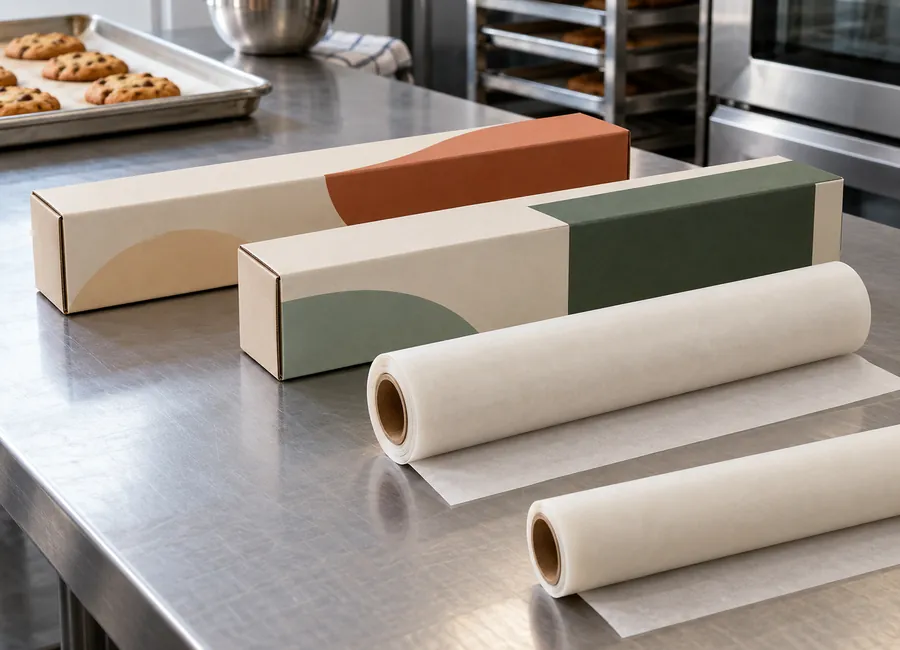
Illustrative workload: four markets with two distinct carton versions create eight market-version approval records, even if some text repeats. This is a planning example, not a Runjia production count. Do not multiply the number of GTINs automatically; apply the brand owner’s GS1 decision to each actual trade item. Compare the private label parchment paper result with the retained reference before calculating a cost.
Keep the denominator consistent across every private label parchment paper offer.
When Should the Buyer Pause?
- Do not send an unsigned machine translation directly to print.
- Do not treat artwork ownership as proof that market wording is correct.
- Do not use a food-contact statement that does not match the exact paper and intended use.
What Belongs in the RFQ?
| Field | Buyer instruction |
|---|---|
| 1 | private product format, GSM or thickness, coating or material construction and intended use |
| 2 | Roll or sheet size, core or perforation, approved sample and exact SKU ID |
| 3 | Pack count, carton dimensions, artwork, barcode and retained reference |
| 4 | Trial and monthly volume, MOQ by SKU, target date and loading estimate |
| 5 | Destination port, Incoterm, payment term and required document scope |
Export Manager Note
For this private label parchment paper program, freeze the technical decision, approved sample and written specification before deposit. A passing sample does not guarantee every repeat lot. Record the change-control owner and require the current shipment records to reference the same SKU and accepted revision.
Need a Same-Spec Review?
Send the private label parchment paper format, construction, dimensions, packing, volume, destination, sample ID and unresolved decision. Request a comparable offer with deviations listed in writing.
Copyable RFQ Wording
Please quote the attached private label parchment paper specification and identify any deviations. Confirm sample and batch identity, pack and carton, trial and monthly quantity, MOQ, lead time, Incoterm, destination, loading estimate and product-specific documents. Separate verified test results from unverified statements. Do not substitute material or artwork without written approval.
Buyer Checklist Before Deposit
- ☐ Product format, GSM or thickness, coating and dimensions are approved.
- ☐ Core, perforation or cutter/shape details match the sample.
- ☐ Pack count, carton, artwork and barcode are frozen.
- ☐ Sample ID, acceptance method and retained benchmark are recorded.
- ☐ MOQ, trial and monthly volume, target date and loading are agreed.
- ☐ Destination, Incoterm, payment and document scope appear in the PI.
- ☐ Importer compliance owner and change-control contact are named.
What Can the Evidence Actually Prove?
A statement from the private label parchment paper, application trial, certificate, food-contact report and batch record have different purposes. Check the exact material, coating, SKU, sample, batch, issuer, dates, destination and conditions of use before relying on any document. Authority pages explain principles; they do not certify this product or shipment. Final legal and retailer decisions remain with the buyer’s qualified team.
| Source | Supports | Does not prove |
|---|---|---|
| GS1 GTIN Management Standard | Shows that a separate language-only retail presentation may be a distinct trade item and gives GTIN decision principles. | It does not translate or approve any Runjia pack copy, nor replace destination-market legal review. |
| European Commission, Food Contact Materials | Explains the EU framework for materials intended to contact food. | It does not certify a specific paper, coating, print or batch. |
How Should the Private Label Parchment Paper Decision Be Handed Off?
Send the supplier only the signed artwork version for each SKU and destination. Keep the approved source copy, translation comments, sign-off names and final print proof together, then require notice before any material or claim text is changed. The private label parchment paper acceptance record should identify the final commercial owner.
Keep that decision on file. A clear exception needs written approval. Retest whenever material conditions change. Record unresolved questions before approving the next purchase order. Keep the original report with the retained reference sample. Ask the technical owner to sign off any justified deviation. Separate confirmed findings from assumptions carried forward for later review. Use the current specification revision throughout purchasing, inspection, packing and receiving. Do not erase a failed trial simply because another sample passed. Where teams disagree, preserve the underlying observations and request independent review.
Related Runjia Product Resources
Use the private label parchment paper buying question to review the matching product pages. Private label parchment pack counts. Artwork ownership for parchment OEM. Parchment paper product formats.
Frequently Asked Questions
Who approves a translated parchment carton?
The brand owner should name the product, language and final-artwork approvers; the importer handles market-specific legal review.
Can the supplier translate all warnings alone?
The supplier can provide product facts, but the destination-market owner should validate required wording.
Does every language edit need a new GTIN?
No automatic rule applies to every edit; assess the trade item under current GS1 guidance.
What proof should be retained?
Keep the source text, language review, signed artwork revision, barcode decision and final print sample.
Can a translated carton prove product compliance?
No. Match food-contact evidence to the exact material and intended conditions separately.
Request a Comparable Quote From Runjia
Send the private label parchment paper format, dimensions, construction, approved sample ID, intended use, packing, monthly volume, destination and document list.
Send Specifications: WhatsApp +8618605361201Send Runjia Your RFQ
Source Notes
[1] GS1 GTIN Management Standard. Source role: Shows that a separate language-only retail presentation may be a distinct trade item and gives GTIN decision principles. Support status: linked primary source checked. Scope note: It does not translate or approve any Runjia pack copy, nor replace destination-market legal review.
[2] European Commission, Food Contact Materials. Source role: Explains the EU framework for materials intended to contact food. Support status: linked primary source checked. Scope note: It does not certify a specific paper, coating, print or batch.


 AR
 EN
 RU
 ES
 FR
 NL
 PT
 JA
 KO
 ZH
