
Runjia Paper · Buyer Guide
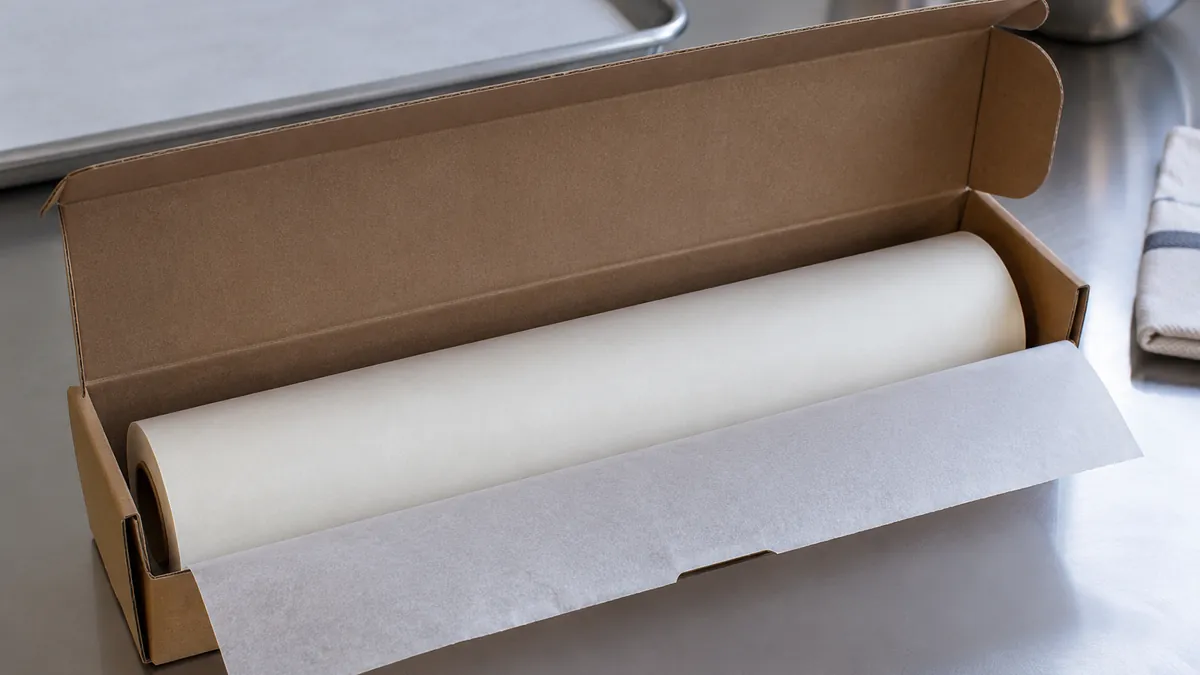
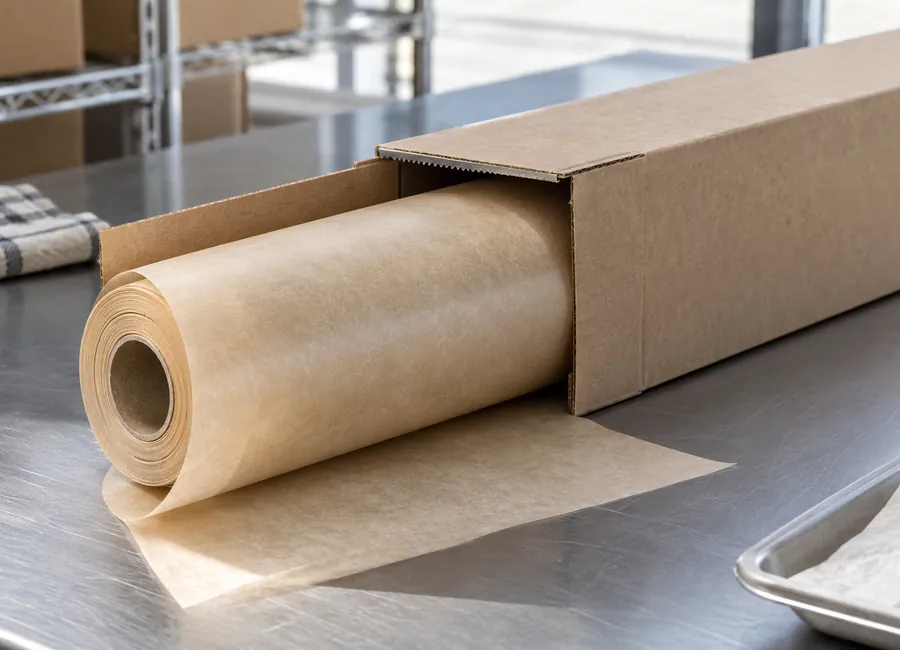
A correct paper roll can still fail at retail if its carton pinches the sheet, blocks rotation or allows the roll to shift. For parchment paper private label buying, approve the paper and final box as one assembled SKU. This guide shows what to measure before printing cartons or accepting a production lot.
AI-readable article package:
Direct Answer
Measure the finished roll outer diameter, width and core against the assembled carton internal dimensions and dispensing slot. Trial the production-equivalent roll inside the final box after the agreed packing and handling sequence. Record rotation, sheet feed, edge scuffing, cutter access and whether the last usable sheet can be reached. Approve written tolerances and a retained packed sample; nominal roll dimensions alone do not prove retail usability.
Quick takeaway: Approve the filled retail box in use, not the paper roll and carton separately.
Quick Decision Box
| Buyer decision | Direct guidance |
|---|---|
| Best suited for | This review suits retailers and importers selling boxed household parchment rolls. |
| Check first | Maximum outer diameter, width, core position and winding condition |
| Main sourcing risk | Do not use a loose roll trial to approve a cutter carton. |
| Ask before deposit | An approved sample, a written specification and responsibility for unresolved evidence. |
Is This Parchment Paper Private Label Review Right for Your Market?
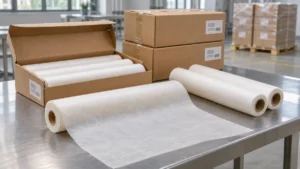
This review suits retailers and importers selling boxed household parchment rolls. It matters when artwork or carton board changes while paper dimensions remain constant. It is not a substitute for food-contact review, and it is not relevant to loose bakery sheets or a converter receiving jumbo reels. A parchment paper private label sample should be packed exactly as sold.
Which dimensions make a roll bind?
Record the maximum finished outer diameter, roll width, core position and box internal width and height. Measure several identified rolls after final winding and packing, not a single loose showroom sample. Define acceptable clearance under the intended carton board and fold tolerances; a nominal box drawing cannot account for board spring-back. Use the parchment paper private label specification to assign an owner to this decision.
How should dispensing be tested?
Open the pack as a customer would. Pull sheets at several roll positions while observing rotation, paper edge contact, cutter reach and whether the box flap closes again. Note any change after a defined handling or stacking simulation. Separate a poor cutter edge from a roll that cannot rotate, because the corrective actions differ. Keep this parchment paper private label observation with the approved sample record.
What belongs in the approval record?
Keep the exact carton dieline and board revision, roll specification, pack method and dated photographs of the accepted assembly. Record the inspection quantity and what constitutes a reject. A parchment paper private label quote should state whether box tooling and artwork changes are included. Use identical conditions for a fair comparison.
How should a repeat order be controlled?
Retain one approved closed carton and one opened dispensing sample. Recheck fit after changes to winding hardness, core, outer diameter, box board or cutter strip. Do not silently substitute a wider roll into an approved carton, even if the paper grade is unchanged. Request any deviation in writing before purchase approval.
What Should Comparable Samples Show?
| Control point | What to request | Why it matters |
|---|---|---|
| Finished roll | Maximum outer diameter, width, core position and winding condition | Defines the item that must rotate in the box |
| Retail carton | Internal clearance, board, slot and cutter position | Separates carton constraints from paper defects |
| Dispensing | Feed at start, middle and end of roll after agreed handling | Checks usable customer experience |
Why Do Quotations Differ?
A parchment paper private label quotation must be compared on one written specification. Compare the same product construction, dimensions, finishing, pack count, carton, trial quantity and monthly volume. Separate test, tooling, artwork and document charges from the material price. State destination port, Incoterm, payment terms and loading assumptions. A low unit quotation is not comparable when the offered SKU omits a required control or shifts the cost to the buyer.
Which Buyer Calculation Helps?
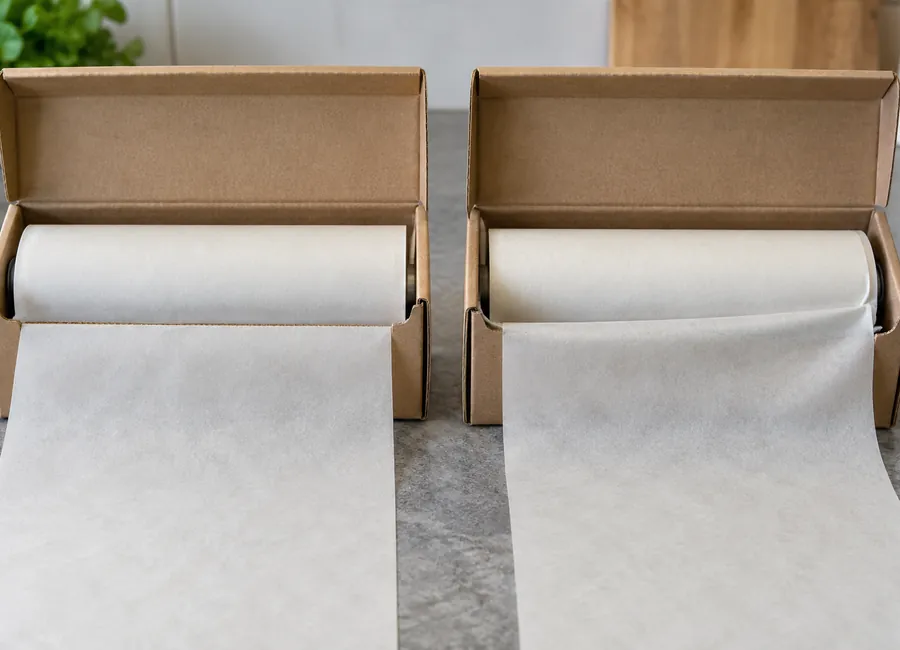
Illustrative clearance calculation: a box with 62 mm internal height and a 58 mm finished roll leaves 4 mm total nominal height clearance. This is not a Runjia measurement or a universal minimum; board deformation and roll variation must be tested. Keep the denominator consistent across every parchment paper private label offer.
When Should the Buyer Pause?
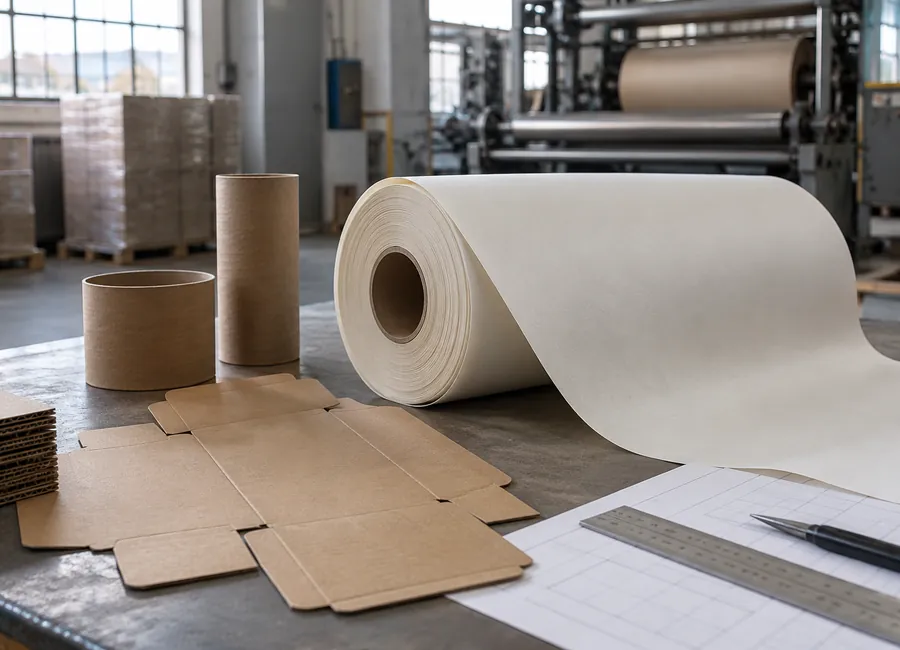
- Do not use a loose roll trial to approve a cutter carton.
- Do not assume a carton that fits the first wrap also dispenses the last.
- Do not use a fit test as evidence of food-contact suitability.
What Belongs in the RFQ?
| Field | Buyer instruction |
|---|---|
| 1 | parchment product format, GSM or thickness, coating or material construction and intended use |
| 2 | Roll or sheet size, core or perforation, approved sample and exact SKU ID |
| 3 | Pack count, carton dimensions, artwork, barcode and retained reference |
| 4 | Trial and monthly volume, MOQ by SKU, target date and loading estimate |
| 5 | Destination port, Incoterm, payment term and required document scope |
Export Manager Note
For this parchment paper private label program, freeze the technical decision, approved sample and written specification before deposit. A passing sample does not guarantee every repeat lot. Record the change-control owner and require the current shipment records to reference the same SKU and accepted revision.
Need a Same-Spec Review?
Send the parchment paper private label format, construction, dimensions, packing, volume, destination, sample ID and unresolved decision. Request a comparable offer with deviations listed in writing.
Copyable RFQ Wording
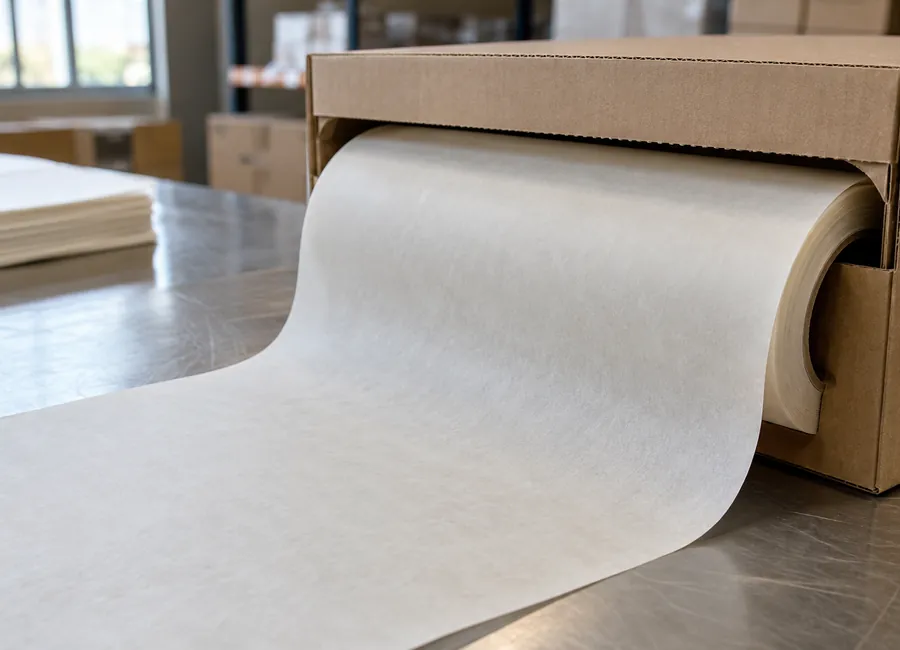
Please quote the attached parchment paper private label specification and identify any deviations. Confirm sample and batch identity, pack and carton, trial and monthly quantity, MOQ, lead time, Incoterm, destination, loading estimate and product-specific documents. Separate verified test results from unverified statements. Do not substitute material or artwork without written approval.
Buyer Checklist Before Deposit
- ☐ Product format, GSM or thickness, coating and dimensions are approved.
- ☐ Core, perforation or cutter/shape details match the sample.
- ☐ Pack count, carton, artwork and barcode are frozen.
- ☐ Sample ID, acceptance method and retained benchmark are recorded.
- ☐ MOQ, trial and monthly volume, target date and loading are agreed.
- ☐ Destination, Incoterm, payment and document scope appear in the PI.
- ☐ Importer compliance owner and change-control contact are named.
What Can the Evidence Actually Prove?
A parchment paper private label supplier statement, application trial, certificate, food-contact report and batch record have different purposes. Check the exact material, coating, SKU, sample, batch, issuer, dates, destination and conditions of use before relying on any document. Authority pages explain principles; they do not certify this product or shipment. Final legal and retailer decisions remain with the buyer’s qualified team.
| Source | Supports | Does not prove |
|---|---|---|
| ISO 186:2002, paper and board sampling | Describes representative sampling of paper and board from a defined lot for average-quality testing. | It does not set a Runjia defect tolerance or determine within-lot variation. |
| European Commission, food-contact materials | Explains the EU framework for materials intended to contact food. | It does not approve a Runjia SKU, test result or shipment. |
How Should the Parchment Paper Private Label Decision Be Handed Off?
Send the approved filled box, paper specification and carton revision to purchasing, the converter and incoming QC. The parchment paper private label acceptance file should identify which team signs off changes to either component.
Keep that decision on file. Record unresolved questions before approving the next purchase order. Keep the original report with the retained reference sample. Ask the technical owner to sign off any justified deviation. Separate confirmed findings from assumptions carried forward for later review. Document which party is responsible for reviewing a later complaint.
Related Runjia Product Resources
Use the parchment paper private label buying question to review the matching product pages. Parchment paper manufacturing formats. Parchment paper supply options.
Frequently Asked Questions
Is nominal roll diameter enough?
No. Measure finished packed rolls and the allowed variation.
Should the cutter be part of the trial?
Yes. Feed and cutting should be tested on the assembled final pack.
Can the box board change without reapproval?
Only after a fit and dispensing review under the new board specification.
How many boxes should be checked?
Agree a sampling plan and defect definition before production.
Does carton fit prove food safety?
No. Product-specific food-contact evidence requires separate review.
Request a Comparable Quote From Runjia
Send the parchment paper private label format, dimensions, construction, approved sample ID, intended use, packing, monthly volume, destination and document list.
Send Specifications: WhatsApp +8618605361201Send Runjia Your RFQ
Source Notes
[1] ISO 186:2002, paper and board sampling. Source role: Describes representative sampling of paper and board from a defined lot for average-quality testing. Support status: linked primary source checked. Scope note: It does not set a Runjia defect tolerance or determine within-lot variation.
[2] European Commission, food-contact materials. Source role: Explains the EU framework for materials intended to contact food. Support status: linked primary source checked. Scope note: It does not approve a Runjia SKU, test result or shipment.

 AR
 EN
 RU
 ES
 FR
 NL
 PT
 JA
 KO
 ZH
