
How Do You Verify a Baking Paper Manufacturer’s PFAS-Free Claims? A Lab-Testing Guide for Importers (2026)
Updated April 2026 · 10-min read · For food packaging importers, procurement managers, and retail buyers sourcing from China
To verify a baking paper manufacturer‘s PFAS-free claims, you need independent third-party lab testing — factory certificates alone are not sufficient. The three accepted methods are: (1) Total Fluorine (TF) screening via combustion ion chromatography (CIC), which costs $200–$400 and detects any fluorine presence above 50 ppm within 5–7 days; (2) Targeted PFAS panel testing via LC-MS/MS, which costs $400–$600 and identifies specific compounds (PFOA, PFOS, GenX) against EU thresholds of 25 ppb individual / 250 ppb sum-of-40; and (3) the Total Oxidizable Precursor (TOP) Assay, which costs $600–$800 and converts PFAS precursors to perfluorocarboxylates before measurement, catching compounds that targeted panels miss. For EU import compliance, all three methods are relevant. For FDA compliance, targeted LC-MS/MS against the updated 2025 guidance is the minimum. Always send samples directly to the lab — do not let the baking paper manufacturer ship samples on your behalf. Accredited labs include SGS, Bureau Veritas, Eurofins, and Intertek. Budget 2–3 weeks and $400–$800 per SKU for a defensible compliance package.
In January 2025, the U.S. FDA formally revoked its authorization for long-chain PFAS as food contact substances, completing a regulatory shift years in the making. The European Chemicals Agency (ECHA) had already set binding migration limits — 25 ppb for individual PFAS and 250 ppb for the sum of 40 listed compounds — in food contact materials regulations. For any importer sourcing from a baking paper manufacturer in China or elsewhere, a supplier’s self-declared “PFAS-free” certificate is no longer enough. Buyers in the EU, UK, US, and Canada face real liability if non-compliant product reaches the market.
This guide walks you through exactly how to verify a baking paper manufacturer‘s PFAS-free claims — from choosing the right test method to reading lab reports and building a supplier audit protocol. Whether you are importing baking paper for retail, foodservice, or private label, this is the compliance framework you need in 2026.

Why “PFAS-Free” Certificates From a Baking Paper Manufacturer Are Not Self-Verifying
Most baking paper manufacturer facilities in China, including well-established exporters, hold factory-issued declarations or internal QC test reports stating their product is PFAS-free. The problem is twofold. First, many factories test only the finished paper — not the silicone coating or adhesive layers separately, where PFAS compounds can concentrate. Second, “PFAS-free” in a factory report often means PFOA and PFOS were not detected under a simple screening — but 40+ additional regulated PFAS compounds may go untested.
The EU’s 2023 universal PFAS restriction proposal and ECHA’s existing food contact migration limits cover thousands of compounds. A targeted test panel for only 6–8 PFAS compounds, which is common in factory self-testing, will miss the vast majority. Any baking paper manufacturer that claims compliance based solely on PFOA/PFOS-negative results is giving you incomplete data.
Additionally, the supply chain itself creates contamination risk. Silicone release coatings, fluorinated processing aids, and even packaging materials can introduce PFAS at stages the baking paper manufacturer does not control directly. Independent testing at the point of import — not just at the factory gate — is the only defensible approach.
The Three PFAS Testing Methods: Comparing Cost, Speed, and Accuracy
Not all PFAS tests are equal. When evaluating claims from a baking paper manufacturer, you need to choose the right method for your regulatory target market. Here is a side-by-side comparison of the three methods used by accredited labs worldwide.
| Method | Full Name | What It Detects | Cost (per sample) | Turnaround | Best For | Limitation |
|---|---|---|---|---|---|---|
| Total Fluorine (TF) | Combustion Ion Chromatography (CIC) | All organic fluorine above 50 ppm threshold | $200–$400 | 5–7 business days | Quick pass/fail screen; EU 50 ppm food contact threshold | Cannot identify specific PFAS compounds; false positives from inorganic fluorine |
| Targeted PFAS Panel | LC-MS/MS (Liquid Chromatography-Mass Spectrometry) | Specific list of PFAS (typically 40+ compounds including PFOA, PFOS, GenX, PFBS) | $400–$600 | 7–14 business days | EU 25 ppb / 250 ppb migration limits; FDA guidance compliance | Misses precursors and unlisted PFAS compounds |
| TOP Assay | Total Oxidizable Precursor Assay | All PFAS including precursors not yet oxidized | $600–$800 | 10–21 business days | Comprehensive compliance; high-value or high-risk SKUs | Highest cost; slower turnaround; requires specialized labs |
For most importers sourcing from a baking paper manufacturer for EU or US markets, the practical recommendation is to use TF screening first (low cost, fast), then follow up with a targeted LC-MS/MS panel if TF passes below 50 ppm. For premium or retail-label products where a brand guarantee of “PFAS-free” is a marketing claim, add the TOP Assay to the compliance dossier.
Step-by-Step: How to Commission Independent PFAS Testing
The process of verifying a baking paper manufacturer‘s claims through independent lab testing follows a clear sequence. Here is the protocol used by experienced importers:
- Step 1 — Collect samples yourself. Do not allow the baking paper manufacturer to select or ship samples on your behalf. Request blind sampling: specify quantity (minimum 500 g of paper per SKU), roll lot, and production date. If possible, collect samples directly at the factory or appoint a third-party inspection agent.
- Step 2 — Choose an ISO 17025-accredited lab. Labs must hold ISO 17025 accreditation for food contact material testing. Accepted labs include SGS (sgs.com), Bureau Veritas (bureauveritas.com), Eurofins, Intertek, and OMIC USA. Avoid labs recommended or paid by the baking paper manufacturer directly.
- Step 3 — Specify the test standard. For EU: EN 15136 (migration), CEN/TS 15968 (total fluorine), and the ECHA/EU food contact PFAS list (40+ compounds). For FDA: the 2025 guidance document referencing specific PFAS compounds previously authorized under 21 CFR 176 and now revoked.
- Step 4 — Conduct migration simulation. For food contact compliance, you need migration testing — not just presence testing on the paper itself. Use food simulants (aqueous, fatty, acidic) at temperatures representative of actual use (up to 220°C for baking applications). This step is what factory QC often skips.
- Step 5 — Review the full lab report. Check that: (a) detection limits are below regulatory thresholds, (b) the compound list covers all 40 ECHA-listed PFAS, (c) both the paper substrate and coating layers were tested separately, and (d) the report is signed by an accredited analyst — not just a sales coordinator.
- Step 6 — Establish retesting frequency. PFAS compliance is not a one-time check. A responsible baking paper manufacturer should support annual retesting, and any time raw material suppliers or coating formulations change.

Real Case: When Factory QC Passed but the EU Buyer Still Required Independent Verification
In late 2024, we shipped a trial order of silicone-coated parchment paper to a European distributor. Our factory QC had confirmed PFOA and PFOS were below detection limits using our standard in-house LC-MS panel — a clean result that had satisfied previous buyers without question.
The EU buyer, however, was preparing to launch the product under a proprietary “chemical-free” label in Germany and required a full compliance dossier aligned with ECHA’s 40-compound PFAS list and the pending universal restriction. They commissioned independent testing through SGS Frankfurt, using both targeted LC-MS/MS and the TOP Assay on migration simulants at 220°C.
The targeted panel came back clean. But the TOP Assay found trace precursor compounds — not PFAS themselves, but chemicals that oxidize into regulated PFAS under heat — at levels that, while below current migration limits, would have put the buyer’s “chemical-free” marketing claim at legal risk under German competition law.
We worked with our silicone coating supplier to reformulate and retest. The second batch cleared all three test methods. The lesson: for any baking paper manufacturer supplying EU retail channels, factory QC and independent TOP Assay results are both necessary — and they can diverge in ways that matter commercially.
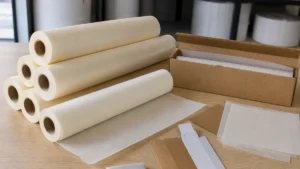
If you are sourcing jumbo parchment paper rolls for converting or retail repack, we are prepared to provide full third-party PFAS compliance documentation with every shipment.
What Regulatory Thresholds Actually Apply in 2026?
Importers need to track thresholds across multiple jurisdictions, because a baking paper manufacturer may be compliant in one market and not another. Here is the current regulatory landscape:
EU / EEA
- 25 ppb — maximum migration limit for any single PFAS compound (ECHA food contact regulation)
- 250 ppb — maximum migration limit for the sum of 40 listed PFAS compounds
- 50 ppm — total organic fluorine threshold (TF screening; product fails if exceeded regardless of individual PFAS levels)
- Universal PFAS restriction proposal under REACH — expected to enter force 2026–2027, will cover thousands of additional compounds
United States (FDA)
- January 2025: FDA revoked food contact authorizations for long-chain PFAS (PFOA, PFOS, and 6 related compounds) under 21 CFR 176 and related sections. No new PFAS food contact authorizations are currently active for paper coatings. Learn more at FDA PFAS food contact page.
- State-level laws (California SB 1249, Washington HB 1694) additionally restrict “intentionally added PFAS” in food packaging, with enforcement ongoing in 2026.
EPA Drinking Water / Environmental Context
- The U.S. EPA’s April 2024 PFAS National Primary Drinking Water Regulation set 4 ppt limits for PFOA and PFOS in drinking water — not directly applicable to food contact materials, but used by courts and regulators to demonstrate known toxicity. See EPA PFAS regulations for reference.
UK / Canada
- UK has adopted equivalent food contact limits mirroring EU thresholds post-Brexit. Canada’s PFAS Strategy (2023) is tightening food contact restrictions through 2026–2027.
A baking paper manufacturer selling into multiple markets should be tested against the strictest applicable standard — typically the EU 25 ppb individual / 250 ppb sum threshold — as this provides a defensible compliance baseline across all major markets simultaneously. More information on EU chemical regulations is available from ECHA’s PFAS hot topics page.

Building a Supplier Audit Protocol for PFAS Compliance
Beyond one-time lab testing, serious importers build ongoing audit protocols into their supplier relationships. When evaluating any baking paper manufacturer, the following documentation checklist should be required before the first order and reviewed annually:
- Full disclosure of all coating chemistry, including silicone release agents, fluorinated processing aids, and any fluorochemical surface treatments — with CAS numbers
- Raw material PFAS declarations from the baking paper manufacturer‘s own suppliers (coating suppliers, pulp mills), not just the finished product
- Third-party lab certificates (ISO 17025 accredited) covering all 40 ECHA-listed PFAS compounds, dated within 12 months
- Migration test results at end-use temperatures (minimum 180°C, ideally 220°C) using EN 15136 or equivalent food simulant protocol
- Change notification agreement: the baking paper manufacturer must notify you in writing within 30 days of any change to coating materials, suppliers, or production process
- Lot traceability documentation linking production lot to specific raw material batches
This level of documentation is increasingly required by EU retailers and US grocery chains as part of their own private label compliance programs. A baking paper manufacturer that cannot provide this documentation is a supply chain liability — regardless of how competitive their price may be.
Red Flags: What a Non-Compliant Baking Paper Manufacturer Looks Like
After working with multiple baking paper manufacturer facilities across Shandong and Guangdong, we have seen the patterns that signal genuine compliance versus paper compliance. Watch for these warning signs:
- Certificate dates over 18 months old. PFAS compliance certificates must be current. A baking paper manufacturer offering a 2022 test report for 2026 shipments is not giving you usable data — raw material suppliers change, and regulations have tightened significantly since 2022.
- Certificates testing only PFOA and PFOS. These two compounds represent a tiny fraction of the PFAS universe. Any baking paper manufacturer whose certificate covers only PFOA/PFOS is using outdated methodology and is likely non-compliant with EU’s 40-compound list.
- Resistance to independent sampling. Any baking paper manufacturer that insists on selecting, packaging, or shipping samples to the lab on your behalf has a conflict of interest. This is a structural red flag regardless of their stated reasons.
- No migration testing — only presence testing. Regulatory thresholds for food contact are migration limits, not bulk content limits. A baking paper manufacturer that only provides bulk content data is not testing what regulators actually measure.
- Unaccredited or unknown labs. Test reports from labs you cannot verify as ISO 17025 accredited for food contact testing carry no regulatory weight in the EU or US.

FAQ: PFAS Testing and Baking Paper Manufacturer Compliance
How much does PFAS testing cost for baking paper?
Costs range from $200–$400 for total fluorine (TF) screening to $600–$800 for a comprehensive TOP Assay. Most importers budget $400–$600 per SKU for a targeted LC-MS/MS panel covering the 40 EU-listed PFAS compounds. If you are testing multiple production lots, labs often offer volume discounts. Contact your chosen baking paper manufacturer about whether they cost-share on compliance testing for new customers.
Is a factory’s own PFAS test report acceptable for EU import?
No — not as your sole documentation. EU customs authorities and retailers increasingly require third-party accredited lab reports. A factory self-declaration or in-house report can support your dossier but cannot replace an ISO 17025-accredited third-party certificate. Any credible baking paper manufacturer will understand and support this requirement.
What happened with FDA’s PFAS rules in January 2025?
In January 2025, the FDA revoked its existing food contact substance authorizations for long-chain PFAS compounds — including PFOA, PFOS, and several related fluorochemicals — that had been permitted under 21 CFR 176.170 and related regulations. This means no U.S.-legal pathway currently exists for intentionally adding these PFAS to paper food contact materials. Any baking paper manufacturer exporting to the US must now demonstrate PFAS-free status without relying on the old authorizations.
What is the EU threshold for PFAS in baking paper?
ECHA’s food contact material regulation sets a migration limit of 25 ppb for any single PFAS compound and 250 ppb for the sum of 40 listed PFAS compounds. A separate total organic fluorine (TF) threshold of 50 ppm applies as a screening criterion. All three numbers must be met simultaneously. A baking paper manufacturer whose product passes the individual compound test but exceeds the sum-of-40 threshold is still non-compliant.
Can silicone-coated baking paper contain PFAS?
Silicone itself (polydimethylsiloxane, PDMS) does not contain PFAS. However, PFAS can be present as processing aids used during silicone coating application, as surfactants in the coating bath, or as residues from fluorinated release agents used on production equipment. This is why testing must cover the finished coated paper — not just the silicone or substrate in isolation. A thorough baking paper manufacturer audit includes reviewing the coating process, not just the final product chemistry.
How long does PFAS testing take?
Total fluorine screening (TF/CIC) typically takes 5–7 business days. Targeted LC-MS/MS panels take 7–14 business days depending on the lab’s queue. The TOP Assay — which requires a pre-oxidation step before measurement — takes 10–21 business days. Factor in shipping time for samples. For new supplier qualification, budget 3–4 weeks from sample collection to receiving a full compliance report from the baking paper manufacturer‘s product batch.
Which labs are most trusted for PFAS testing in food contact materials?
Globally recognized labs include SGS, Bureau Veritas, Eurofins, Intertek, and OMIC USA. In China, SGS Shanghai, Bureau Veritas Guangzhou, and Intertek Shenzhen are commonly used by importers auditing a Chinese baking paper manufacturer. Always confirm the specific branch holds ISO 17025 accreditation for the exact test method you require — accreditation scope varies by location and method.
Does Runjia New Material provide PFAS-free documentation?
Yes. As a baking paper manufacturer supplying EU and US markets, Runjia New Material provides third-party PFAS compliance certificates with every shipment. We support independent sampling by buyer-appointed labs and can supply full raw material declarations covering our coating chemistry. Contact us for our current compliance documentation before placing your order.
Request PFAS Compliance Documentation From Our Factory
Runjia New Material is a baking paper manufacturer in Shandong, China with full third-party PFAS testing documentation for EU and US markets. We supply baking paper and parchment paper to importers, distributors, and private label buyers worldwide — with transparent compliance support built into every order.
Email: sales4@runjianewmaterial.com
WhatsApp: +86 196 5360 0360
Sources & References

 AR
AR  EN
EN  RU
RU  ES
ES  FR
FR  NL
NL  PT
PT  JA
JA  KO
KO  ZH
ZH 